The Environmental Impact of Smart Climate Control
Transforming your house into an eco-friendly smart home starts with addressing your largest energy consumer: your HVAC system. According to the U.S. Department of Energy, heating and cooling account for nearly half of the average home's total energy consumption. Traditional thermostats rely on manual adjustments, which often leads to wasted energy heating or cooling empty homes. Smart thermostats eliminate this waste through automation, geofencing, and advanced learning algorithms.
But the benefits extend far beyond your personal utility bill. Upgrading to an Energy Star-certified device is a direct investment in a greener power grid. The EPA's Energy Star program notes that certified smart thermostats save users an average of 8% on heating and cooling bills annually. When scaled across millions of homes, this drastically reduces the need for fossil-fuel-powered 'peaker plants' that fire up during times of high grid demand. By choosing the right eco-friendly smart thermostat, you are optimizing your home's carbon footprint while maintaining perfect indoor comfort.
Top Eco-Friendly Smart Thermostats Reviewed
We have evaluated the market's leading smart thermostats based on energy-saving features, grid-interactivity, smart home ecosystem compatibility, and overall return on investment. Here are the best picks for eco-conscious homeowners.
1. ecobee Smart Thermostat Premium (Best Overall for Eco-Homes)
The ecobee Smart Thermostat Premium is arguably the most powerful tool for eco-conscious homeowners, largely due to its proprietary eco+ software. This feature doesn't just look at the temperature inside your home; it analyzes local weather forecasts, your home's thermal dynamics, and time-of-use electricity rates. During peak hours when the local power grid is strained and relying on dirtier energy sources, eco+ can subtly adjust your HVAC system to reduce load, shifting your energy consumption to off-peak hours when renewable energy (like solar and wind) is more abundant.
Additionally, the Premium model includes a SmartSensor that detects occupancy and temperature in specific rooms. This prevents your HVAC system from overworking to cool an empty guest room, ensuring energy is only spent where it is needed. The built-in air quality monitor also alerts you to high VOCs or humidity, allowing you to run your ventilation system efficiently rather than blindly.
- Cost Range: $240 - $260
- Ecosystem Compatibility: Apple HomeKit, Amazon Alexa, Google Home, Samsung SmartThings, IFTTT
- Key Eco-Feature: eco+ time-of-use shifting and SmartSensor occupancy detection.
2. Google Nest Learning Thermostat (Best for Automated Efficiency)
The Google Nest Learning Thermostat pioneered the smart climate category and remains a top-tier choice for hands-off energy savings. Its core philosophy is simple: it learns your schedule and programs itself. Within a week of installation, the Nest builds an Auto-Schedule based on your manual adjustments, ensuring the HVAC system powers down when you leave for work and ramps up right before you return.
For the eco-friendly user, Nest's Home/Away Assist uses built-in motion sensors and the GPS from your smartphone to trigger 'Eco Temperatures' the moment the house is empty. Furthermore, the Nest Renew feature (available in supported regions) automatically shifts your heating or cooling to times when the local grid is powered by cleaner, renewable energy sources. The iconic 'Nest Leaf' icon provides real-time positive reinforcement, appearing on the display when you select a temperature that saves energy.
- Cost Range: $220 - $250
- Ecosystem Compatibility: Google Home, Amazon Alexa (No native Apple HomeKit support)
- Key Eco-Feature: Auto-Schedule, Home/Away Assist, and Nest Renew grid-shifting.
3. Honeywell Home T9 (Best for Zoned Energy Savings)
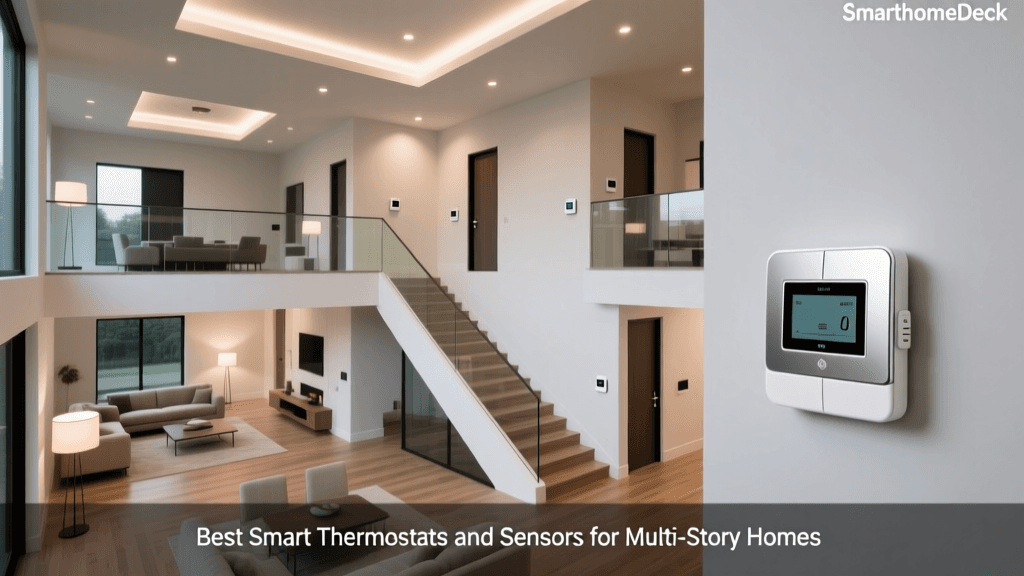
Multi-story homes or houses with large sun-facing windows often suffer from severe temperature imbalances. This forces the HVAC system to run longer than necessary just to make one specific room comfortable, wasting massive amounts of energy. The Honeywell Home T9 solves this with its dual-band Wi-Fi smart room sensors.
Unlike basic sensors that only read temperature, the T9 sensors detect humidity and occupancy. You can set the thermostat to prioritize the living room during the day and the bedrooms at night. By targeting your heating and cooling exactly where people are, the T9 prevents the 'over-conditioning' of the entire house. Its adaptive recovery learning algorithm also calculates exactly how long it takes your specific HVAC system to achieve the right temperature, eliminating the energy waste of premature heating or cooling.
- Cost Range: $180 - $210
- Ecosystem Compatibility: Amazon Alexa, Google Home, Samsung SmartThings, IFTTT
- Key Eco-Feature: Multi-room prioritization via smart sensors and adaptive recovery.
4. Amazon Smart Thermostat (Best Budget Energy-Saver)
You do not need to spend over $200 to make a meaningful environmental impact. The Amazon Smart Thermostat, built in partnership with Honeywell, is an Energy Star-certified workhorse that brings essential eco-friendly features to a budget-friendly price point. While it lacks a built-in display screen and advanced learning AI, it makes up for it with robust Alexa integration.
Using the Alexa app, you can create highly specific eco-routines. For example, you can program your thermostat to automatically raise the temperature by 4 degrees when your smart lock detects you have left for work, and lower it when your phone enters a 5-mile geofence around your home. The app also provides monthly energy usage reports, helping you track your carbon footprint reduction over time.
- Cost Range: $70 - $90
- Ecosystem Compatibility: Amazon Alexa (Ring ecosystem integration)
- Key Eco-Feature: Energy Star certification on a budget, Alexa geofencing routines.
Feature Comparison Table
| Product | Best For | Primary Eco-Feature | Sensor Included? | Est. Price |
|---|---|---|---|---|
| ecobee Premium | Overall Eco-Homes | eco+ Grid Shifting | Yes (1) | $249 |
| Nest Learning | Automated Savings | Auto-Schedule & Renew | No | $229 |
| Honeywell T9 | Zoned Efficiency | Multi-Room Prioritization | Yes (1) | $199 |
| Amazon Smart | Budget Upgrades | Alexa Geofencing | No | $79 |
Upfront Cost vs. Estimated Annual Savings
Investing in a smart thermostat pays for itself through energy savings. The chart below illustrates the relationship between the initial hardware investment and the estimated first-year energy savings based on average household HVAC usage.
Crucial Installation and Compatibility Checks
Before purchasing any eco-friendly smart thermostat, you must verify your HVAC system's compatibility. An improperly installed thermostat can actually decrease your system's efficiency and shorten its lifespan.
The C-Wire Requirement
Most advanced smart thermostats require a Common Wire (C-Wire) to provide continuous 24V power. This constant power is necessary to keep the Wi-Fi radio active, run the display, and continuously monitor your home's thermal envelope. If your current thermostat lacks a C-Wire, you have two options: use a C-Wire adapter (often included with ecobee and Honeywell models) or hire an electrician to run a new wire from your furnace control board. The Amazon Smart Thermostat strictly requires a C-Wire and will not function with an adapter.
Heat Pump and Auxiliary Heat Staging
If your eco-friendly home utilizes an electric heat pump, your thermostat must support auxiliary (AUX) or emergency heat staging. Heat pumps are incredibly efficient but struggle in freezing temperatures. A smart thermostat with intelligent AUX heat control (like the ecobee or Nest) will calculate whether it is more energy-efficient to run the heat pump longer or to engage the energy-hungry electric resistance backup strips. Poorly configured thermostats will trigger the backup strips unnecessarily, spiking your energy bill and carbon footprint.
Matter Support and Future-Proofing
For the ultimate eco-friendly smart home, look for devices that support the Matter protocol. Matter ensures that your thermostat can communicate locally and securely with other smart devices (like smart blinds or leak detectors) without relying on cloud servers, reducing latency and server-side energy usage. ecobee and newer iterations of smart home hubs are rapidly adopting Matter, ensuring your investment remains viable for the next decade.
How to Maximize Your Thermostat's Eco-Friendly Potential
Buying the hardware is only the first step. To truly minimize your environmental impact, pair your smart thermostat with these actionable eco-hacks:
- The Ceiling Fan Synergy: The Department of Energy notes that using a ceiling fan allows you to raise your thermostat setting by about 4°F with no reduction in comfort due to the wind-chill effect. Use smart plugs to sync your ceiling fans with your thermostat's 'Home' and 'Away' modes.
- Smart Blinds Integration: Solar heat gain is a major factor in summer cooling costs. Integrate your thermostat with smart blinds (like SwitchBot or Lutron Serena). Program the blinds to automatically close during the hottest, sunniest parts of the afternoon, drastically reducing the workload on your air conditioner.
- Filter Reminders: A clogged HVAC air filter restricts airflow, forcing the blower motor to work harder and consume more electricity. Use the thermostat's built-in filter replacement reminders (which calculate usage based on actual HVAC run-time, not just calendar days) to maintain peak system efficiency.
- Optimize Geofencing Boundaries: Adjust your smartphone's geofencing radius. A 5-mile radius is usually the sweet spot; it triggers the 'Eco' mode when you leave the neighborhood but ensures the house is perfectly conditioned by the time you pull into the driveway, avoiding the need for extreme, energy-wasting temperature overrides.
Frequently Asked Questions
Do smart thermostats work with older HVAC systems?
Most smart thermostats work with standard 24V forced-air systems, including older models. However, they are generally incompatible with high-voltage systems (like electric baseboard heaters) or millivolt systems (like some older wall heaters) unless you purchase a specific high-voltage adapter or a specialized thermostat like the Mysa.
Will my utility company pay me to install one?
Yes! Because smart thermostats reduce strain on the local power grid, many municipal and private utility companies offer instant rebates ranging from $50 to $150. Both ecobee and Nest have portals on their websites where you can enter your zip code to check for local utility incentives, effectively cutting the upfront cost of your eco-upgrade in half.
What happens to the thermostat if the Wi-Fi goes down?
Smart thermostats are designed to function as standard programmable thermostats if the internet connection drops. Your set schedules, eco-temperatures, and sensor data are stored locally on the device's internal memory, ensuring your home remains comfortable and your HVAC system continues to operate efficiently even during an outage.