Building the Ultimate Google Home Ecosystem
Building a smart home around Google's ecosystem requires more than just shouting 'Hey Google' to turn off the lights. With the complete overhaul of the Google Home app and the industry-wide adoption of the Matter protocol, Google has transformed its platform into a robust, locally processed, and highly automated ecosystem. Whether you are upgrading a single room or wiring an entire house, choosing devices that offer native Google Home integration ensures faster response times, deeper routine customization, and a much more reliable experience.
In this comprehensive buyer's guide, we break down the best smart home devices specifically optimized for the Google Home ecosystem. We evaluate products based on their native app integration, support for Google Assistant routines, local processing capabilities, and overall value. From intelligent climate control to responsive lighting and security, here are the top picks for Google-centric smart homes.
The Core: Best Hubs and Smart Displays
Every great Google Home ecosystem needs a central command post. While your smartphone is the primary controller, a dedicated smart display or speaker acts as the physical anchor for your home's automations, providing ambient information and hands-free control.
1. Google Nest Hub Max (Best Overall Visual Hub)
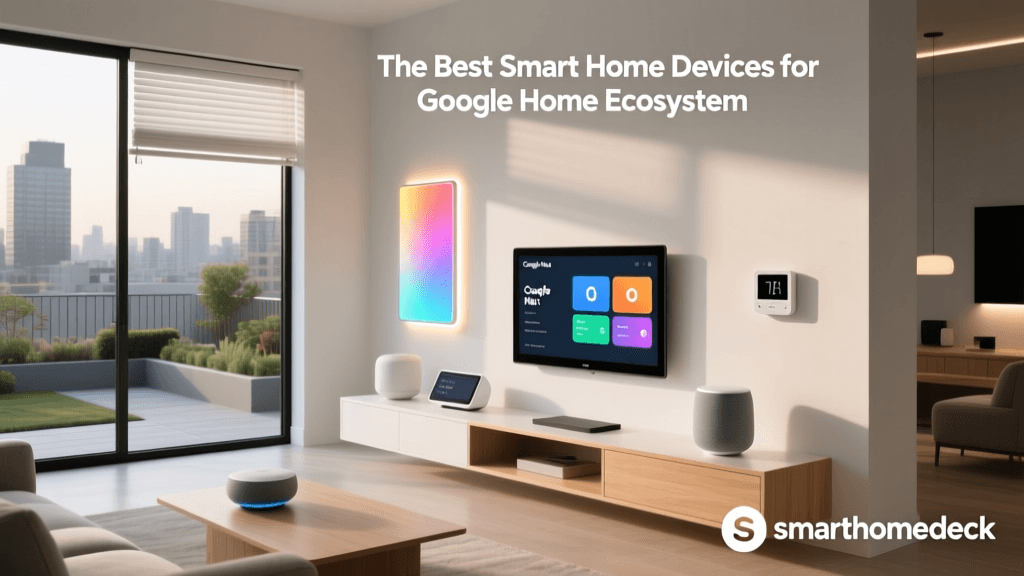
The Google Nest Hub Max remains the undisputed king of Google smart displays. Featuring a vibrant 10-inch HD touchscreen, it serves as a digital photo frame, a recipe viewer for the kitchen, and a powerful smart home controller. More importantly for ecosystem builders, the Nest Hub Max acts as a built-in camera for video calls and home monitoring, and it functions as a Thread border router, which is essential for connecting next-generation low-power smart home devices locally.
- Key Google Feature: 'Quick Gestures' allow you to snooze alarms or pause media with a simple hand wave, without saying a wake word.
- Protocol Support: Wi-Fi, Bluetooth, Thread.
- Approximate Price: $229
2. Google Nest Audio (Best Budget Audio Hub)
If you don't need a screen and prioritize audio quality and budget, the Google Nest Audio is the perfect satellite controller. It delivers room-filling sound and houses far-field microphones that can hear your Google Assistant commands over loud music. It seamlessly integrates into multi-room audio setups via Chromecast and acts as a reliable voice relay for triggering automations across your home.
- Key Google Feature: Media EQ and Ambient IQ automatically adjust audio profiles based on what you are listening to and the ambient noise in the room.
- Protocol Support: Wi-Fi, Bluetooth, Chromecast built-in.
- Approximate Price: $99
Illumination: Best Smart Lights for Google Home
Lighting is often the gateway to smart home technology. For Google Home users, the goal is instant responsiveness and deep integration with Google's 'Adaptive Lighting' and circadian rhythm routines.
3. Philips Hue White and Color Ambiance (Best Premium Lighting)
Philips Hue is the gold standard for smart lighting. While it relies on its own Zigbee bridge, Philips has aggressively updated its ecosystem to support Matter, meaning your Hue lights can now be controlled locally by the Google Home app without relying on cloud servers. The color accuracy is unmatched, and the Hue Sync feature allows lights to react to your TV or music, all controllable via Google Assistant voice commands.
- Key Google Feature: Native support for Google Home 'Gentle Wake Up' and 'Sleep' routines, gradually shifting color temperatures to match your biological clock.
- Protocol Support: Zigbee (via Hue Bridge), Matter.
- Approximate Price: $199 (Starter Kit)
4. Nanoleaf Shapes (Best Decorative & Thread Lighting)
For ambient and decorative lighting, Nanoleaf Shapes offer modular, touch-responsive light panels. Nanoleaf was one of the first major brands to adopt Thread networking, meaning these panels connect directly to your Nest Hub Max or Nest Wifi routers without needing a proprietary bridge. This results in lightning-fast response times when triggering Google Home scenes.
- Key Google Feature: Touch Actions allow you to tap a physical Nanoleaf panel to trigger a Google Home routine, like turning on the coffee maker or locking the front door.
- Protocol Support: Thread, Matter, Wi-Fi.
- Approximate Price: $149 (Starter Pack)
Climate Control: Best Smart Thermostats
Google's machine learning algorithms shine brightest when managing your home's climate. A native Nest thermostat doesn't just respond to commands; it learns your habits and works in tandem with your Google Pixel or Android phone's location services to save energy.
5. Google Nest Learning Thermostat (4th Gen)
The latest Google Nest Learning Thermostat features a stunning, high-resolution circular display and a built-in Soli radar sensor that detects your presence in the room to adjust the temperature dynamically. It automatically programs itself based on your manual adjustments over the first week. Furthermore, smart thermostats that meet strict efficiency criteria are Energy Star certified, ensuring that your smart home upgrade actively reduces your carbon footprint and utility bills.
- Key Google Feature: Home/Away Assist uses the GPS on any logged-in Android/iOS device to drop the temperature the moment the last person leaves the geofence.
- Protocol Support: Wi-Fi, Thread, 802.15.4.
- Approximate Price: $279
Security: Best Cameras and Doorbells
Security devices require high bandwidth and deep app integration to be truly useful. Google's proprietary cameras offer the tightest integration with the Google Home app's new 'Favorites' and 'Spaces' architecture.
6. Google Nest Cam (Wired)
The Google Nest Cam (Wired) utilizes Google's custom Tensor chip to process video feeds locally on the device. This means it can distinguish between people, animals, and vehicles without requiring a cloud subscription. If you have a Nest Hub Max, the camera feed will automatically pop up in picture-in-picture mode when someone rings your Nest Doorbell or walks into the driveway.
- Key Google Feature: Familiar Face Alerts. The camera learns the faces of your family members and sends specific Google Home notifications like 'Mom is at the front door' rather than a generic person alert.
- Protocol Support: Wi-Fi (5GHz/2.4GHz), Bluetooth.
- Approximate Price: $179
The Foundation: Best Smart Plugs
Smart plugs are the unsung heroes of the smart home, turning 'dumb' appliances into automated assets. They are perfect for controlling lamps, fans, and coffee makers.
7. TP-Link Kasa Smart Plug Mini (Matter-Enabled)
The TP-Link Kasa EP25 is a compact, Matter-enabled smart plug that includes energy monitoring. Because it supports Matter, it pairs directly to the Google Home app in seconds via a QR code scan, bypassing the need for third-party app linking and cloud delays. You can monitor the exact wattage of your connected space heater or window AC unit directly within the Google Home app's device dashboard.
- Key Google Feature: Energy dashboards and automated shut-offs based on Google Home 'Goodnight' routines to prevent vampire power drain.
- Protocol Support: Wi-Fi, Matter.
- Approximate Price: $15 (Single) / $35 (4-Pack)
Ecosystem Comparison Table
Use the table below to compare our top picks based on their primary category, networking protocol, and native support level within the Google Home app.
| Device Category | Top Pick | Primary Protocol | Google Native App Support | Approx. Price |
|---|---|---|---|---|
| Smart Display | Nest Hub Max | Wi-Fi / Thread | Full (Local & Cloud) | $229 |
| Smart Lighting | Philips Hue Starter | Zigbee / Matter | Full (via Bridge) | $199 |
| Thermostat | Nest Learning (4th Gen) | Wi-Fi / 802.15.4 | Full (Native) | $279 |
| Security Camera | Nest Cam (Wired) | Wi-Fi | Full (Native) | $179 |
| Smart Plug | TP-Link Kasa EP25 | Wi-Fi / Matter | Full (Matter) | $15 |
Data Visualization: Price vs. Integration Score
The following chart illustrates the relationship between the retail price of these top-tier devices and their overall Google Home integration score. The score (out of 10) factors in local processing speed, depth of Google Assistant commands, and native app dashboard features.
Understanding Matter and the Future of Google Home
To truly future-proof your Google Home ecosystem, you must understand the Matter protocol. Developed by the Connectivity Standards Alliance (CSA), Matter is an open-source, royalty-free standard that allows smart home devices from different brands to communicate locally and securely.
For Google Home users, Matter is a game-changer. Historically, adding a third-party device required linking a cloud account (e.g., logging into your TP-Link or Wyze account inside the Google Home app). This created cloud dependency; if the internet went down, or the manufacturer's server lagged, your voice commands would fail. With Matter, devices connect directly to your Google Nest Hub or Nest Wifi Pro router over Thread or Wi-Fi. The Google Home app acts as the local controller, meaning your 'Good Morning' routines will execute instantly, even if your broadband connection is temporarily offline.
Buying Guide: How to Choose for Google Home
When shopping for Google Home-compatible devices, keep these three critical factors in mind:
1. Network Topology: Wi-Fi vs. Thread vs. Zigbee
Wi-Fi devices are easy to set up but can congest your home network if you have dozens of smart bulbs and plugs. Thread is the superior choice for modern Google ecosystems. It creates a low-power, self-healing mesh network that requires a Thread Border Router (like the Nest Hub Max or Nest Learning Thermostat). Zigbee is still highly reliable but requires a dedicated brand-specific hub, like the Philips Hue Bridge.
2. Local vs. Cloud Processing
Always check if a device supports 'Local Control'. Native Google devices (Nest thermostats, cameras, and displays) process most commands locally. When buying third-party gear, look for the 'Matter' logo on the box. This guarantees local execution via the Google Home app, drastically reducing latency between your voice command and the device's physical reaction.
3. Privacy and Hardware Mutes
Google has made significant strides in user privacy, but hardware-level privacy controls are essential. Ensure the smart displays and cameras you purchase have physical microphone mute switches and camera shutters. The Nest Hub Max, for instance, includes a physical switch that electrically disconnects the microphones and camera, giving you peace of mind in private spaces like bedrooms.
Conclusion
Curating the best smart home devices for the Google Home ecosystem is no longer just about finding products that say 'Works with Google Assistant' on the box. It is about building a cohesive, locally controlled network that leverages the new Google Home app architecture and the Matter standard. By anchoring your home with a Nest Hub Max, utilizing Thread-enabled lighting like Nanoleaf, and relying on the machine learning of the Nest Learning Thermostat, you create a living space that is not just connected, but genuinely intelligent. Start with a robust foundation, prioritize Matter compatibility, and let Google's ecosystem do the heavy lifting for you.