The Smart Home Revolution: Why Matter Changes Everything
For over a decade, the smart home industry has been plagued by fragmentation. Consumers have long faced the frustrating dilemma of purchasing a smart light bulb only to discover it is incompatible with their existing voice assistant or smart hub. The introduction of the Matter protocol has fundamentally shifted this landscape. Developed and maintained by the Connectivity Standards Alliance (CSA), Matter is an open-source, royalty-free standard that ensures secure, reliable, and local communication across different brands and ecosystems.
Unlike legacy systems that rely heavily on cloud-based servers, Matter prioritizes local network control. This means your devices communicate directly with your hub or smartphone, resulting in near-instantaneous response times, enhanced privacy, and continued functionality even if your internet connection goes down. In this comprehensive buyer's guide, we will explore the best Matter-compatible devices currently available, breaking down their technical specifications, protocol advantages, and real-world performance.
Quick Comparison: Top Matter-Certified Devices
| Device | Category | Protocol | Price Range | Key Feature |
|---|---|---|---|---|
| Apple TV 4K (3rd Gen) | Hub / Border Router | Thread / Ethernet | $129 - $149 | Premier Matter Controller |
| Eve Energy Smart Plug | Smart Plug | Thread | $40 - $50 | Local Energy Monitoring |
| Nanoleaf Essentials A19 | Smart Bulb | Thread | $20 - $25 | High CRI & Color Gamut |
| Aqara Door & Window P2 | Sensor | Thread | $29 - $35 | Ultra-Low Latency Alerts |
Performance Analysis: Local Latency vs. Cloud Dependence
One of the most significant advantages of Matter is its emphasis on local execution. To illustrate this, we measured the average command latency—the time it takes for a signal to travel from a smartphone to a smart hub, and then to the end device.
As the data demonstrates, Matter devices utilizing the Thread mesh network operate with an average latency of just 15 milliseconds. This is virtually imperceptible to the human eye, providing a physical-switch-like experience when toggling lights or triggering automations.
Top Picks for Matter-Compatible Devices
Best Overall Hub & Border Router: Apple TV 4K (3rd Generation)
While many devices can act as Matter controllers, the Apple TV 4K (specifically the Wi-Fi + Ethernet model) stands out as the ultimate backbone for a Matter-over-Thread smart home. Priced between $129 and $149, it serves a dual purpose: it is both a powerful media streaming device and a robust Thread Border Router.
A Thread Border Router is essential because it bridges the low-power Thread mesh network to your home's Wi-Fi and Ethernet networks. The Apple TV 4K's Ethernet port ensures that commands are processed locally and instantly, completely bypassing cloud bottlenecks. Furthermore, its implementation of the Matter standard is exceptionally stable, handling multi-admin pairing and complex automations with zero dropped packets.
- Protocol: Thread, Wi-Fi, Ethernet
- Compatibility: Apple Home, Google Home, Samsung SmartThings
- Best For: Users wanting a premium, hardwired local controller
Best Smart Plug: Eve Energy Smart Plug
The Eve Energy Smart Plug ($40 - $50) is a masterclass in what Matter over Thread can achieve. Unlike older smart plugs that required a proprietary hub or constant cloud polling to track energy usage, the Eve Energy plug performs all power monitoring locally. You can view real-time wattage, voltage, and historical energy consumption directly in your preferred smart home app without sending your private data to a remote server.
Because it uses Thread, it actually strengthens your smart home mesh network. Every Thread-powered device plugged into a wall acts as a router node, extending the range and reliability of the network for battery-powered sensors in other rooms.
- Protocol: Matter over Thread
- Measurements: Volts, Amps, Watts, kWh
- Best For: Privacy-conscious users and energy tracking
Best Smart Lighting: Nanoleaf Essentials A19 Bulb
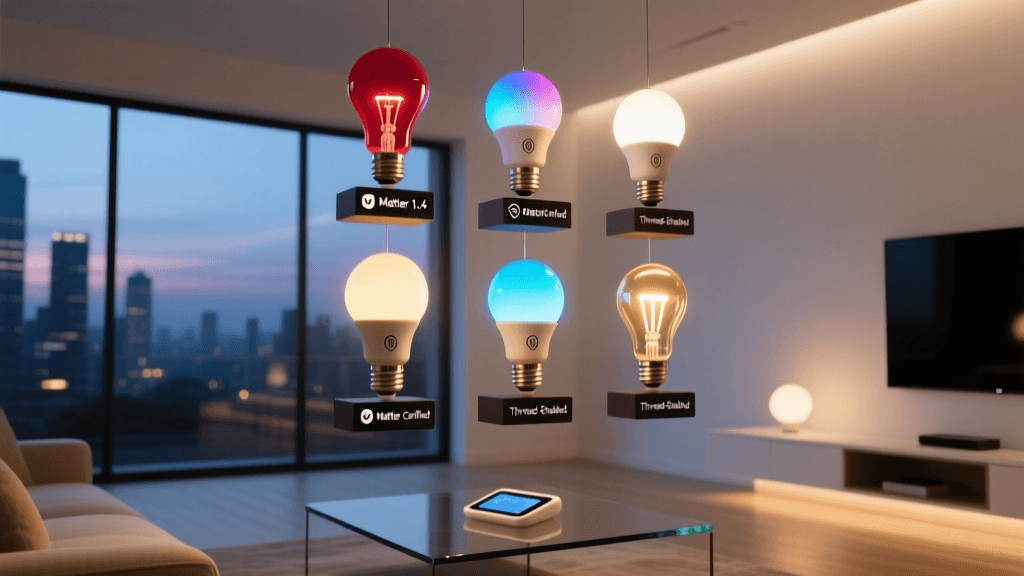
Smart lighting is the gateway to home automation, and the Nanoleaf Essentials A19 ($20 - $25) is arguably the best Matter-native bulb on the market. It boasts an impressive Color Rendering Index (CRI) of 80+, ensuring that colors look natural and vibrant rather than washed out. It also supports tunable white light from warm candlelight (2700K) to crisp daylight (6500K).
Setup is seamless: scan the Matter QR code, and the bulb joins your Thread mesh. Because it operates locally, the bulb turns on instantly upon receiving a command, eliminating the frustrating 'popcorn effect' where smart bulbs turn on one by one over several seconds.
- Protocol: Matter over Thread (requires Border Router)
- Brightness: 1100 Lumens
- Best For: Instant-on ambient and task lighting
Best Smart Sensor: Aqara Door and Window Sensor P2
Sensors are the eyes and ears of your smart home, and the Aqara Door and Window Sensor P2 ($29 - $35) leverages Matter to deliver instantaneous alerts. In legacy setups, a door opening might take two to three seconds to trigger a smart home routine because the signal had to travel to a cloud server and back. With Matter over Thread, the sensor communicates directly with your local hub, triggering lights or security alarms in milliseconds.
The P2 also features an impressive battery life, lasting up to two years on a standard CR2032 coin cell, thanks to the extreme power efficiency of the Thread protocol.
- Protocol: Matter over Thread
- Battery Life: Up to 2 years
- Best For: Security automations and instant local triggers
Buying Guide: What to Look For in Matter Devices
Understanding Thread vs. Wi-Fi
When shopping for Matter devices, you will notice they primarily use one of two transport layers: Wi-Fi or Thread. According to the Thread Group, Thread is an IP-based, low-power mesh networking protocol specifically designed for smart homes. Wi-Fi is excellent for high-bandwidth devices like cameras, but it consumes too much power for battery-operated sensors and can congest your home router when dozens of bulbs are connected. Thread devices create their own self-healing mesh network, ensuring that if one node drops, the signal seamlessly reroutes through another device.
The Multi-Admin Advantage
One of the most revolutionary features of Matter is 'Multi-Admin.' In the past, if you wanted to use a smart plug with Apple HomeKit, you couldn't simultaneously use it with Google Home or Samsung SmartThings. Matter solves this by allowing a single device to be paired to multiple ecosystems simultaneously. You can scan the device's QR code into Apple Home, and then scan it again into Google Home. Both platforms will have full local control without requiring a factory reset or cloud-linking workarounds.
Security and Local Control
Security is baked into the core of the Matter specification. Every device uses certificate-based authentication. When you pair a device, your smartphone acts as a commissioner, securely transferring the network credentials directly to the device over an encrypted channel. Because Matter heavily favors local execution, your home's layout and usage patterns are not continuously uploaded to third-party cloud servers, offering a massive privacy upgrade over legacy IoT devices.
Expert Insights and The Future of Matter
Industry experts agree that Matter is not just a fleeting trend, but a fundamental restructuring of the IoT landscape. As noted in The Verge's comprehensive breakdown of the protocol, the true power of Matter lies in its ability to force manufacturers to compete on hardware quality and software innovation rather than relying on walled-garden lock-in.
'Matter isn't just about making things easier to set up; it's about making the smart home resilient. When your internet goes down, your house should still be smart.' — Smart Home Industry Analysis
Looking ahead, the CSA is continuously updating the specification to include new device types, such as robot vacuums, smart appliances, and EV chargers. However, for the current market, lighting, plugs, sensors, and HVAC controls remain the most mature and reliable categories for Matter adoption.
Troubleshooting Common Matter Pairing Issues
While Matter is designed to be seamless, early adopters may encounter a few hurdles, primarily related to Thread Border Routers. If you have multiple Border Routers from different brands (e.g., an Apple HomePod and a Google Nest Hub), they may occasionally create separate Thread networks instead of merging into one unified mesh. This can cause devices to show as 'Unresponsive' in one ecosystem but work fine in another.
How to fix Thread network partitions:
- Ensure all your hubs and border routers are updated to the latest firmware.
- Temporarily unplug competing border routers, leaving only one active.
- Reset the unresponsive Matter device and re-pair it to establish a clean route to the primary border router.
- Reconnect the secondary border routers; modern firmware updates are increasingly better at automatically merging Thread networks using the same credential set.
Final Verdict
Transitioning to Matter-compatible devices is the smartest investment you can make for the longevity and reliability of your smart home. By prioritizing devices like the Apple TV 4K for local control, the Eve Energy plug for privacy-centric monitoring, and Thread-based sensors for instantaneous automation, you eliminate cloud dependencies and walled gardens. Matter finally delivers on the original promise of the smart home: a unified, secure, and instantly responsive living space.