The Hidden Vulnerability of Cloud-Dependent Smart Homes
When your internet connection drops, does your smart home become a dumb home? For millions of users relying on cloud-centric ecosystems like Amazon Alexa and Google Home, an internet outage means losing voice control, automated routines, and remote access. While these platforms offer unparalleled convenience and broad third-party compatibility, their reliance on remote servers introduces a critical vulnerability: latency and single points of failure.
Enter the champions of local control: Apple HomeKit and Home Assistant. Both platforms prioritize processing commands within your local area network (LAN), ensuring that your lights, locks, and thermostats continue to function even when your Internet Service Provider (ISP) goes down. But how do these two offline-first ecosystems compare in terms of reliability, setup complexity, and hardware costs? In this comprehensive guide, we break down the offline capabilities of HomeKit and Home Assistant, helping you build a truly resilient smart home.
Understanding Local Control vs. Cloud Dependency
To appreciate offline reliability, we must first understand how smart home commands are routed. In a cloud-dependent setup, pressing a smart switch on your phone sends a signal to your router, out to the internet, into the manufacturer's server (e.g., Amazon's AWS), back through the internet, and finally to your smart bulb. This round-trip introduces latency (often 200ms to 500ms) and creates a hard dependency on your Wide Area Network (WAN) connection.
Local control flips this architecture. When you issue a command via a local hub, the signal travels from your phone to your router, and directly to the hub and device on your LAN. The internet is entirely bypassed. This results in near-instantaneous response times (often under 50ms) and guarantees that automations—like motion-triggered lighting or scheduled heating—execute flawlessly during an internet blackout.
According to the Connectivity Standards Alliance, the industry push toward local networking protocols like Thread and Matter is fundamentally driven by consumer demand for faster, more reliable, and private smart home experiences that do not rely on external servers.
Apple HomeKit: The Premium Local Experience
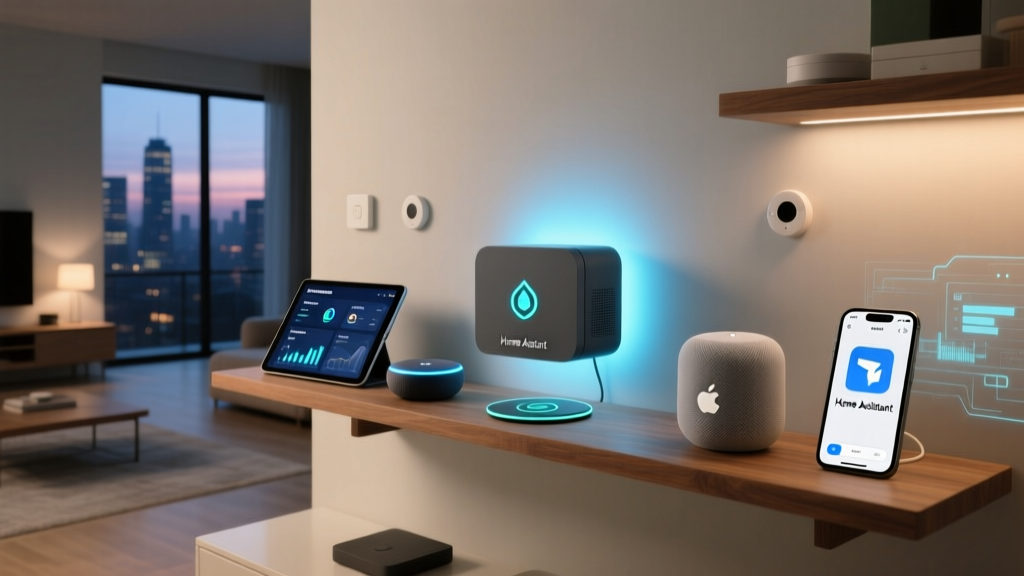
Apple HomeKit has long been the gold standard for consumers who want local control without the steep learning curve of open-source software. HomeKit processes automations and remote access requests locally through a designated Home Hub, which can be an Apple TV 4K or a HomePod.
How HomeKit Handles Offline Scenarios
When your internet goes down, HomeKit's local network capabilities keep your physical switches, Siri voice commands (via local processing on newer HomePods), and sensor-based automations fully operational. If a Philips Hue motion sensor detects movement, the signal travels via Zigbee to the Hue Bridge, which communicates locally with the Apple TV over Ethernet or Wi-Fi to turn on the lights. No cloud required.
Furthermore, Apple's aggressive adoption of Thread has turned newer HomePods and Apple TVs into Thread Border Routers. Thread is a low-power, mesh-networking protocol that operates independently of your home Wi-Fi network. If your Wi-Fi router crashes but your Thread mesh and hub remain powered, Thread devices can still communicate with each other and execute local automations.
HomeKit Secure Video and Local Processing
HomeKit Secure Video (HKSV) is another testament to Apple's local-first approach. When a compatible security camera detects motion, the video stream is analyzed locally by the Home Hub for facial recognition and object detection before being encrypted and sent to iCloud. During an internet outage, while cloud recording will pause, the local motion detection can still trigger local automations—such as turning on the porch lights or triggering a local smart siren—without needing cloud-based AI processing.
Hardware Costs and Compatible Devices
Building a resilient HomeKit setup requires specific hardware. A Home Hub like the Apple TV 4K starts at $129, while the HomePod Mini costs $99. Compatible offline devices include Eve Energy smart plugs ($40), Nanoleaf Essentials bulbs ($20), and Philips Hue starter kits ($100+). While the ecosystem is highly reliable, Apple's strict certification process means compatible devices often carry a premium price tag.
Home Assistant: The Ultimate Offline Powerhouse
If Apple HomeKit is a walled garden with reliable local execution, Home Assistant (HA) is the sprawling, open-source metropolis of local control. Home Assistant runs entirely on local hardware, communicating directly with thousands of integrations without ever needing to phone home.
Unmatched Protocol Support
Home Assistant's offline reliability stems from its ability to natively host and manage local radio protocols. By plugging a USB Zigbee coordinator (like the Sonoff Zigbee 3.0 USB Dongle Plus, ~$25) or a Z-Wave stick into your HA server, you create a local mesh network that operates completely independently of your Wi-Fi and internet.
Through add-ons like Zigbee2MQTT and Z-Wave JS, Home Assistant processes sensor data and triggers automations locally with virtually zero latency. Even complex automations—such as calculating solar panel yield via local MQTT brokers to trigger a smart plug on your water heater—run entirely on your local server.
Hardware Options and Costs
The Home Assistant Green ($99) is the official, plug-and-play hub designed specifically for users who want a reliable, dedicated local server without managing Linux containers. For advanced users, running HA on a Raspberry Pi 4 or an Intel NUC mini-PC ($150 to $300) offers even more processing headroom. Because Home Assistant integrates with almost any device that has a local API (including Shelly Wi-Fi relays, local Tuya devices, and DIY ESPHome nodes), users can build a highly resilient smart home using budget-friendly hardware.
Head-to-Head Comparison: HomeKit vs. Home Assistant
| Feature | Apple HomeKit | Home Assistant |
|---|---|---|
| Offline Automations | Excellent (via Home Hub) | Unmatched (Native Local) |
| Hardware Cost | $99 - $129+ | $25 - $150 |
| Setup Difficulty | Easy / Plug-and-Play | Moderate to Advanced |
| Protocol Support | Wi-Fi, Thread, Matter | Zigbee, Z-Wave, Thread, Matter, Wi-Fi, BLE |
| Ecosystem Lock-in | High (Apple Ecosystem) | None (Open Source) |
Visualizing Latency and Reliability
One of the most noticeable differences between cloud and local ecosystems is command latency. The chart below illustrates the average time it takes for a command to travel from a user interface to a smart bulb across different architectures.
Average Local Command Latency Comparison
As the data suggests, local ecosystems like Home Assistant and HomeKit offer near-instantaneous response times, making physical interactions with smart switches and motion sensors feel completely natural and wired-like.
The Impact of Matter and Thread on Offline Reliability
The introduction of Matter and Thread is actively blurring the lines between ecosystems, significantly boosting offline reliability across the board. Matter is an application-layer protocol that standardizes how devices communicate locally over IP networks (Wi-Fi, Ethernet, and Thread).
When a Matter-certified device is paired to Home Assistant or Apple HomeKit, it establishes a local, encrypted connection. Thread, in particular, is a game-changer for offline resilience. Unlike Wi-Fi devices that crash your router when there are too many connections, Thread devices form a self-healing mesh network. If one smart plug loses power, the Thread mesh automatically reroutes the signal through neighboring devices.
As highlighted by the Thread Group, this mesh architecture ensures that smart home commands are delivered reliably even in dense environments or during partial network failures, making Thread the premier choice for offline-resilient sensors and smart locks.
Actionable Guide: Building an Unbreakable Offline Smart Home
To guarantee your smart home survives an internet outage, follow these actionable steps:
1. Isolate Your Smart Home Network
Do not overload your primary Wi-Fi router with 50+ smart bulbs. Use a dedicated Zigbee or Thread mesh network for sensors and lighting. This prevents Wi-Fi congestion and ensures that if your main router needs a reboot, your Zigbee mesh remains intact and ready to process local hub commands.
2. Invest in an Uninterruptible Power Supply (UPS)
Offline functionality is useless during a power outage. Connect your modem, primary Wi-Fi router, and your local hub (Apple TV or Home Assistant Green) to a compact UPS (e.g., APC Back-UPS BE600M1, ~$70). A 600VA UPS can keep your core networking and local smart home infrastructure running for 2 to 4 hours during a blackout, allowing your battery-powered Zigbee sensors to continue triggering local automations like emergency lighting.
3. Prioritize Local APIs and Flashing
When buying Wi-Fi smart plugs or relays, prioritize brands that support local control out of the box, such as Shelly. For example, the Shelly Plus 1 ($15) allows you to enable local HTTP webhooks, ensuring Home Assistant can trigger it without internet access. Avoid cheap, no-name Tuya devices unless you plan to flash them with open-source ESPHome firmware to sever their cloud dependency.
4. Use Physical Fallbacks
No software is immune to bugs. Ensure that critical smart home installations—like smart lighting—utilize smart switches (e.g., Lutron Caseta or Inovelli) rather than just smart bulbs. This guarantees that a physical wall switch can cut or restore power, and local hub automations can still dictate the bulb's state when power is restored.
Conclusion: Which Ecosystem Should You Choose?
If you prioritize a seamless, polished experience and are willing to pay a premium for certified hardware, Apple HomeKit offers exceptional offline reliability with minimal configuration. The integration of Thread via HomePods makes it a future-proof choice for local mesh networking.
Conversely, if you demand absolute control, zero ecosystem lock-in, and the ability to integrate thousands of budget-friendly devices via local protocols, Home Assistant is the undisputed king of offline reliability. While it requires a steeper learning curve, the payoff is a truly autonomous smart home that answers only to you, regardless of the status of the outside internet.