The Developer Dilemma: Cloud vs. Local Execution
For smart home enthusiasts, enterprise integrators, and software developers, the true value of a smart home ecosystem is not defined by its mobile app or its voice assistant. Instead, it is defined by the openness, flexibility, and reliability of its Developer Application Programming Interface (API). When building custom dashboards, writing automation scripts, or developing commercial hardware integrations, the API is the bridge between your code and the physical devices in your home.
However, not all APIs are created equal. The smart home industry is currently fractured between cloud-dependent architectures and local-first networks. Cloud APIs offer broad reach and easy remote access but suffer from latency (often 200ms to 500ms per command), strict rate limits, and a reliance on external servers. Local APIs offer near-instantaneous execution (under 50ms), enhanced privacy, and offline reliability, but they require developers to manage network discovery and local authentication.
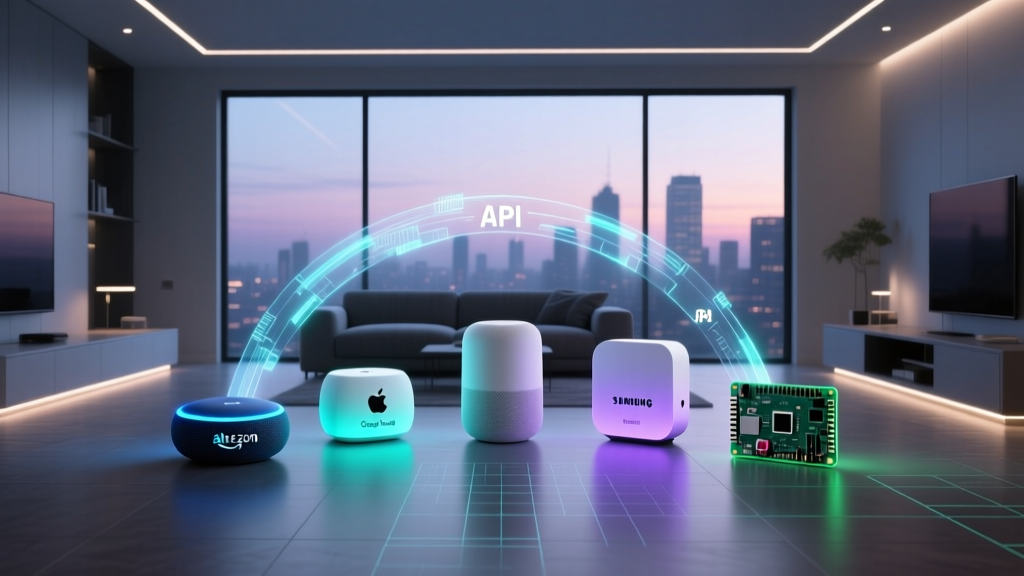
In this comprehensive guide, we will dissect the developer APIs of the five major smart home ecosystems: Amazon Alexa, Google Home, Apple HomeKit, Samsung SmartThings, and Home Assistant. We will evaluate their architecture, rate limits, documentation quality, and overall openness to help you decide which platform deserves your development resources.
Defining 'Openness' in Smart Home APIs
Before diving into specific platforms, we must establish what makes an API 'open' in the context of smart home development. An open API ecosystem provides the following:
- Unrestricted Local Execution: The ability to send commands directly to devices over the local network (LAN) without routing through a cloud server.
- Generous Rate Limits: The absence of artificial throttling that prevents complex automations from firing multiple events per second.
- Granular Device State Access: Real-time WebSocket or Server-Sent Events (SSE) for instant state changes, rather than relying on slow polling or delayed webhooks.
- Comprehensive Documentation: Clear, versioned, and well-maintained developer documentation with active community support.
- Low Barrier to Entry: Minimal certification requirements, allowing hobbyists and indie developers to build integrations without paying enterprise licensing fees.
Amazon Alexa Smart Home API: The Cloud Giant
Amazon Alexa dominates the consumer voice assistant market, but its developer ecosystem is heavily skewed toward cloud-based interactions. The Alexa Smart Home Skill API allows developers to connect their cloud services to Alexa, enabling voice control for third-party devices. However, this architecture requires developers to host their backend logic on AWS Lambda.
While AWS Lambda provides a free tier that is sufficient for most hobbyists, the architecture is inherently cloud-dependent. When a user issues a voice command, the request travels from the Echo device to Amazon's cloud, then to your AWS Lambda function, then to your device's cloud API, and finally down to the local device. This multi-hop journey introduces latency and creates multiple points of failure.
Furthermore, Amazon does not provide a documented, supported local LAN API for third-party developers to discover and control Echo devices or Alexa-compatible accessories directly. While protocols like local discovery exist for specific hardware (like Philips Hue), they are not exposed as a general-purpose developer API. For developers seeking low-latency, local-first control, Alexa's API is highly restrictive.
Google Home Developer Console: The Push for Local Fulfillment
Google has historically mirrored Amazon's cloud-first approach, but the introduction of the Local Home SDK marked a significant shift. The Local Home SDK allows developers to route Google Assistant intents directly to local smart home devices via the local network, bypassing the cloud entirely. This drastically reduces latency and improves reliability.
However, implementing local fulfillment is complex. Developers must build a local fulfillment app using TypeScript or JavaScript, which is then downloaded and executed locally on Google Nest speakers and displays. The app must scan the local network using protocols like mDNS, UPnP, or UDP to discover devices and establish a direct connection.
While the Local Home SDK is a powerful tool for enterprise hardware manufacturers (like TP-Link or Philips), it is overkill and largely inaccessible for indie developers or hobbyists who simply want to write a Python script to toggle a smart plug. The Google Home Graph API exists for cloud state reporting, but local state querying remains locked behind the complex Local Home SDK requirements.
Apple HomeKit ADK: The Walled Garden's Gate
Apple's approach to smart home development is famously stringent. The HomeKit Accessory Protocol (HAP) is a robust, secure, local-first protocol that relies on cryptographic pairing (using Ed25519 and SRP) to ensure end-to-end encryption. For hardware manufacturers, Apple provides the HomeKit Accessory Development Kit (ADK), an open-source C-based framework that allows developers to build HomeKit-compatible accessories.
However, from a software integration perspective, Apple remains a walled garden. There is no public, documented REST API that allows a developer to query the state of all HomeKit devices on the network without going through the official MFi (Made for iPhone) certification program or relying on reverse-engineered libraries like HAP-NodeJS. Software developers are largely restricted to using Siri Shortcuts or building native iOS apps using the HomeKit framework, which limits cross-platform automation and server-side scripting.
Apple's ecosystem is excellent for consumer privacy and local execution, but its API openness for software developers and tinkerers is severely limited by design.
Samsung SmartThings API: The RESTful Standard
Samsung SmartThings offers one of the most balanced and well-documented cloud APIs in the industry. The SmartThings REST API allows developers to manage devices, execute commands, and subscribe to webhook events using standard OAuth 2.0 authentication. According to the official SmartThings Developer Documentation, the platform supports a wide array of device capabilities, making it a favorite for commercial SaaS integrations and property management software.
SmartThings also introduced the Edge platform, which allows developers to write Lua-based drivers that run directly on the SmartThings Hub (such as the $70 SmartThings Station or Hub v3). This enables local execution for Zigbee, Z-Wave, and LAN devices. However, the Edge driver development environment requires a specific CLI toolchain and is primarily designed for hardware protocol translation rather than general-purpose automation scripting.
For cloud-based developers, the SmartThings API is excellent. It features reasonable rate limits (typically around 10 requests per second per token) and comprehensive webhook support. However, it still relies on the cloud for device discovery and initial OAuth pairing, meaning a loss of internet connectivity can disrupt new device onboarding.
Home Assistant: The Undisputed Champion of Openness
When evaluating pure API openness, Home Assistant stands alone at the top of the hierarchy. Home Assistant is an open-source, local-first home automation platform that exposes a comprehensive REST API and a high-speed WebSocket API to the local network. As detailed in the Home Assistant Developer REST API Documentation, developers can query any entity state, trigger services, and stream real-time events with zero artificial rate limits.
Because Home Assistant runs locally on hardware like the $99 Home Assistant Green, a Raspberry Pi, or a custom x86 server, all API calls remain on the local network. This results in sub-10ms latency and complete immunity to internet outages. Authentication is handled via simple Long-Lived Access Tokens, eliminating the need for complex OAuth 2.0 flows or cloud-based token refreshing.
Furthermore, Home Assistant's Event Bus allows developers to subscribe to state changes instantly via WebSockets. If a motion sensor triggers, your custom Python or Node.js script receives the JSON payload in milliseconds. This level of granular, unrestricted access makes Home Assistant the gold standard for developers, data scientists, and automation engineers who demand total control over their environment.
Ecosystem API Feature Comparison
To help you visualize the differences between these platforms, we have compiled a comparison table detailing the core API architectures, local execution capabilities, and associated hardware costs.
| Ecosystem | API Architecture | Local Execution | Auth Method | Hardware Cost Range |
|---|---|---|---|---|
| Home Assistant | REST & WebSocket | Full Local (Unrestricted) | Long-Lived Tokens | $0 (Software) - $199 |
| Samsung SmartThings | REST & Webhooks | Partial (via Edge Lua Drivers) | OAuth 2.0 | $70 - $150 |
| Google Home | Cloud Graph & Local SDK | Complex (Local Home SDK) | OAuth 2.0 / Google Cloud | $99+ (Nest Hubs) |
| Apple HomeKit | HAP (Hardware ADK) | Full Local (Hardware Only) | Cryptographic Pairing | $99+ (HomePod Mini) |
| Amazon Alexa | Cloud Skill API | None (Cloud Dependent) | OAuth 2.0 / AWS Lambda | $50+ (Echo Devices) |
Visualizing API Openness
The following chart illustrates how these ecosystems score across three critical developer metrics: Local Execution capability, Documentation and Community support, and Rate Limit Flexibility. Scores are based on developer consensus, architectural limitations, and practical testing.
The Matter Protocol: A Paradigm Shift for Developers
No discussion of smart home APIs is complete without addressing the Matter protocol. Developed by the Connectivity Standards Alliance (CSA), Matter is an open-source, royalty-free connectivity standard built on IP (Internet Protocol). Matter operates over Thread (a low-power mesh network) and Wi-Fi, utilizing Bluetooth Low Energy (BLE) for initial device commissioning.
For developers, Matter is revolutionary because it standardizes the local API layer. Instead of learning the proprietary LAN protocols of Philips Hue, LIFX, and Nanoleaf, developers can interact with the unified Matter API. The open-source Matter SDK provides libraries in C++ that allow developers to build controllers capable of discovering, pairing, and controlling any Matter-certified device on the local network.
While Matter does not replace cloud APIs for remote access or voice assistant integration, it drastically lowers the barrier to entry for local control. Ecosystems like Apple, Google, Amazon, and Samsung are all adopting Matter, meaning a developer who builds a Matter-compliant local controller will inherently support devices across all major platforms without needing to integrate four separate cloud APIs.
Actionable Advice for Smart Home Developers
Choosing the right API depends entirely on your project's scope, target audience, and technical requirements. Here is our practical advice for different developer profiles:
1. The Hobbyist and Automation Tinkerer
If your goal is to write custom Python scripts, integrate machine learning models, or build complex, multi-step automations without worrying about cloud latency or rate limits, Home Assistant is the only logical choice. Invest in a Home Assistant Green ($99) or deploy it on an existing Linux server. Utilize the WebSocket API to stream state changes to your custom dashboards or Node-RED flows.
2. The Commercial SaaS Developer
If you are building a cloud-based property management platform, an energy monitoring dashboard, or a commercial integration service, the Samsung SmartThings REST API offers the best balance of device reach and documentation. Its standard OAuth 2.0 flow and webhook architecture make it easy to integrate into existing cloud backends. Ensure you implement exponential backoff strategies to handle occasional rate limiting gracefully.
3. The Hardware Manufacturer
If you are developing a new smart plug, bulb, or sensor, you must prioritize Matter. By utilizing the Matter SDK, your device will be natively discoverable and controllable by Apple, Google, Amazon, and Samsung ecosystems simultaneously. For legacy support, provide a well-documented local REST or MQTT API, as advanced users heavily favor hardware that does not require a cloud connection for basic operation.
4. The Voice-First App Developer
If your product relies heavily on voice commands and you are building a custom skill or action, you must engage with the Amazon Alexa Smart Home API and the Google Home Developer Console. Be prepared to manage AWS Lambda functions and navigate the complex certification processes required by both Amazon and Google to get your skill published to their respective marketplaces.
Conclusion
The landscape of smart home developer APIs is vast and varied. While Amazon and Google offer massive consumer reach through their cloud-based voice ecosystems, they impose significant latency and architectural hurdles for developers seeking direct device control. Apple maintains a secure but heavily restricted environment, and Samsung SmartThings provides an excellent, well-documented cloud REST API with emerging local capabilities.
However, when evaluating pure API openness, local execution, and freedom from artificial rate limits, Home Assistant remains the undisputed champion. Combined with the rising adoption of the Matter protocol, the future of smart home development is trending toward local, IP-based, and open-standard APIs. By understanding the strengths and limitations of each ecosystem, developers can architect solutions that are not only powerful and responsive but also resilient and future-proof.