The Fragmentation Problem in Smart Home Automation
For the past decade, the smart home industry has been plagued by a frustrating barrier: ecosystem fragmentation. Homeowners and renters alike have historically been forced to choose a side. If you bought an Apple HomePod, you were largely restricted to HomeKit-compatible accessories. If you invested in Amazon Echo devices, you needed Alexa-certified products. Google Nest users faced similar walled gardens. This fragmentation meant that making devices work together across different platforms was nearly impossible without relying on clunky, cloud-dependent third-party workarounds like IFTTT or complex local servers like Home Assistant.
The result was a disjointed user experience. You might have a smart thermostat that only worked with Google, smart bulbs that required the Philips Hue app, and a smart lock that demanded Apple HomeKey. Creating a unified automation routine—such as turning off all lights, locking the doors, and adjusting the thermostat when the last person leaves the house—required immense technical overhead. True smart home integration, where devices communicate locally and instantaneously regardless of their branding, remained out of reach for the average consumer.
Enter Matter: The Universal Language for Smart Devices
To solve this interoperability crisis, the industry’s biggest rivals came together. Apple, Google, Amazon, and Samsung, alongside hundreds of other tech companies, formed the Connectivity Standards Alliance (CSA) to develop and launch the Matter protocol. Matter is not a new wireless radio frequency; rather, it is an open-source, royalty-free application layer protocol that runs on top of existing networking technologies like Wi-Fi, Ethernet, and Thread.
Think of Matter as a universal translator. Before Matter, a smart plug from Brand A spoke a completely different digital language than a smart switch from Brand B. With Matter, both devices share a standardized method for describing their capabilities, receiving commands, and reporting their status. When you buy a Matter-certified device, you are guaranteed that it will integrate natively with Apple Home, Google Home, Amazon Alexa, and Samsung SmartThings, right out of the box.
How Matter Changes the Integration Landscape
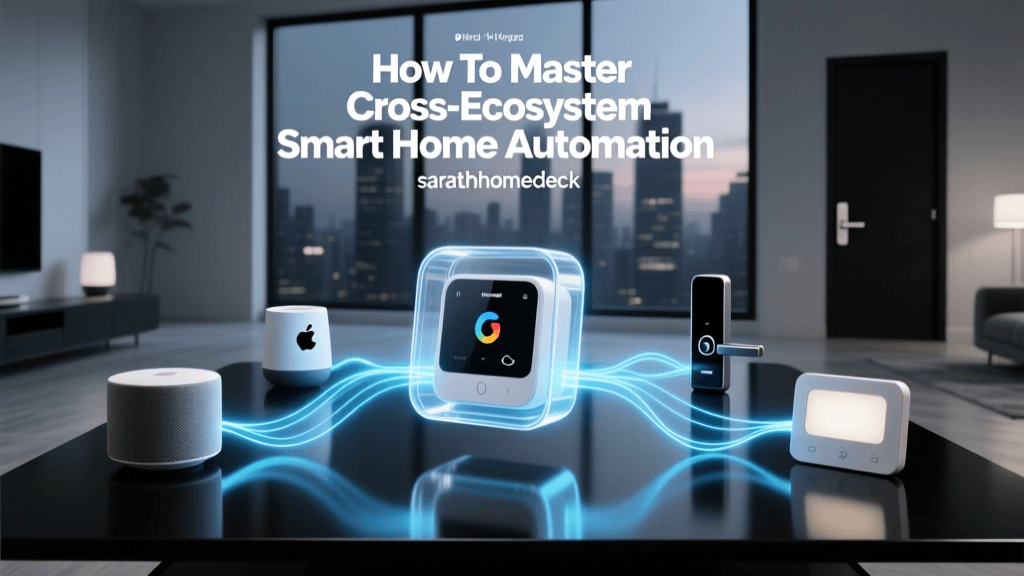
The most revolutionary feature of Matter for smart home automation is "Multi-Admin." In the pre-Matter era, a device could only be claimed by one ecosystem. If you paired a smart plug to Apple HomeKit, it was locked out of Google Home. Multi-Admin allows a single physical device to be connected to multiple ecosystems simultaneously. You can pair a Matter smart plug to your Apple HomePod for Siri control, while simultaneously pairing it to your Amazon Echo for Alexa routines, and even to a Samsung SmartThings hub for advanced conditional logic.
This completely changes how we build automations. You are no longer forced to build your entire automation logic within a single app. You can use the Google Home app to trigger complex, AI-driven presence routines based on Nest Wi-Fi data, while using the Apple Home app to control the same Matter lighting devices via HomeKit Secure Video triggers. The devices seamlessly accept commands from whichever controller initiates the action, executing locally over your network with sub-100-millisecond latency.
Supported Connectivity Protocols: Thread vs. Wi-Fi
Matter relies on your existing home network, but it primarily utilizes two protocols for device communication: Wi-Fi and Thread.
- Wi-Fi: Ideal for high-bandwidth, mains-powered devices like smart displays, robot vacuums, and smart TVs. Wi-Fi Matter devices connect directly to your router, but they can congest your network if you have dozens of them.
- Thread: A low-power, low-latency, mesh networking protocol operating on the 2.4 GHz spectrum. Thread is designed specifically for smart home sensors, smart locks, and smart bulbs. Unlike Wi-Fi, Thread devices do not connect to your router; instead, they connect to a "Thread Border Router." They create a self-healing mesh network where every plugged-in device acts as a repeater, extending the range and reliability of your smart home without burdening your main Wi-Fi network.
According to Apple’s official Thread documentation, devices like the Apple TV 4K and HomePod mini act as Thread Border Routers, bridging the Thread mesh network to your home’s Wi-Fi and Ethernet network, allowing your Thread-based Matter sensors to communicate with your Wi-Fi-based Matter hubs.
Building Your First Cross-Ecosystem Automation
Let’s move from theory to practice. Building a cross-ecosystem Matter automation requires a few key components: a Matter controller (hub), a Thread Border Router (if using Thread devices), and Matter-certified end devices. A basic 5-device Matter starter kit, including a hub, two Thread smart plugs, a door/window sensor, and a motion sensor, typically costs between $150 and $250.
Step 1: Choosing the Right Border Router and Hub
To ensure maximum compatibility, you need a hub that supports both Matter and Thread. The Apple TV 4K (3rd Generation, Wi-Fi + Ethernet) is widely considered the gold standard for Thread Border routing, priced around $149. For Google users, the Nest Hub Pro (2nd Gen) at $229 offers excellent Thread routing. For Amazon users, the Echo Show 8 (3rd Gen) at $149 serves as both a Matter controller and a Thread Border Router. Ensure your primary hub is connected via Ethernet if possible, as this provides a stable backbone for your local automations.
Step 2: Pairing Devices via QR Code
Matter simplifies pairing through standardized QR codes. Every Matter device features an 11-digit setup code and a QR code on the packaging or the device itself. Open your preferred ecosystem app (e.g., Apple Home), scan the QR code, and the app will use Bluetooth Low Energy (BLE) to securely provision the device with your Wi-Fi or Thread network credentials. Because of Multi-Admin, you can then open the Google Home app, scan the exact same QR code, and add the device to your Google ecosystem without interrupting its Apple Home connection.
Step 3: Creating the Automation Routine
With devices integrated, you can now build automations. Let’s create a "Movie Night" routine. In your automation app, set the Trigger to a Matter motion sensor detecting no motion in the kitchen for 10 minutes (indicating everyone has moved to the living room). Set the Action to dim your Matter-certified living room smart bulbs to 20% brightness and turn on your Matter smart plug connected to the TV backlighting. Because Matter operates locally, this automation will execute instantly, even if your home’s internet connection goes down.
Hub-Based vs. Hubless Integration: What You Still Need
While Matter aims to reduce the need for proprietary hubs, legacy devices and specific use cases still require them. For example, Philips Hue bulbs use Zigbee, not Thread or Wi-Fi. To integrate Hue bulbs into a Matter ecosystem, you still need the Philips Hue Bridge. The Bridge acts as a translator, exposing the Zigbee bulbs to your network as virtual Matter devices. Similarly, Z-Wave devices require a dedicated Z-Wave hub that supports Matter bridging.
| Hub Device | Primary Ecosystem | Thread Support | Matter Controller | Approx. Cost |
|---|---|---|---|---|
| Apple TV 4K (3rd Gen) | Apple HomeKit | Yes | Yes | $129 - $149 |
| Amazon Echo Show 8 (3rd Gen) | Amazon Alexa | Yes | Yes | $149 |
| Google Nest Hub Pro (2nd Gen) | Google Home | Yes | Yes | $229 |
| Philips Hue Bridge | Proprietary/Matter | No (Zigbee) | Bridges to Matter | $59 |
| Aqara Hub M3 | Aqara / Agnostic | Yes | Yes (Border Router) | $129 |
Visualizing the Shift to Unified Protocols
The adoption of Matter has grown exponentially since its official launch, signaling a massive shift away from proprietary walled gardens. The chart below illustrates the rapid expansion of Matter-certified devices in the market, highlighting why cross-ecosystem automation is becoming the standard rather than the exception.
As the The Verge’s comprehensive Matter explainer notes, the initial rollout focused heavily on smart plugs and lighting, but the protocol is rapidly expanding into complex appliances, HVAC systems, and advanced security sensors, further enabling deep, whole-home automations.
Practical Automation Scenarios for Mixed Ecosystems
With a unified Matter network, you can build highly sophisticated automations that leverage the unique strengths of different ecosystems. Here are two advanced scenarios:
Scenario 1: The Geofencing & Local Sensor Handoff
The Setup: You use an iPhone (Apple Home) and an Android tablet (Google Home). You have a Matter smart lock and a Matter thermostat.
The Logic: Apple HomeKit’s geofencing is highly accurate for iOS users. You set an Apple Home automation to trigger the "Arrival" scene when your iPhone crosses the virtual perimeter. This scene unlocks the Matter smart lock. Simultaneously, a Google Nest Hub in the entryway uses its local Soli radar sensor to detect physical presence, triggering the Google Home app to adjust the Matter thermostat to your preferred temperature. The two ecosystems work in tandem without conflicting.
Scenario 2: Energy Management & Peak Hours
The Setup: A Matter smart plug connected to an EV charger, a Matter smart switch for the water heater, and an energy monitoring hub.
The Logic: Using a platform like Samsung SmartThings (which excels in energy dashboards), you create an automation that monitors local utility API data for peak pricing hours. When peak hours begin, SmartThings sends a command via Matter to turn off the water heater and pause the EV charging. Once off-peak hours resume, the devices turn back on. Because Matter commands are local, the state changes happen instantly without routing through external cloud servers.
Troubleshooting Common Integration Roadblocks
While Matter promises seamless integration, the reality of home networking can introduce roadblocks. Here is how to troubleshoot the most common cross-ecosystem integration issues:
- mDNS Discovery Failures: Matter relies heavily on multicast DNS (mDNS) to discover devices on your local network. If you have a complex router setup with IGMP snooping enabled, or if your smart devices are placed on a separate IoT VLAN (Virtual Local Area Network) without proper mDNS reflectors configured, your hubs will not be able to "see" the Matter devices. Solution: Ensure your IoT VLAN has an mDNS repeater enabled, or keep all smart hubs and devices on the same primary LAN subnet.
- Thread Mesh Partitioning: If you have multiple Thread Border Routers (e.g., an Apple TV and a Nest Hub) on different Wi-Fi networks or subnets, they may create separate, competing Thread mesh networks instead of merging into one. This causes devices to drop offline when moving between routers. Solution: Ensure all Thread Border Routers are connected to the exact same Wi-Fi SSID and subnet, and that they share the same Thread network credentials via the Matter Multi-Admin fabric.
- Firmware Update Delays: Because Matter is a new standard, early adopters often face bugs related to device firmware. If a device shows as "No Response" in Apple Home but works in Google Home, it is often a firmware desync. Solution: Use the manufacturer’s native app to force a firmware update before relying solely on the ecosystem hubs for maintenance.
Security and Privacy in Cross-Ecosystem Automations
One of the most significant, yet under-discussed, benefits of Matter is its robust security architecture. Matter utilizes Device Attestation Certificates (DAC). When you scan a Matter QR code, the controller cryptographically verifies the device’s identity against the CSA’s blockchain-backed ledger. This ensures that the device is genuinely certified and has not been tampered with.
Furthermore, all Matter communications are encrypted end-to-end using local keys. When your Apple HomePod sends a command to a Google-compatible Matter smart plug, the command is encrypted locally on your network. The cloud is entirely bypassed for execution, meaning your automation routines are shielded from internet outages and cloud server breaches. This local-first approach not only enhances privacy but also drastically reduces latency, making automations feel truly instantaneous.
The Future of Unified Smart Home Control
The era of choosing between Apple, Google, or Amazon for your smart home is ending. Matter has successfully shifted the industry’s focus from proprietary lock-in to user experience and device innovation. As more manufacturers adopt Thread and Matter, the need for specialized, single-brand hubs will fade, replaced by powerful, localized border routers that manage a unified mesh of interoperable devices.
For the smart home enthusiast, this means your time and money are finally protected. You can invest in high-quality sensors, locks, and lighting without the nagging fear that a platform shutdown or ecosystem shift will render your home’s automation useless. By mastering Matter, understanding Thread networking, and leveraging Multi-Admin capabilities, you can build a resilient, lightning-fast, and truly intelligent home that works together seamlessly, regardless of the logo on the speaker you use to control it.