Introduction to Room-by-Room Smart Home Automation
Transforming your house into a smart home does not require a complete, expensive overhaul all at once. The most successful smart home setups are built incrementally, focusing on specific rooms, daily pain points, and realistic budgets. Whether you are renting an apartment and need non-invasive solutions, or you own a home and are ready to invest in premium hardwired technology, understanding how to allocate your budget by room is the key to a seamless ecosystem.
In this comprehensive guide, we will break down practical smart home ideas by room and budget. We will explore actionable device recommendations, compatibility requirements, and cost ranges across three distinct budget tiers: Starter, Mid-Range, and Premium. By the end of this article, you will have a clear, strategic roadmap for automating your living spaces without overspending or compromising on ecosystem harmony.
Defining Your Smart Home Budget Tiers
Before purchasing individual devices, it is crucial to understand the three primary budget tiers for smart home upgrades. These tiers dictate not just the price, but the installation complexity, build quality, and ecosystem integration of the devices you choose.
- Starter Tier ($50 - $150 per room): Focuses on plug-and-play devices, smart plugs, entry-level smart bulbs, and basic voice assistants. Ideal for renters and beginners. Most devices rely on 2.4GHz Wi-Fi.
- Mid-Range Tier ($150 - $500 per room): Introduces dedicated smart home hubs, advanced sensors, smart thermostats, and motorized retrofit devices. This tier balances cost with reliability, often utilizing Zigbee or Thread protocols for better mesh networking.
- Premium Tier ($500+ per room): Features hardwired solutions, high-end ambient lighting systems, integrated smart appliances, and professional-grade automated window treatments. This tier requires professional installation and offers the most seamless, invisible automation experience.
The Living Room: Entertainment & Ambiance
The living room is the central hub of most homes, making it the perfect starting point for smart home automation. The goal here is to enhance entertainment, manage ambient lighting, and control climate efficiently.
Starter Budget: Smart Plugs and IR Blasters
For under $100, you can dramatically improve your living room. Start with a Kasa Smart Plug Mini (EP10) (approx. $15) to automate your floor lamps. Pair this with a SwitchBot Hub Mini and IR Blaster (approx. $35) to connect your existing "dumb" TV, soundbar, and air conditioner to your voice assistant. This allows you to use voice commands or routines to turn on your entertainment center without replacing your existing appliances.
Mid-Range Budget: Smart Lighting and Climate
With a budget around $300, you can introduce dynamic lighting and climate control. Invest in a Philips Hue White and Color Ambiance Starter Kit (approx. $200). The included Hue Bridge uses the Zigbee protocol, creating a reliable mesh network that won't clog your Wi-Fi router. Add an Amazon Echo Show 8 (approx. $130) to serve as your central control panel for viewing security cameras, managing video calls, and controlling your Hue lights via an intuitive dashboard.
Premium Budget: Motorized Blinds and Hidden Tech
Premium living room automation focuses on luxury and seamlessness. Consider installing Lutron Serena Roller Shades (starting around $600 per window), which integrate flawlessly with Apple HomeKit, Amazon Alexa, and Google Home. Pair these with a Samsung The Frame TV and a hardwired Lutron Caseta Smart Lighting System to create a "Movie Night" routine that simultaneously dims the lights, lowers the blinds, and turns on your home theater system with a single voice command.
The Bedroom: Sleep & Comfort Optimization
Bedroom automation should prioritize sleep hygiene, comfort, and gentle transitions between day and night. Avoid bright screens and loud notifications in this space.
Starter Budget: Sunrise Alarms and Fan Control
Improve your sleep cycle without breaking the bank. Use a Wyze Plug Outdoor (approx. $20) to control a traditional window fan based on room temperature triggers set via the Wyze app. Combine this with a budget-friendly smart bulb like the WiZ Tunable White Bulb (approx. $12) placed in a bedside lamp. Program the bulb to slowly fade from a warm 2700K to a bright 5000K over 30 minutes, simulating a natural sunrise to help regulate your circadian rhythm.
Mid-Range Budget: Smart Thermostats and Air Quality
Temperature fluctuations can ruin a good night's sleep. According to the U.S. Department of Energy, smart thermostats can significantly reduce heating and cooling costs while maintaining optimal comfort. Install an Ecobee SmartThermostat Premium (approx. $250) with its included SmartSensor. Place the sensor in your bedroom so the HVAC system prioritizes your sleeping temperature over the empty living room. Add a Levoit Smart Air Purifier (approx. $150) to automatically ramp up filtration if indoor VOC levels rise during the night.
Premium Budget: Sleep Tracking and Automated Blackouts
For the ultimate sleep sanctuary, invest in the Eight Sleep Pod 4 (starting around $2,299). This smart mattress cover uses AI to independently regulate the temperature on each side of the bed based on your biometric sleep data. Pair this with hardwired blackout drapery tracks from Somfy to ensure your room remains pitch black until your desired wake-up time.
The Kitchen: Efficiency & Safety
The kitchen is a high-traffic area where smart technology can assist with cooking timers, grocery management, and crucial safety monitoring.
Starter Budget: Smart Displays and Leak Detection
A smart display is the ultimate kitchen companion. The Google Nest Hub (2nd Gen) (approx. $100) allows you to follow step-by-step recipes, set multiple visual timers for different burners, and broadcast intercom messages to the rest of the house. For safety, place a YoLink Water Leak Sensor (approx. $20) under your sink. Utilizing LoRaWAN technology, it offers an exceptional range and will instantly alert your phone if a pipe bursts, potentially saving you thousands in water damage.
Mid-Range Budget: Smart Appliances and Lighting
Upgrade your morning routine with a GE Profile Smart Coffee Maker (approx. $250) that can be scheduled to brew via Alexa or Google Home. Under-cabinet lighting is also a game-changer for kitchen prep. Install Govee Smart LED Strip Lights (approx. $40) along your countertops, linking them to motion sensors so they automatically illuminate your workspace when you walk in with groceries.
Premium Budget: Smart Fridges and Touchless Fixtures
Premium kitchens feature integrated appliances like the Samsung Bespoke 4-Door Flex Refrigerator (approx. $3,500), which features internal cameras, AI food recognition, and a built-in Family Hub touchscreen. Combine this with a touchless smart faucet like the Moen Smart Faucet with Motion Control (approx. $650), allowing you to turn on the water and dispense exact measurements using simple voice commands, keeping your fixtures clean while handling raw ingredients.
The Bathroom: Convenience & Water Conservation
Bathroom automation is often overlooked, but it offers incredible opportunities for water conservation and luxury.
Starter Budget: Motion Lighting and Humidity Control
Navigating a dark bathroom at night can be jarring. Install a Ring Smart Switch or use battery-powered Philips Hue Motion Sensors (approx. $40) to trigger dim, warm floor lighting when motion is detected after 10 PM. To prevent mold, use a smart plug connected to your exhaust fan, triggering it to run for 20 minutes after a shower based on a humidity threshold set via a cheap smart temperature/humidity sensor.
Mid-Range Budget: Smart Showers and Scales
Upgrade your daily routine with a Withings Body Scan Scale (approx. $400) to track comprehensive body composition metrics, syncing directly to your health apps. For water conservation, the EPA WaterSense program highlights that undetected leaks and excessive shower times waste thousands of gallons annually. Combat this with a hai Smart Shower Head (approx. $130), which tracks your water usage and alerts you via an LED light ring when you have reached your target shower duration.
Premium Budget: Smart Toilets and Heated Floors
Luxury bathrooms feature smart toilets like the TOTO Neorest NX2 (approx. $10,000), which includes automatic lid opening, heated seats, bidet functions, and UV self-cleaning. Pair this with a Schluter DITRA-HEAT-E-WiFi thermostat to warm your tile floors precisely when you wake up, ensuring your bare feet never touch cold tile on a winter morning.
Bar chart showing estimated smart home upgrade costs by room across three budget tiers.
Understanding Ecosystems and Protocols
When selecting devices across different rooms and budgets, compatibility is paramount. Buying a mix of incompatible devices will result in a fragmented experience requiring multiple apps. Here is a breakdown of the core protocols and ecosystems you need to understand.
The Big Three Ecosystems
- Amazon Alexa: Offers the widest compatibility with budget and mid-range devices. Ideal for users who want extensive third-party support and affordable smart speakers.
- Google Home: Excels in voice recognition, natural language processing, and integration with Android devices and Google services like Nest and YouTube.
- Apple HomeKit: Known for strict privacy standards, local processing (faster response times), and a highly polished user interface. However, HomeKit-compatible devices often carry a premium price tag.
Wireless Protocols Explained
| Protocol | Range | Power Consumption | Best Use Case |
|---|---|---|---|
| Wi-Fi (2.4GHz) | Medium | High | High-bandwidth devices (Cameras, Smart Displays) |
| Zigbee | Medium (Mesh) | Very Low | Sensors, Smart Bulbs, Switches (Requires Hub) |
| Z-Wave | High (Mesh) | Low | Door Locks, Garage Doors, Security Systems |
| Thread | Medium (Mesh) | Very Low | Next-gen sensors and lighting (No traditional hub needed) |
| Bluetooth/BLE | Low | Low | Proximity unlocking, local setup, portable devices |
The Game Changer: Matter
The introduction of the Matter standard by the Connectivity Standards Alliance has revolutionized cross-brand compatibility. Matter is an open-source, royalty-free connectivity protocol that runs over Wi-Fi, Thread, and Ethernet. When you purchase a device with the Matter logo, you are guaranteed that it will work seamlessly with Apple HomeKit, Amazon Alexa, Google Home, and Samsung SmartThings simultaneously. When planning your room-by-room upgrades, prioritize Matter-compatible devices to future-proof your investment and eliminate ecosystem lock-in.
Designing Impactful Automation Routines
Hardware is only half the battle; the true magic of a smart home lies in automation routines. Here are three foundational routines to implement across your newly automated rooms.
1. The "Good Morning" Routine
- Trigger: Time (e.g., 6:30 AM) or smart alarm dismissal.
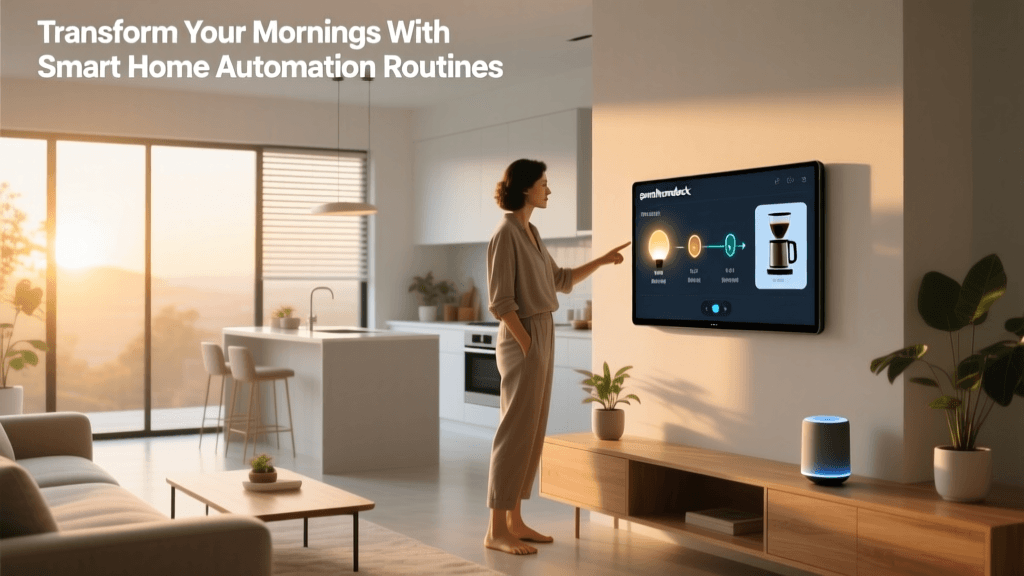
- Actions: Bedroom smart bulbs fade to 100% brightness (cool white). Smart thermostat adjusts from sleep mode to daytime temperature. Kitchen smart plug turns on the coffee maker. Living room motorized blinds open to 50%.
2. The "Movie Night" Routine
- Trigger: Voice command ("Start Movie Night") or smart remote button press.
- Actions: Living room overhead lights turn off. Philips Hue accent lights dim to 10% (deep blue or amber). Smart IR blaster turns on the TV and soundbar, setting the volume to 15. Smart thermostat lowers the temperature by 2 degrees to compensate for body heat.
3. The "Away" Security Routine
- Trigger: Geofencing (all registered phones leave a 1-mile radius) or manual switch.
- Actions: All smart lights turn off. Smart plugs connected to irons or hair straighteners cut power. Thermostat switches to Eco mode. Indoor privacy shutters on smart cameras slide open, and exterior security cameras arm to detect motion.
Conclusion: Start Small and Scale Smart
Building a smart home is a marathon, not a sprint. By approaching your automation room-by-room and adhering to a defined budget tier, you prevent buyer's remorse and ensure every device serves a distinct, practical purpose. Start with the Starter Tier in high-traffic areas like the living room and kitchen. As you become comfortable with routines, voice commands, and ecosystem management, gradually upgrade to Mid-Range and Premium solutions that require more complex installation. Always prioritize devices that support modern protocols like Thread and Matter, ensuring your smart home remains adaptable, efficient, and seamlessly integrated for years to come.