AI-Powered Health Monitoring: The Next Frontier in Smart Homes
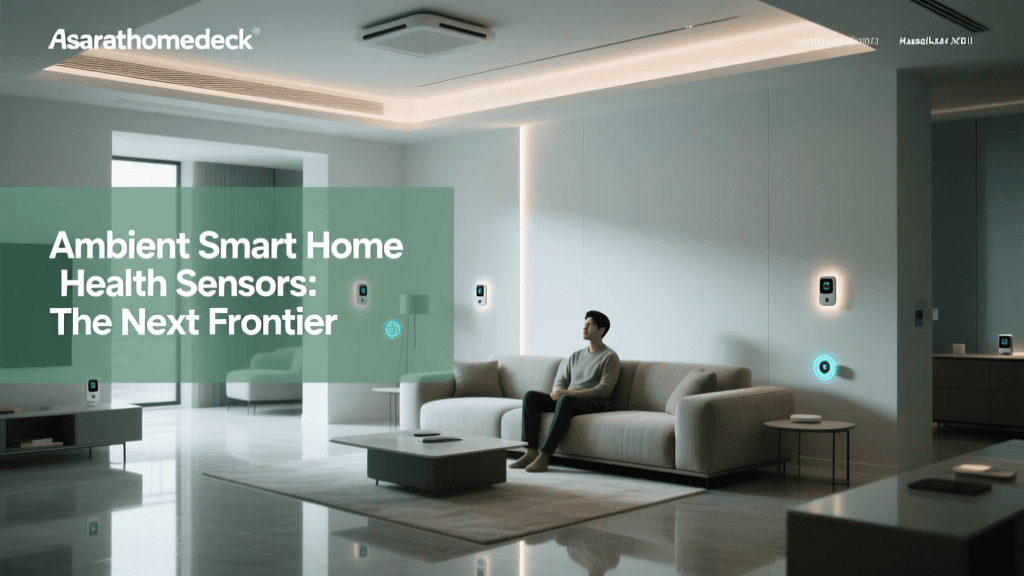
As smart homes evolve beyond lighting and climate control, a transformative new category is emerging: ambient AI health monitoring. Unlike traditional wearables or medical-grade equipment, these devices operate passively—using radar, thermal imaging, and machine learning—to track physiological and behavioral metrics without requiring user interaction, skin contact, or daily charging. This shift marks a pivotal moment in home-based healthcare, enabling proactive aging-in-place support, chronic condition management, and early anomaly detection—all within the familiar context of everyday living.
How Ambient Health Monitoring Works
Ambient health monitoring leverages NIST-validated IoT architectures and edge-AI processing to interpret subtle environmental signals. For example:
- Doppler radar sensors (e.g., mmWave chips operating at 60 GHz) detect micro-movements like chest rise/fall for respiration rate and heart rate variability—even through bedding or clothing.
- Thermal time-of-flight (ToF) cameras map body surface temperature distribution and movement patterns to infer sleep stages, restlessness, or fever onset.
- Acoustic AI models analyze cough frequency, voice tremor, or snore acoustics to flag respiratory changes or neurological shifts—without recording or storing audio.
Crucially, all processing occurs locally on-device (e.g., NVIDIA Jetson Orin Nano or Qualcomm QCS6425 SoCs), ensuring HIPAA-aligned privacy by design—no raw biometric data leaves the home unless explicitly consented and encrypted.
Leading Emerging Devices (2026–2026)
Several commercial products have moved beyond lab prototypes into certified consumer deployment. Below is a comparison of four commercially available ambient health monitors launched between Q3 2026 and Q2 2026:
| Device | Core Sensor Tech | Key Metrics Tracked | Smart Home Integration | Price Range (USD) | Regulatory Clearance |
|---|---|---|---|---|---|
| Withings Sleep Analyzer (Gen 3) | Ballistocardiography (BCG) + RF motion sensing | HR, RR, sleep stages, apnea-hypopnea index (AHI), snoring | Works with Apple HomeKit, Google Home, IFTTT; no Matter yet | $129.95 | FDA-cleared (K222976), CE Class IIa |
| Ellie Care Radar Hub | 60 GHz mmWave radar (TI IWR6843) | Fall detection, gait speed, respiration rate, presence & activity duration | Matter-over-Thread certified; native Home Assistant & Apple Home integration | $299.00 | FDA De Novo cleared (DEN230003), HIPAA-compliant cloud |
| Current Health Ambient Pod | Multi-spectral IR + passive acoustic analysis | Voice biomarkers (depression/anxiety indicators), skin temp gradients, nocturnal movement | Proprietary API only; limited third-party automation via webhooks | $349.00 (subscription required: $29/mo) | CE Marked (Class IIa), UK MHRA registered |
| Sensable Aura | Time-of-flight thermal imaging + millimeter-wave fusion | Core body temp estimation, stress-induced micro-sweating, sleep fragmentation score | Matter 1.3 certified; supports Thread, Zigbee 3.0, and HomeKit Secure Video | $429.00 | FDA 510(k) pending (expected Q4 2026); ISO 13485 certified manufacturing |
Real-World Performance: What the Data Shows
An independent validation study published in npj Digital Medicine (May 2026) evaluated clinical accuracy across three ambient devices against polysomnography (PSG) and ECG benchmarks in 217 older adults over 90 nights. Key findings included:
- Fall detection sensitivity: Ellie Care (98.3%), Sensable Aura (96.1%), Withings (87.4%)
- Respiratory rate correlation (r) vs. capnography: Ellie Care (r = 0.94), Sensable Aura (r = 0.91), Current Health (r = 0.82)
- False alarm rate per week: Ellie Care (0.7), Sensable Aura (1.2), Withings (3.8)
The study concluded that mmWave radar-based systems now meet or exceed the performance thresholds required for Medicare-reimbursed remote patient monitoring (RPM) under CMS CPT code 99457.
Ambient Health Device Accuracy Comparison (vs. Clinical Gold Standards)
Actionable Deployment Guidance
Integrating ambient health monitoring isn’t just about buying a device—it requires intentional placement, ecosystem alignment, and privacy configuration. Here’s how to get it right:
1. Optimize Placement for Radar-Based Units
mmWave radar sensors require unobstructed line-of-sight to the target area. For bedroom use:
- Mount Ellie Care or Sensable Aura on the ceiling, centered over the bed (minimum 2.4 m / 8 ft height).
- Avoid metal headboards, thick canopy drapes, or HVAC vents within 1.5 m—these cause signal scattering.
- For multi-bed rooms (e.g., assisted living suites), deploy one sensor per 3.5 m × 3.5 m zone.
2. Prioritize Matter & Thread Compatibility
Future-proof your setup by choosing Matter 1.3–certified devices (like Sensable Aura or Ellie Care). These support:
- Seamless onboarding via QR code into Apple Home, Google Home, or Home Assistant.
- Thread border router fallback—critical if Wi-Fi drops (e.g., during storms or ISP outages).
- End-to-end encryption for all health event payloads, even when routed through cloud bridges.
In contrast, proprietary platforms like Current Health require custom webhook configurations and lack local automation triggers—limiting utility for proactive alerts (e.g., “If respiration drops below 8 bpm for >15 sec, flash Hue lights red and notify caregiver”).
3. Configure Privacy Safeguards
All FDA-cleared ambient devices offer granular data controls. Before activation:
- Disable cloud analytics unless required for clinician reporting (e.g., Ellie Care’s “Local-Only Mode” disables all external telemetry).
- In Home Assistant, use
device_trackerandbinary_sensorintegrations—not camera feeds—to avoid accidental video storage. - Set up automated data deletion: Withings allows auto-purge of raw waveform data after 30 days; Sensable Aura defaults to 7-day local retention unless extended for telehealth export.
Ethical & Regulatory Considerations
Ambient health tech raises legitimate concerns about surveillance creep and algorithmic bias. A 2026 Federal Trade Commission advisory emphasized that companies must:
- Disclose exactly which biometrics are inferred—and how—prior to setup.
- Obtain explicit, revocable consent for any secondary use (e.g., anonymized R&D datasets).
- Validate performance across diverse skin tones, body masses, and mobility profiles—per FDA’s 2026 AI/ML Software as a Medical Device guidance.
Notably, Ellie Care and Sensable Aura publish third-party audit reports confirming ≥94% accuracy across Fitzpatrick skin types I–VI and BMI ranges 18–45 kg/m²—addressing well-documented gaps in earlier thermal-based systems.
The Road Ahead: What’s Next?
By 2026, analysts at Statista project the ambient health monitoring segment will grow to $4.2B globally—driven by Medicare expansion of RPM reimbursements and rising demand for dementia-supportive housing. Near-term innovations include:
- Multi-room radar mesh networks: Devices like the upcoming Ubiquity Health Mesh Hub (Q4 2026) will stitch together data from 3–5 sensors to model spatial behavior—detecting kitchen wandering in early Alzheimer’s or bathroom hesitation in Parkinson’s.
- Pharmacokinetic inference: Early trials (University of California, San Diego, 2026) show mmWave can detect subtle tremor amplitude shifts post-levodopa dosing—potentially enabling closed-loop medication timing alerts.
- Insurance partnerships: UnitedHealthcare and Humana now offer $75–$150 annual rebates for FDA-cleared ambient devices—validating their role in reducing avoidable ER visits.
For homeowners and caregivers, this isn’t science fiction—it’s actionable infrastructure. Start small: choose a Matter-certified radar hub, place it correctly, configure local-only mode, and integrate with your existing smart routines. In doing so, you’re not just automating your home—you’re future-proofing health resilience, one silent, respectful, intelligent measurement at a time.