The Evolution of the Smart Home: From Reactive to Predictive
For the past decade, the smart home industry has been defined by remote control and basic conditional logic. We have grown accustomed to turning on lights via smartphone apps or setting rigid schedules for our thermostats. However, a massive paradigm shift is currently underway in the smart home market. We are transitioning from the era of reactive Internet of Things (IoT) devices to the age of proactive, predictive ecosystems powered by Edge Artificial Intelligence (Edge AI). As a consumer or industry observer, understanding this shift is critical for making informed purchasing decisions and future-proofing your home infrastructure.
The market is rapidly moving away from cloud-dependent processing, where every voice command and sensor trip must travel to a remote server and back. Instead, the future of smart home technology relies on local, on-device processing. This transition not only drastically reduces latency but also addresses growing consumer concerns regarding data privacy and internet reliability. According to the National Institute of Standards and Technology (NIST), the decentralization of IoT computing to the network edge is a foundational pillar for the next generation of scalable, secure smart environments.
What is Edge AI in the Smart Home Context?
Edge AI refers to the execution of artificial intelligence algorithms locally on hardware devices within your home, rather than relying on distant cloud servers. In practical terms, this means your smart home hub, thermostat, or security camera possesses a dedicated Neural Processing Unit (NPU) capable of running machine learning models in real-time.
Consider a smart security camera. A cloud-dependent camera records motion, uploads the video clip to a server, analyzes it to determine if the motion was a person, a pet, or a swaying tree, and then sends an alert to your phone. This process can take several seconds and requires a constant, high-bandwidth internet connection. An Edge AI-enabled camera, such as the latest generations of local-processing hubs, analyzes the video feed locally in milliseconds. It only sends an alert to your phone if it confidently identifies a human, keeping the raw video data entirely within your home network.
This local processing capability is transforming devices from simple data collectors into intelligent decision-makers. The market has seen a surge in hubs equipped with dedicated AI silicon, enabling complex automations that previously required expensive, enterprise-grade server racks.
The Shift from Reactive to Predictive Automation
Reactive automation follows a simple 'If This, Then That' (IFTTT) logic. For example: 'If the front door opens, turn on the hallway light.' While useful, this requires the user to manually program every conceivable scenario, resulting in brittle routines that fail when real-life variables change.
Predictive automation, driven by Edge AI, learns from historical data and environmental context to anticipate your needs before you explicitly command them. Instead of reacting to a trigger, the system predicts the optimal state of the home based on occupancy patterns, circadian rhythms, and external variables like weather forecasts or time-of-use utility rates.
Real-World Predictive Scenarios
- Climate Control: A predictive thermostat does not simply turn on the AC when the room hits 75°F. It analyzes the home's thermal mass, the current outdoor humidity, and the historical time it takes to cool your specific rooms. It pre-cools the house during off-peak energy hours, ensuring comfort the moment you arrive home while minimizing grid strain.
- Adaptive Lighting: Instead of a static schedule, Edge AI lighting systems track the exact color temperature of natural sunlight entering your windows and smoothly transition indoor LED bulbs to match, promoting healthier circadian rhythms without manual intervention.
- Predictive Maintenance: Smart water valves and HVAC monitors analyze vibration and flow anomalies to predict equipment failures or pipe leaks weeks before a catastrophic event occurs, automatically shutting off main valves if a critical threshold is breached.
Cloud AI vs. Edge AI: A Market Comparison
To understand the market trajectory, it is essential to compare the traditional cloud model with the emerging edge model. The industry is heavily investing in local processing to overcome the limitations of the cloud.
| Feature | Cloud-Dependent AI | Edge AI (Local Processing) |
|---|---|---|
| Latency | High (500ms - 2+ seconds) | Ultra-Low (<50ms) |
| Privacy | Low (Data stored on corporate servers) | High (Data remains on local network) |
| Internet Dependency | Total (Devices fail if offline) | Minimal (Core functions work offline) |
| Bandwidth Usage | High (Constant video/audio streaming) | Low (Only metadata or alerts sent) |
| Hardware Cost | Lower upfront, higher subscription fees | Higher upfront, zero subscription fees |
The Role of Matter and Thread in the Predictive Future
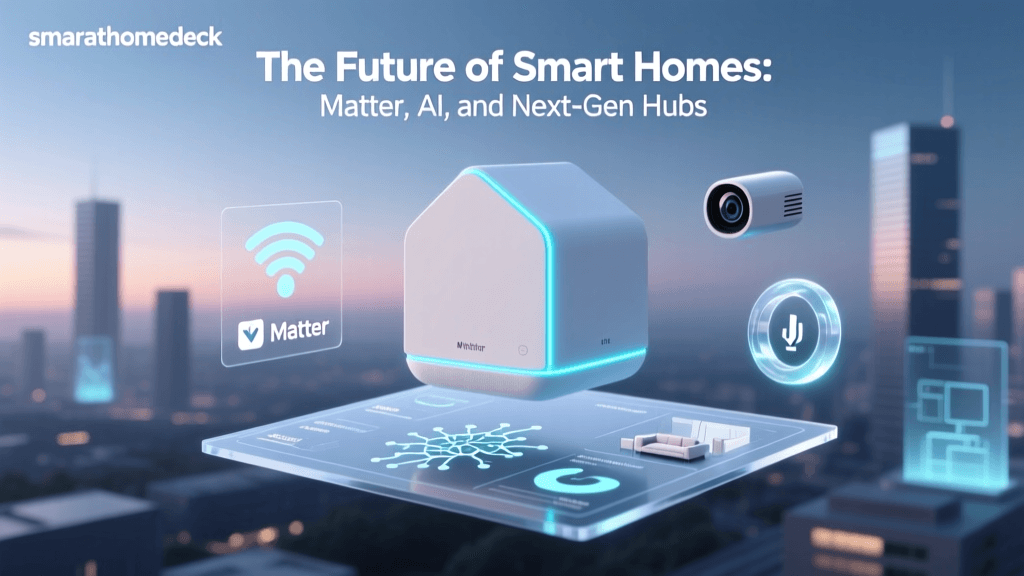
Edge AI cannot function optimally in a fragmented ecosystem. For a predictive hub to make intelligent decisions, it requires real-time, low-latency data from every sensor in the home. This is where the Matter protocol and Thread networking standard become critical market drivers.
Thread is an IP-based, low-power mesh networking protocol that allows devices to communicate with one another without congesting your primary Wi-Fi network. Unlike Zigbee or Z-Wave, Thread creates a self-healing mesh where every mains-powered device acts as a router, ensuring that a motion sensor in the farthest corner of your basement can communicate with your Edge AI hub in milliseconds.
Matter, built on top of Thread and Wi-Fi, provides the unified language that allows devices from different manufacturers to share data locally. With the rollout of Matter 1.2 and the upcoming 1.3 specifications, the protocol now supports complex device categories like robot vacuums, water management systems, and EV chargers. This unified local communication is the bedrock upon which predictive Edge AI models are trained and executed.
Projected Market Shift: Edge AI vs Cloud Processing in Smart Homes
Energy Management and Grid Interaction
One of the most lucrative applications of predictive smart home technology is advanced energy management. As utility companies increasingly adopt Time-of-Use (TOU) pricing and dynamic grid loads, the smart home is evolving into a micro-grid participant. The U.S. Department of Energy highlights that smart home technologies are pivotal in reducing residential energy consumption and enabling demand-response programs.
Predictive Edge AI hubs can integrate with local utility APIs to forecast peak pricing windows. If the AI knows your historical hot water usage peaks at 6:00 PM, and the grid's peak pricing starts at 5:00 PM, it will instruct your smart water heater to super-heat the tank at 3:00 PM using cheaper, off-peak electricity. Similarly, smart panels like the SPAN electrical panel use local AI to prioritize circuits during a power outage or peak pricing event, automatically shedding non-essential loads (like the guest bedroom AC) while preserving critical infrastructure (like the refrigerator and medical equipment).
Actionable Advice: Future-Proofing Your Smart Home
If you are building or upgrading a smart home today, it is vital to invest in hardware that supports the transition to Edge AI and local predictive automation. Here is a strategic buyer's guide to future-proofing your ecosystem.
1. Invest in a Local Processing Hub
Do not rely solely on cloud-based voice assistants. Invest in a hub designed for local execution.
Top Pick: Home Assistant Green ($99). This plug-and-play local server allows you to run complex, predictive automations without sending data to the cloud. It natively supports Matter and Thread, acting as the central brain for your Edge AI routines.
Alternative: Apple TV 4K (3rd Generation, $129). With its powerful A15 Bionic chip, it acts as a formidable local HomeKit hub and a Thread Border Router, processing Siri commands and HomeKit Secure Video locally.
2. Prioritize Thread-Enabled Sensors
When buying motion, door, or environmental sensors, look for the Thread logo. Thread's low-latency mesh ensures your predictive automations trigger instantly.
Top Pick: Eve Motion Sensor ($49.95). Utilizing Thread, it communicates instantly with local hubs, enabling rapid, predictive lighting adjustments based on ambient light and presence.
3. Upgrade to Predictive Climate Control
Move beyond basic programmable thermostats to units that learn and adapt.
Top Pick: Ecobee Smart Thermostat Premium ($249). Featuring an eco+ algorithm, it learns your home's thermal profile and adjusts heating and cooling based on real-time weather data, occupancy, and utility rates, all while processing core logic locally to maintain function during internet outages.
4. Implement Local Smart Lighting Bridges
Wi-Fi bulbs clog your router and rely on the cloud. Opt for local mesh networks.
Top Pick: Philips Hue Bridge ($59.99) with Matter update. The Hue system processes lighting scenes, circadian rhythms, and motion-triggered automations locally on the bridge, ensuring zero latency and continued operation if your internet goes down.
Privacy and Security Implications
The shift toward Edge AI is largely driven by consumer demand for privacy. In a cloud-dependent model, your daily routines, voice recordings, and camera feeds are stored on corporate servers, making them vulnerable to data breaches and unauthorized monetization. Edge AI inherently solves this by keeping the data on the local network. When you utilize a local hub like Home Assistant or an Apple HomePod, the AI models that learn your wake-up times and occupancy patterns never leave your physical property. This 'privacy-by-design' architecture is becoming a major selling point for premium smart home devices, forcing legacy manufacturers to adapt or lose market share.
Conclusion
The smart home industry is maturing from a collection of novelty gadgets into a cohesive, intelligent infrastructure. The integration of Edge AI, the Thread mesh protocol, and the Matter standard is paving the way for homes that do not just respond to commands, but actively anticipate needs, optimize energy consumption, and protect user privacy. By understanding these market trends and strategically investing in local-processing hardware today, consumers can build resilient, future-proof ecosystems that will only grow more intelligent and valuable over time.