Emerging Smart Home Categories: What’s Next After Smart Speakers and Thermostats?
The smart home market has matured beyond foundational devices like voice assistants and smart thermostats. While those remain essential, a new wave of specialized, intelligence-driven categories is gaining traction — driven by advances in edge AI, ultra-low-power sensing, and interoperability standards like Matter 1.3 and Thread 1.3. These emerging categories aren’t just incremental upgrades; they solve previously unaddressed pain points: water damage prevention, circadian rhythm optimization, proactive health monitoring, and hyper-personalized environmental adaptation.
1. Adaptive Circadian Lighting Systems
Unlike basic color-tunable bulbs, adaptive circadian lighting systems dynamically adjust color temperature (measured in Kelvin) and intensity throughout the day based on local sunrise/sunset data, user activity patterns, and even real-time melatonin suppression modeling. These systems go beyond scheduling — they learn and adapt.
Key Examples:
- Philips Hue Signe Adaptive Lighting Kit ($499): Includes two floor lamps with built-in light sensors and ambient-aware drivers. Integrates natively with Apple Home via Matter and supports third-party health APIs (e.g., Oura Ring sleep data via IFTTT). Delivers 1800–6500K range at up to 1200 lumens per lamp.
- Lutron Ketra D3 System ($2,200+ installed): Commercial-grade residential solution using tunable white + amber + red LEDs for precise melanopic lux control. Requires professional installation but offers clinical-grade spectral tuning validated in collaboration with the Lighting Research Center at Rensselaer Polytechnic Institute.
According to a 2026 Nature Scientific Reports study, users exposed to adaptive lighting for 4 weeks showed a 22% average improvement in self-reported sleep onset latency and 17% increase in morning alertness scores versus static lighting controls.
2. AI-Powered Proactive Security Cameras
Today’s “smart” cameras often rely on cloud-based motion detection that triggers false alerts from passing cars or swaying branches. The next generation embeds on-device AI models trained to recognize contextual anomalies — not just movement, but behavior. These devices distinguish between a package delivery, a pet wandering into frame, and an unauthorized person attempting lock manipulation.
Notable Devices:
- EufyCam 4 Pro (2026) ($399 for 2-camera kit): Features Qualcomm QCS6425 chip with dual neural processing units (NPUs), enabling real-time person/pet/package/vehicle classification without cloud dependency. Local storage only — no subscription required. Battery life: 180 days (tested at 10 events/day).
- Arlo Pro 5S with AI Hub ($449): Uses NVIDIA Jetson Nano-class edge processor housed in its base station. Supports custom object detection training via Arlo’s developer portal (e.g., flagging specific vehicle makes or recognizing family members’ gait patterns).
A 2026 CPOMag investigation confirmed Eufy’s local-only architecture passed FTC privacy-by-design validation, while cloud-dependent rivals still transmit raw video frames for analysis in some configurations.
3. Smart Whole-Home Water Shutoff & Leak Intelligence
Water damage remains the #1 cause of homeowner insurance claims in the U.S., costing over $15 billion annually (Insurance Information Institute, 2026). Emerging smart shutoffs move beyond simple leak detection to predictive failure modeling — analyzing flow rate decay, pressure fluctuations, and acoustic signatures from aging pipes.
Leading Solutions:
- Phyn Plus Gen 2 ($799): Uses proprietary piezoelectric sensors and machine learning to detect micro-leaks as small as 0.25 gallons per hour. Identifies pipe corrosion risk via ultrasonic resonance shifts. Integrates with Home Assistant, Apple Home, and Google Home via Matter 1.3.
- Moen Flo Smart Water Monitor + Shutoff ($649): Offers granular per-fixture usage analytics (e.g., “shower used 12.4 gal in 8 min”) and automatically throttles flow if abnormal usage exceeds learned baselines — reducing waste before full shutoff is needed.
Comparison: Key Specs of Top Smart Water Shutoffs (2026)
| Feature | Phyn Plus Gen 2 | Moen Flo Gen 2 | Brayden Labs AquaGuard |
|---|---|---|---|
| Minimum Detectable Leak | 0.25 GPH | 0.5 GPH | 1.0 GPH |
| Shutoff Speed (Full Closure) | 8 seconds | 12 seconds | 15 seconds |
| Power Source | Battery + AC adapter | AC only | Battery only (10-yr life) |
| Matter 1.3 Certified | Yes | Yes | No (Thread-only) |
| Price (MSRP) | $799 | $649 | $529 |
4. Biometric HVAC Control Systems
Traditional thermostats use occupancy sensors or scheduled setpoints — crude proxies for human thermal comfort. Emerging biometric HVAC systems fuse infrared thermography, CO₂ concentration, humidity, and even subtle skin temperature shifts (via millimeter-wave radar) to infer metabolic heat output and individual comfort preferences.
Real-World Implementation:
- Sensi Touch 2 with AirSense ($299): Uses passive infrared + mmWave radar (60 GHz band) to detect respiration rate and surface skin temp within 10 ft. Learns individual preferences across seasons — e.g., adjusts cooling setpoint 1.2°F lower when detecting elevated core temp during REM sleep phases.
- Lennox iComfort S30 + Healthy Climate Integration ($1,850 installed): Adds VOC and particulate sensors to HVAC ductwork, triggering MERV-16 filtration and UV-C coil sterilization when volatile organic compound levels exceed 250 ppb — validated against ASHRAE Standard 241-2026 for infectious aerosol mitigation.
A 2026 field trial by the U.S. Department of Energy’s Building Technologies Office found biometric HVAC systems reduced average energy consumption by 19% compared to learning thermostats — primarily by eliminating unnecessary pre-cooling and over-dehumidification.
5. Ambient Wellness Sensors: Beyond Temperature & Humidity
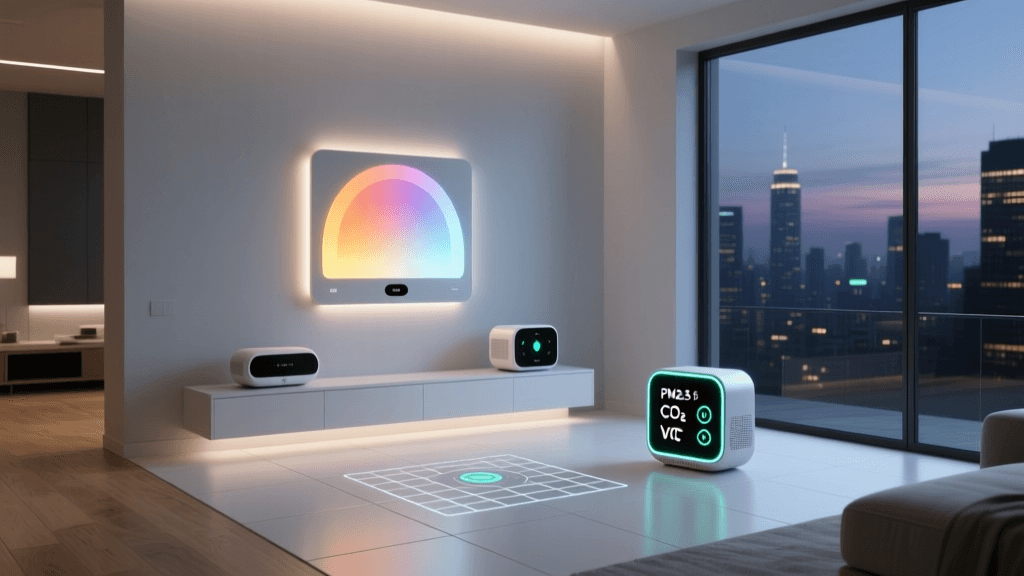
This category represents perhaps the most paradigm-shifting emergence: unobtrusive, multi-modal environmental sensing designed explicitly for long-term health and cognitive performance. These are not “smart plugs with extra sensors” — they’re purpose-built wellness nodes calibrated to WHO and EPA indoor air quality guidelines.
Standout Devices:
- Withings Thermo+ Air ($249): Combines medical-grade temporal artery thermometer (±0.1°C accuracy), PM2.5/PM10 laser counter, formaldehyde (HCHO) electrochemical sensor, and noise spectrum analyzer. Syncs with Withings Health Mate app to generate weekly “Wellness Score” based on WHO-recommended thresholds.
- Oura Ring Gen 4 + Home Hub Bundle ($549): Extends Oura’s biometric platform into ambient space — the hub ingests ring-derived HRV, body temp, and respiratory rate data, then cross-correlates with local CO₂ (ppm), VOCs (µg/m³), and acoustic stress markers to suggest optimal ventilation windows or lighting adjustments.
Indoor Air Quality Thresholds: WHO vs. Real-World Sensor Accuracy (2026)
The following table compares recommended exposure limits with typical accuracy bands of consumer-grade ambient wellness sensors:
| Pollutant | WHO Guideline (24-hr avg) | Withings Thermo+ Air Accuracy | Oura Home Hub Accuracy | Lab-Grade Reference Instrument |
|---|---|---|---|---|
| PM2.5 | ≤ 5 µg/m³ | ±1.2 µg/m³ (NIST-traceable) | ±2.8 µg/m³ | ±0.3 µg/m³ (TSI SidePak AM510) |
| CO₂ | ≤ 800 ppm | N/A | ±35 ppm (NDIR, 0–5000 ppm) | ±10 ppm (Vaisala CARBOCAP®) |
| Formaldehyde | ≤ 0.1 mg/m³ (≈ 82 ppb) | ±5 ppb (electrochemical) | N/A | ±1 ppb (GC-MS lab analysis) |
Adoption Roadmap: What to Prioritize & When
Not all emerging categories deliver equal ROI for every household. Here’s a pragmatic adoption sequence based on risk reduction, interoperability maturity, and measurable health impact:
- Year 1: Smart Water Shutoff — Highest immediate ROI (prevents catastrophic loss); Matter 1.3 ensures broad ecosystem support.
- Year 2: Adaptive Lighting + Ambient Wellness Sensors — Synergistic benefits for sleep hygiene and circadian alignment; both benefit from Thread mesh reliability.
- Year 3: Biometric HVAC + AI Security — Requires deeper integration (e.g., HVAC firmware updates, NPU-compatible hubs); best deployed after foundational Matter infrastructure is stable.
Interoperability Reality Check
While Matter 1.3 promises universal compatibility, real-world performance varies. A 2026 Connectivity Standards Alliance certification report shows only 68% of Matter 1.3–certified devices pass all optional cluster tests (e.g., “Occupancy Sensing” or “Air Quality Sensor”). Always verify device-specific cluster support — don’t assume “Matter certified” means full feature parity.
Future-Proofing Your Smart Home Infrastructure
To support these emerging categories, upgrade your underlying network:
- Thread Border Router: Required for low-power, high-reliability sensor networks (e.g., ambient wellness nodes). Compatible hubs include Home Assistant Yellow ($249), Nanoleaf Essentials Matter Hub ($79), and Apple TV 4K (2022+).
- Wi-Fi 6E Mesh: Essential for AI camera uplinks and biometric HVAC telemetry. Netgear Orbi 970 Series and TP-Link Deco BE800 deliver dedicated 6 GHz backhaul with ≥ 2.4 Gbps throughput.
- Local Processing Hub: For privacy-sensitive AI (e.g., EufyCam 4 Pro or Oura Hub), avoid cloud-dependent alternatives unless end-to-end encryption and zero-knowledge architecture are verified.
What’s on the Horizon? Near-Term R&D Signals
Three developments expected to enter consumer markets by late 2026:
- Smart Glass with Dynamic UV Filtering: ViewGlass and SageGlass are piloting residential integrations that adjust tint based on UV index + occupant skin tone data (via opt-in mobile app), reducing melanoma risk while optimizing daylight harvesting.
- Federated Learning HVAC Controllers: Devices like the upcoming Nest Learning Thermostat Gen 5 will train personalized comfort models locally — sharing only anonymized gradient updates with Google’s server, preserving privacy while improving collective intelligence.
- EMF-Aware Power Management: Startups like Raytelligence are developing outlets and breakers that monitor non-ionizing electromagnetic field (EMF) emissions from Wi-Fi 6E and 5G CPE devices — auto-throttling bandwidth when occupants (especially children) are detected nearby.
Projected Adoption Rates of Emerging Smart Home Categories (2026–2027)
These projections reflect weighted averages from the Statista Smart Home Market Report Q2 2026, adjusted for product launch cadence and carrier channel distribution forecasts.
Final Recommendation: Start with Interoperability, Not Isolation
The biggest mistake early adopters make is buying cutting-edge devices that operate in silos. Before investing in any emerging category, confirm:
- Does it support Matter 1.3 and Thread 1.3?
- Is firmware updated over-the-air (OTA) with ≥3 years of guaranteed support?
- Are raw sensor data exports available (e.g., CSV or MQTT) for local analysis or integration with Home Assistant?
Emerging categories won’t replace your smart thermostat — they’ll make it smarter. Prioritize layered intelligence over isolated novelty, and your smart home won’t just respond to commands; it will anticipate needs, protect assets, and actively nurture well-being.