The Paradigm Shift: From Cloud Silos to Unified Local Intelligence
For the past decade, the smart home industry has been defined by fragmentation. Consumers were forced to choose between competing ecosystems—Apple HomeKit, Amazon Alexa, Google Home, and Samsung SmartThings—resulting in a disjointed experience where devices from different manufacturers refused to communicate without complex third-party workarounds. Furthermore, the heavy reliance on cloud processing introduced latency, privacy vulnerabilities, and the constant threat of servers being shut down, turning expensive hardware into useless plastic.
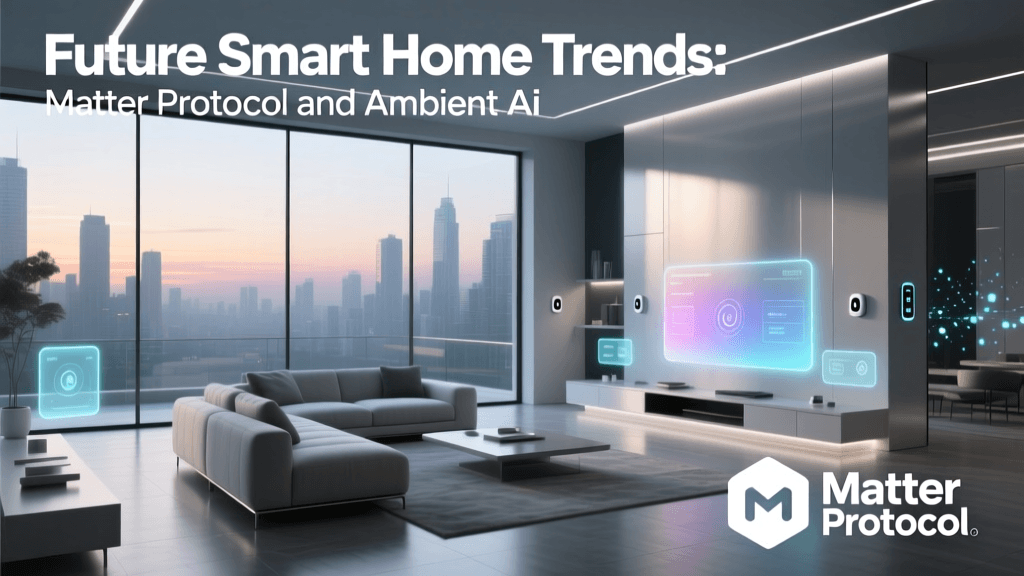
Today, we are standing at the precipice of a massive architectural shift in the smart home market. The convergence of the Matter protocol, developed by the Connectivity Standards Alliance (CSA), and the rapid advancement of AI Edge Computing is fundamentally rewriting the rules of home automation. This transition moves the 'brain' of the smart home from distant, centralized cloud servers back into the home itself, prioritizing local processing, instantaneous response times, and absolute data sovereignty. For consumers and market analysts alike, understanding this shift is critical to making informed purchasing decisions and future-proofing residential technology investments.
The Matter Protocol: Engineering True Interoperability
Matter is not a wireless protocol like Wi-Fi or Bluetooth; rather, it is an application layer that sits on top of existing networking technologies, primarily Wi-Fi, Ethernet, and Thread. Its primary objective is to provide a unified, secure, and reliable communication standard that allows devices to work seamlessly across all major smart home platforms. When a device is 'Matter-certified,' it guarantees out-of-the-box compatibility with Apple, Amazon, Google, and Samsung ecosystems simultaneously.
From a market analysis perspective, Matter is driving a significant consolidation in the hardware manufacturing sector. Brands no longer need to produce separate SKUs for different ecosystems, reducing supply chain complexity and lowering retail costs. For the consumer, this means an end to the 'walled garden' trap. You can purchase a Nanoleaf smart bulb, control it via Apple HomePod, trigger it with an Amazon Echo voice command, and monitor its energy usage on a Samsung SmartThings dashboard—all concurrently.
Thread vs. Wi-Fi: The Networking Backbone of Matter
While Matter can operate over Wi-Fi, the industry is heavily favoring Thread for low-power devices like sensors, smart locks, and lighting. Thread is an IPv6-based, low-power mesh networking protocol (IEEE 802.15.4) that allows devices to relay signals to one another, eliminating the single point of failure inherent in traditional hub-and-spoke Zigbee or Z-Wave networks.
| Feature | Matter over Thread | Matter over Wi-Fi | Legacy Zigbee/Z-Wave |
|---|---|---|---|
| Power Consumption | Ultra-Low (Battery operated) | High (Mains powered) | Low (Battery operated) |
| Network Topology | Self-healing Mesh | Star (Router dependent) | Mesh (Hub dependent) |
| IP Addressing | Native IPv6 | Native IPv4/IPv6 | Proprietary/Translated |
| Ecosystem Lock-in | None (Multi-Admin) | None (Multi-Admin) | High (Hub specific) |
To build a robust Thread network, you need Thread Border Routers. These devices bridge the Thread mesh network to your home's Wi-Fi/Ethernet. Excellent market options include the Apple TV 4K (3rd Gen, Wi-Fi + Ethernet) priced around $129, and the Amazon Echo (4th Gen) at $99. Both act as native Matter controllers and Thread Border Routers, providing an immediate foundation for a next-generation smart home.
AI Edge Computing: Bringing the Brain Inside Your Home
While Matter solves the communication problem, AI Edge Computing solves the intelligence and privacy problem. Historically, when you issued a voice command or triggered a complex automation, the audio or data was sent to a cloud server, processed by an AI model, and the result was sent back. This round-trip introduces 200ms to 500ms of latency, requires an active internet connection, and sends intimate household data to corporate servers.
Edge AI flips this model by running machine learning algorithms locally on hardware situated inside your home. Modern smart home hubs are increasingly being equipped with Neural Processing Units (NPUs) capable of executing complex AI tasks—such as natural language processing, facial recognition, and predictive behavioral automation—without a single byte of data leaving your local network.
The Rise of Local Voice Assistants and Predictive AI
The open-source community, spearheaded by the Home Assistant project, has proven that local AI is not just viable, but superior in many metrics. Using local AI models like Whisper (for speech-to-text) and Piper (for text-to-speech), homeowners can achieve voice control latency of under 15 milliseconds. Furthermore, edge AI enables predictive automation. Instead of simple 'if-this-then-that' rules, local AI models analyze historical sensor data (temperature, occupancy, ambient light) to predict your needs, adjusting HVAC systems and lighting proactively while optimizing energy consumption.
Market Analysis: The Economics of Local Processing
The smart home market is currently undergoing a bifurcation. On one side, mass-market consumers continue to rely on subsidized, cloud-dependent hardware (like basic Echo Dots or Nest Minis) where the manufacturer monetizes user data and ecosystem lock-in. On the other side, a rapidly growing segment of 'prosumers' and privacy-conscious consumers are investing in premium, local-first hardware.
Industry projections indicate a massive shift in processing workloads from the cloud to the edge over the next five years, driven by the rising costs of cloud compute and increasing consumer demand for privacy.
Cost Comparison: Cloud Subscriptions vs. Edge Hardware
One of the primary market drivers for Edge AI is the long-term economic advantage. Cloud-based smart home features are increasingly being gated behind monthly subscriptions (e.g., Ring Home, Nest Aware, Arlo Secure), which can cost between $5 and $20 per month per camera or hub. Conversely, a one-time investment in local edge hardware eliminates these recurring fees.
| Setup Type | Initial Hardware Cost | Annual Software/Cloud Fees | 5-Year Total Cost of Ownership | Data Privacy |
|---|---|---|---|---|
| Cloud-Dependent Ecosystem | $250 (Hubs + Cameras) | $180 (Avg. Subscriptions) | $1,150 | Low (Data on corporate servers) |
| Local Edge AI Server | $350 (Mini PC + Local Storage) | $0 | $350 | High (Data stays on LAN) |
Hardware like the Beelink S12 Pro Mini PC (featuring an Intel N100 processor, 16GB RAM, and 500GB SSD) retails for approximately $160 to $180. When paired with a $99 Home Assistant Green server or run via Docker containers, it provides enterprise-grade local AI processing, local network video recording (NVR) via Frigate, and complete automation control without a single monthly fee.
Privacy and Security: The Ultimate Edge Advantage
As smart homes integrate more invasive sensors—such as indoor cameras, sleep-tracking mattresses, and always-on microphones—privacy has become the paramount concern for modern consumers. The National Institute of Standards and Technology (NIST) has repeatedly highlighted the vulnerabilities inherent in IoT devices that rely on continuous cloud connectivity, noting that every open port and cloud API represents a potential attack vector for malicious actors.
Edge computing inherently mitigates these risks through network segmentation. By utilizing a local AI hub, you can place all your IoT devices on an isolated Virtual Local Area Network (VLAN) that has no direct access to the wider internet. The local hub acts as a secure gateway, fetching only necessary, anonymized updates while keeping your camera feeds, voice logs, and occupancy data strictly within the physical confines of your home. This 'air-gapped' approach to smart home management is rapidly becoming the gold standard for cybersecurity in residential architecture.
Actionable Roadmap: Future-Proofing Your Smart Home Today
Transitioning to a Matter-compatible, Edge-AI-powered smart home does not require tearing out your existing walls or replacing every device overnight. Here is a strategic, phased roadmap to upgrade your home's infrastructure:
Step 1: Audit and Establish a Thread Border Network
Before buying new Matter devices, ensure your network can support them. Purchase at least two Thread Border Routers to create a resilient mesh. If you are in the Apple ecosystem, the Apple TV 4K (Ethernet model, $129) is the most stable option. For mixed or Amazon-heavy homes, the Amazon Echo (4th Gen, $99) or Eero 6 Mesh Routers provide excellent Thread and Matter bridging capabilities. Place these routers in central, elevated locations to maximize 2.4 GHz IEEE 802.15.4 signal propagation.
Step 2: Migrate to a Local Control Hub
Move away from cloud-dependent hubs. Invest in a dedicated local server. The Home Assistant Green ($99) is a plug-and-play local hub designed specifically for beginners wanting local control. For advanced users willing to tinker with Docker and AI models, an Intel N100 Mini PC ($160) running Proxmox allows you to host Home Assistant, local voice pipelines, and local media servers simultaneously.
Step 3: Prioritize Matter-Certified Replacements
As your older Zigbee or Wi-Fi devices fail or become obsolete, replace them exclusively with Matter-over-Thread certified products. Look for the official Matter QR code on packaging. Brands like Aqara, Nanoleaf, and Eve Systems are currently leading the market in producing high-quality, Thread-native Matter devices. For example, the Eve MotionBlinds or Aqara Door and Window Sensor P2 connect directly to your Thread mesh, offering instant response times and zero cloud reliance.
Step 4: Implement Local AI Voice and Vision
For voice control, explore local wake-word engines and AI pipelines. Projects like Willow or Home Assistant's built-in Year of the Voice initiative allow you to use ESP32-based microphones ($15-$25 each) scattered around the house, processing all audio locally on your N100 Mini PC. For security cameras, switch to RTSP-compatible cameras (like Amcrest or Reolink) and process the video feeds locally using Frigate NVR, which utilizes AI object detection to distinguish between humans, pets, and vehicles without sending video to the cloud.
Conclusion
The era of the fragmented, cloud-dependent smart home is drawing to a close. The synergistic combination of the Matter protocol and AI Edge Computing represents the most significant leap forward in residential technology since the introduction of the smartphone. Matter provides the universal language that allows devices to collaborate seamlessly, while Edge AI provides the local intelligence required to make those collaborations instantaneous, predictive, and profoundly private.
For consumers, the market message is clear: stop investing in proprietary, cloud-locked ecosystems that treat your data as a commodity. By strategically investing in Thread border routers, local processing hubs, and Matter-certified end-devices, you are not just buying smart gadgets; you are building a resilient, future-proof digital infrastructure that respects your privacy, eliminates recurring subscriptions, and operates at the speed of thought. The future of the smart home is not in the cloud—it is right inside your living room.