What Is the Thread Smart Home Protocol? A Complete Technical Guide
The smart home landscape has undergone a massive transformation, shifting from fragmented, proprietary ecosystems to unified, interoperable networks. At the very heart of this revolution is the Thread smart home protocol. Designed to address the limitations of traditional wireless standards, Thread provides a robust, low-power, and highly reliable foundation for modern connected devices. Whether you are setting up your first smart bulb or architecting a fully automated estate, understanding Thread is essential for building a future-proof smart home.
Developed and maintained by the Thread Group—an alliance of major tech giants including Apple, Google, Amazon, and Samsung—Thread is not just another wireless radio standard. It is an IP-based, low-power, wireless mesh networking protocol built specifically for the Internet of Things (IoT). In this comprehensive guide, we will explore the technical mechanics of Thread, how it compares to legacy protocols, its critical relationship with the Matter protocol, and the best devices to integrate into your Thread network.
How the Thread Protocol Works
To understand why Thread is so revolutionary, we must look at its underlying architecture. Thread is built on top of the IEEE 802.15.4 physical and MAC (Media Access Control) layer. This is the same foundational radio frequency layer used by Zigbee. However, while Zigbee builds a proprietary application layer on top of 802.15.4, Thread takes a completely different approach by utilizing standard Internet Protocol (IP).
IPv6 and 6LoWPAN
Thread natively supports IPv6, the latest version of the Internet Protocol that provides a virtually unlimited number of IP addresses. Because standard IPv6 packets are too large for low-power, low-bandwidth IoT radios, Thread utilizes 6LoWPAN (IPv6 over Low-Power Wireless Personal Area Networks). This technology compresses IPv6 headers so they can be efficiently transmitted over the 802.15.4 radio layer. As a result, every single Thread device gets its own unique, globally routable IP address, allowing it to communicate seamlessly with local networks and the broader internet without the need for complex translation bridges.
Mesh Topology and Node Types
Thread operates on a mesh network topology, meaning devices can communicate with one another to pass data across the network, rather than relying solely on a central hub. This creates a highly resilient web of connections. The network consists of several specific node types:
- Leader: The device responsible for managing the network, assigning router IDs, and preventing routing loops. If the Leader drops offline, the network automatically elects a new Leader, ensuring zero downtime.
- Router: Always-on devices (like smart plugs or wired lighting) that route traffic between other nodes and the Border Router. They form the backbone of the mesh.
- Router-Eligible End Device (REED): Devices that have the capability to become a Router if the network requires more routing capacity, but currently operate as end nodes to save power or bandwidth.
- Sleepy End Device (SED): Battery-powered devices (like motion sensors or door contacts) that spend most of their time in a deep sleep state to conserve energy. They only wake up to send data or poll their parent Router for messages.
The Role of the Thread Border Router
A Thread Border Router is the crucial bridge between the Thread mesh network and your home's primary Wi-Fi or Ethernet network. It routes traffic between local Thread devices and the internet, while also facilitating secure commissioning. Unlike proprietary hubs that lock you into a single brand, Thread Border Routers are increasingly being built directly into mainstream smart home hardware. Devices like the Apple HomePod Mini, Amazon Echo (4th Gen), and Google Nest Hub act as Border Routers, meaning you likely already own the hardware required to run a Thread network. For dedicated setups, exploring the best Thread border routers can help optimize your network layout.
Thread vs. Zigbee vs. Z-Wave vs. Wi-Fi
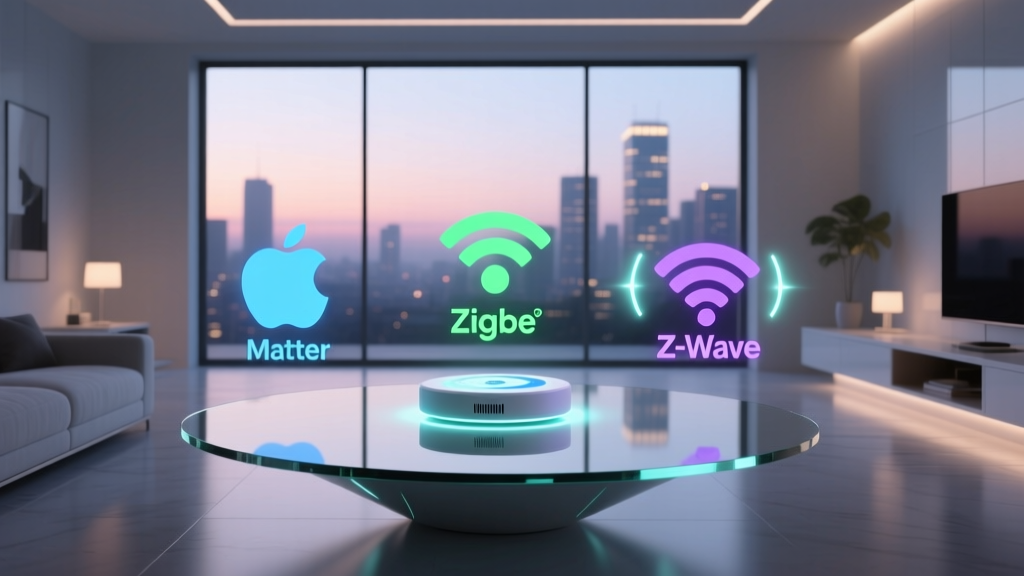
When designing a smart home, choosing the right communication protocol is critical. Thread is often compared to legacy mesh protocols like Zigbee and Z-Wave, as well as standard Wi-Fi. Below is a visualization of how these protocols stack up against one another across key performance metrics.
Power Consumption: Thread and Zigbee are highly optimized for battery-powered devices, allowing sensors to run for years on a single coin cell battery. Z-Wave is also highly efficient. Wi-Fi, conversely, is notoriously power-hungry and generally unsuitable for battery-operated sensors.
Range and Topology: Thread, Zigbee, and Z-Wave all utilize mesh networking to extend range. However, Thread's IP-based routing often results in more efficient pathfinding. Wi-Fi relies on a star topology centered around a single access point, which can lead to dead zones in larger homes.
Mesh Reliability: Thread's self-healing capabilities and dynamic Leader election make it incredibly robust. While Zigbee and Z-Wave also feature self-healing meshes, Thread's foundation on standard IP protocols reduces the latency and bottlenecking often seen when translating data through proprietary hubs.
IP Compatibility: This is Thread's greatest advantage. Because Thread is natively IP-based, it integrates seamlessly with modern networking infrastructure, cloud services, and the Matter application layer without requiring a protocol-translation hub.
Compatibility and the Matter Connection
It is impossible to discuss Thread without addressing its intrinsic relationship with the Matter protocol. A common misconception is that Thread and Matter are competing standards. In reality, they are complementary layers of the same smart home stack.
Think of Thread as the highway system, and Matter as the language spoken by the drivers on that highway. Thread operates at the network and transport layers (Layers 1 through 3 of the OSI model), handling the physical transmission of data, IP addressing, and routing. Matter operates at the application layer (Layer 7), defining how devices interpret commands, report status, and interact with ecosystems like Apple Home, Google Home, and Amazon Alexa.
Matter requires an IP-based network to function. While Matter can run over Wi-Fi, Wi-Fi is too power-intensive for small sensors and locks. Thread provides the perfect low-power, mesh-networked IP transport layer for Matter. When you buy a "Matter over Thread" device, you are getting the universal compatibility of Matter combined with the low-power, high-reliability mesh networking of Thread.
Furthermore, Thread is ecosystem-agnostic. A Thread network created by an Apple HomePod can seamlessly be joined by devices commissioned via a Google Nest Hub or an Amazon Echo. The Thread Group ensures that all certified Border Routers interoperate, breaking down the walled gardens that historically plagued the smart home industry.
Performance, Range, and Reliability
The true test of any smart home protocol is how it performs in a real-world environment filled with interference, physical obstacles, and dozens of connected devices. Thread excels in performance due to several key architectural decisions.
Self-Healing Mesh Networks
In a traditional Wi-Fi setup, if your router goes down, your entire smart home goes offline. In a Thread mesh, there is no single point of failure. If a Thread Router (like a smart plug) is unplugged, the network instantly recalculates the most efficient path for data to travel, routing around the dead node. If the network Leader fails, a REED automatically promotes itself to take over management duties in milliseconds. This self-healing capability ensures that your smart sensors and security devices remain online even if individual nodes experience hardware failures or power outages.
Low Latency and High Responsiveness
Because Thread utilizes IPv6 natively, data packets do not need to be unpacked, translated, and repacked by a proprietary hub before reaching their destination. This direct IP routing drastically reduces latency. When you flip a smart switch or trigger an automation, the response time on a Thread network is often measured in single-digit milliseconds, providing a tactile, instantaneous feel that rivals traditional wired switches.
Avoiding Wi-Fi Congestion
Modern homes are saturated with Wi-Fi devices—laptops, smartphones, streaming boxes, and cameras—all fighting for bandwidth on the 2.4GHz and 5GHz spectrums. Thread operates on the 2.4GHz spectrum but uses the IEEE 802.15.4 standard, which occupies different channels and utilizes a much narrower bandwidth footprint. This means your Thread mesh will not congest your home Wi-Fi network, and conversely, your heavy Wi-Fi downloads will not cause your Thread-based smart lights to lag or drop connections.
Security Features of Thread
Security is a paramount concern for any connected home, especially when dealing with smart home security devices like door locks and cameras. Thread was designed from the ground up with enterprise-grade security baked into the protocol level.
Network-Wide Encryption
Every packet of data transmitted across a Thread network is encrypted using AES-128 (Advanced Encryption Standard) at the MAC layer. This means that even if a bad actor intercepts the radio waves, the data is entirely unreadable. Furthermore, Thread utilizes secure network keys that are distributed only to authenticated devices.
Secure Commissioning
Adding a new device to a Thread network (commissioning) is handled via DTLS (Datagram Transport Layer Security). When you scan a QR code or use NFC to add a Thread device to your home, the Border Router and the new device perform a secure cryptographic handshake. This prevents unauthorized devices from sneaking onto your mesh network and ensures that the network keys are transferred securely.
No Centralized Hub Vulnerability
Legacy smart home systems rely on a central hub that holds the keys to the entire network. If that hub is compromised, the attacker gains control of every connected device. Because Thread is a distributed mesh with IP-based routing, there is no single central brain to hack. Security is distributed across the network, and application-layer security (handled by Matter) ensures that even if a node is compromised, the attacker cannot easily pivot to control other devices in your home.
Best Thread-Enabled Devices and Ecosystems
As Thread adoption accelerates, an increasing number of manufacturers are releasing Thread-native hardware. When shopping for devices, look for the official Thread logo or the "Matter over Thread" designation. Here are the primary categories and top ecosystems leading the Thread charge.
Smart Lighting
Lighting is one of the most common use cases for Thread. Brands like Nanoleaf (with their Essentials line) and Eve Systems offer Thread-enabled bulbs, light strips, and switches. Because Thread handles mesh routing so efficiently, adding dozens of Thread light bulbs to your home actually strengthens the network rather than bogging it down, as each wired bulb acts as a Router.
Sensors and Climate Control
Battery-powered devices benefit immensely from Thread's Sleepy End Device (SED) architecture. Companies like Aqara, Eve, and Third Reality produce Thread-based motion sensors, door/window contacts, and temperature/humidity monitors. These devices can run for years on standard batteries while maintaining instantaneous communication with your smart home hub.
Smart Plugs and Energy Monitoring
Smart plugs are the unsung heroes of a Thread network. Because they are wired into your wall outlets, they act as permanent Thread Routers, extending the mesh to the far corners of your home. The Eve Energy plug is a premier example, offering not only network extension but also precise energy monitoring capabilities via the Thread protocol.
Smart Locks and Security
Security devices require both low power consumption and high reliability. The Yale Assure Lock 2 and Schlage Encode Plus utilize Thread to ensure that lock and unlock commands are executed instantly, even if your home Wi-Fi is experiencing heavy traffic. For more hardwired automation, exploring the best smart plugs and switches can help you build a rock-solid Thread backbone.
Frequently Asked Questions
Does Thread require a hub?
Thread does not require a traditional, proprietary smart home hub. However, it does require a Thread Border Router to connect the Thread mesh to your home's Wi-Fi network and the internet. Fortunately, many modern smart speakers and displays—such as the Apple HomePod Mini, Apple TV 4K, Google Nest Hub (2nd Gen), Nest Wifi Pro, and Amazon Echo (4th Gen)—have Thread Border Routers built directly into them. If you own one of these devices, you already have the "hub" required to run a Thread network.
Is Thread better than Wi-Fi for smart home devices?
For high-bandwidth devices like security cameras, smart displays, and laptops, Wi-Fi is absolutely necessary. However, for low-bandwidth IoT devices like smart bulbs, motion sensors, and smart locks, Thread is vastly superior. Thread consumes a fraction of the power required by Wi-Fi, supports mesh networking to eliminate dead zones, and prevents your home's primary Wi-Fi router from becoming overwhelmed by dozens of low-level device connections.
Can Thread devices communicate with Zigbee devices?
Thread and Zigbee operate on the same physical radio frequency (IEEE 802.15.4) and can physically coexist on the same radio chip, but they speak completely different network languages. A Thread device cannot natively talk to a Zigbee device. However, if both ecosystems are integrated into a unified smart home platform (like Apple Home, Google Home, or Home Assistant) via their respective Border Routers and hubs, the software platform can bridge the two, allowing a Thread motion sensor to trigger a Zigbee smart bulb through software automations.
How do I know if my router supports Thread?
It is important to distinguish between your home's Wi-Fi router and a Thread Border Router. Your standard Wi-Fi router (from your ISP or a mesh Wi-Fi system like Eero or Orbi) does not need to "support" Thread natively; it just needs to provide internet access to your Thread Border Router. To check if you have a Thread Border Router, consult the specifications of your smart speakers, smart displays, or mesh Wi-Fi nodes. Some advanced mesh Wi-Fi systems, like the Eero 6+ and Nest Wifi Pro, have Thread Border Routers built directly into the Wi-Fi access points themselves.
Will Thread drain the battery on my smart sensors?
No. Thread is specifically engineered for ultra-low power consumption. Through the use of Sleepy End Devices (SEDs), Thread sensors can put their radios into a deep sleep state, waking up only for milliseconds to transmit data or check for pending messages. It is common for Thread-based door sensors and motion detectors to operate for two to five years on a single standard coin cell or AA battery, matching or exceeding the battery life of legacy Zigbee and Z-Wave sensors.
Building a smart home on the Thread protocol ensures that your network is fast, secure, and ready for the future of interoperable IoT standards. By leveraging the power of IPv6 mesh networking and the universal compatibility of Matter, Thread eliminates the frustrations of fragmented ecosystems, providing a seamless and reliable automation experience.