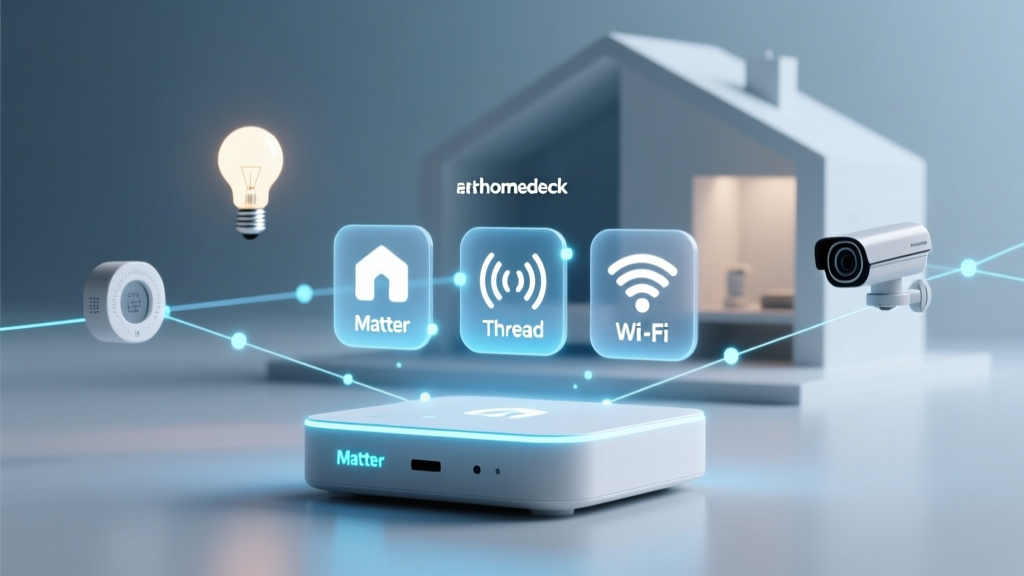
Navigating the Smart Home Protocol Landscape
Building a reliable smart home is no longer just about buying the flashiest gadgets; it is about understanding the invisible language your devices use to communicate. The smart home ecosystem is fragmented across several wireless protocols, each with distinct advantages regarding range, power consumption, bandwidth, and network topology. Whether you are deploying battery-powered sensors in a sprawling backyard or high-bandwidth smart displays in your living room, selecting the right protocol-specific hardware is paramount for a seamless automation experience.
In this curated guide, we break down the best-in-class devices for the four dominant smart home protocols: Matter, Zigbee, Z-Wave, and Thread. We evaluate these picks based on technical reliability, security frameworks, ecosystem compatibility, and real-world latency, ensuring your home automation network is built on a rock-solid foundation.
Matter: The Cross-Platform Unifier
Matter is not a wireless radio protocol itself; rather, it is an application layer that runs over existing transport protocols like Wi-Fi, Thread, and Ethernet. Backed by the Connectivity Standards Alliance, Matter aims to solve the interoperability crisis by allowing devices to work natively across Apple HomeKit, Amazon Alexa, Google Home, and Samsung SmartThings without relying on cloud-based middlemen.
Top Pick: Eve Energy Smart Plug (Matter over Thread)
The Eve Energy smart plug is a masterclass in modern smart home engineering. By utilizing Matter over Thread, it bypasses the congestion of your home's 2.4 GHz Wi-Fi network, relying instead on a low-power, self-healing mesh network.
- Technical Specs: 110-240V AC, 16A max load, integrated power metering (voltage, current, wattage).
- Security: Matter's Device Attestation Certificate (DAC) ensures hardware-level cryptographic verification.
- Cost Range: $39 - $49 per unit.
- Best Use Case: Monitoring energy consumption of high-draw appliances like space heaters or window AC units while maintaining local, instantaneous control via Apple Home or Amazon Alexa.
Top Pick: Nanoleaf Essentials A19 Bulb
Nanoleaf was among the first to adopt Thread and Matter natively. The Essentials A19 bulb delivers 1100 lumens of brightness and supports color temperatures from 2700K to 6500K, alongside 16 million colors.
- Technical Specs: E26 base, 11W power draw, Bluetooth fallback for initial provisioning.
- Network Behavior: Acts as a Thread end-device, routing signals through your Thread Border Router (like an Apple TV or Nest Hub) for zero-latency local control.
- Cost Range: $24 - $29 per bulb.
Zigbee: The High-Capacity Mesh Veteran
Operating on the IEEE 802.15.4 standard at 2.4 GHz, Zigbee is the veteran of smart home mesh networks. While it shares the same frequency band as Wi-Fi and Bluetooth, Zigbee's low data rate and channel-hopping capabilities allow it to coexist with minimal interference. A single Zigbee network can theoretically support up to 65,000 nodes, making it ideal for dense sensor deployments.
Top Pick: Philips Hue Bridge and Color Bulbs
Philips Hue utilizes a proprietary implementation of Zigbee Light Link (ZLL). While it requires the Hue Bridge, this closed-loop Zigbee network guarantees exceptional reliability and instant group-casting that Wi-Fi-based bulbs struggle to match.
- Technical Specs: Bridge supports up to 50 bulbs and 12 accessories. Bulbs output up to 1100 lumens with a CRI (Color Rendering Index) > 90.
- Latency: Group commands execute in under 100ms locally via the bridge.
- Cost Range: $60 for the Bridge, $50+ for White and Color Ambiance bulbs.
- Best Use Case: Whole-home ambient lighting scenes and motion-based automation where zero-latency synchronization across multiple bulbs is required.
Top Pick: Aqara Temperature and Humidity Sensor
Aqara's Zigbee sensors are renowned for their aggressive pricing, compact form factors, and exceptional battery life. The sensor samples environmental data every few seconds, pushing updates to the hub only when a configurable threshold is crossed.
- Technical Specs: CR2032 coin battery (2-year typical life), ±0.3°C accuracy, IP rating for indoor use.
- Compatibility: Works natively with Aqara hubs, Home Assistant (via Zigbee2MQTT), and Hubitat.
- Cost Range: $18 - $24.
Z-Wave: The Interference-Free Workhorse
Z-Wave operates in the sub-1 GHz spectrum (908.42 MHz in North America, 868.42 MHz in Europe). This is its superpower: because it avoids the crowded 2.4 GHz band, Z-Wave signals easily penetrate walls and floors without competing with your Wi-Fi router or Bluetooth speakers. According to the Z-Wave Alliance, the protocol mandates strict backward compatibility and mesh routing standards, ensuring devices from different manufacturers play nicely together.
Top Pick: Aeotec Smart Switch 7
Aeotec is a premium Z-Wave manufacturer, and the Smart Switch 7 (Z-Wave Plus V2) is widely considered the gold standard for smart plugs.
- Technical Specs: 15A / 1800W max load, built-in overload protection, real-time power reporting (accurate to within 1%).
- Security: Utilizes Z-Wave S2 Security with Elliptic Curve Diffie-Hellman key exchange, preventing brute-force and man-in-the-middle attacks.
- Range: Up to 100 meters (line of sight) with enhanced mesh repeating capabilities.
- Cost Range: $45 - $55.
Top Pick: Ring Alarm Security Kit (2nd Gen)
Ring's security ecosystem is built entirely on Z-Wave for its peripheral sensors (contact sensors, motion detectors, keypads), while the base station uses Wi-Fi for internet connectivity and LTE for cellular backup.
- Technical Specs: Base station includes a 24-hour backup battery and Z-Wave Plus controller.
- Reliability: Sub-GHz frequencies ensure that contact sensors on far-flung exterior doors report instantly without dropping packets due to Wi-Fi dead zones.
- Cost Range: $199 - $249 for a 5-piece kit.
Thread: The Low-Power Border Router Backbone
Thread is an IPv6-native, low-power mesh networking protocol built on the same IEEE 802.15.4 radio standard as Zigbee. However, unlike Zigbee, Thread does not dictate the application layer (that is Matter's job) and has no single point of failure. If one Thread router goes offline, the network dynamically reroutes traffic. The Thread Group emphasizes that Thread networks are self-healing and securely encrypted via AES-128.
Top Pick: Eve Motion Sensor
Eve's motion sensor is a Thread-native device that wakes up, detects motion, and transmits an IPv6 packet to your border router in milliseconds, all while sipping power from standard AA batteries.
- Technical Specs: 160-degree detection angle, adjustable sensitivity, IPX3 water resistance for covered outdoor use.
- Privacy: No cloud requirement; all data stays local via Thread/Matter.
- Cost Range: $39 - $49.
Top Pick: Google Nest Hub (2nd Gen) as Thread Border Router
While not an end-device sensor, the Nest Hub (2nd Gen) is an essential piece of Thread infrastructure. It acts as a Thread Border Router, bridging the low-power 802.15.4 mesh network to your home's Wi-Fi and Ethernet networks.
- Technical Specs: Integrated Thread radio, 7-inch smart display, Sleep Sensing radar.
- Network Role: Enables Matter-over-Thread devices to communicate with cloud services and local Wi-Fi devices seamlessly.
- Cost Range: $79 - $99.
Protocol Performance and Latency Comparison
When designing automations—especially those involving motion sensors triggering lights or security alarms—command latency is critical. Below is a visualization of average command latency across the top protocols based on local network conditions.
Pro Tip: While Wi-Fi offers the lowest raw latency for single-device commands, Wi-Fi networks degrade rapidly as you add dozens of IoT devices. Thread and Z-Wave maintain consistent latency even as network node density increases.
Protocol Specification Matrix
| Protocol | Frequency Band | Max Theoretical Nodes | Topology | Best Curated Pick |
|---|---|---|---|---|
| Matter (Thread) | 2.4 GHz (802.15.4) | Limitless (IPv6) | Mesh | Eve Energy Plug |
| Zigbee | 2.4 GHz (802.15.4) | 65,000+ | Mesh | Philips Hue System |
| Z-Wave Plus V2 | Sub-1 GHz (900 MHz) | 232 | Mesh | Aeotec Smart Switch 7 |
| Matter (Wi-Fi) | 2.4 / 5 GHz | Router Dependent | Star | Nanoleaf Essentials |
Security Frameworks Across Protocols
Security in the smart home extends beyond strong Wi-Fi passwords. Each protocol handles encryption differently:
- Matter: Uses blockchain-style distributed ledger technology for device attestation and mandates AES-128 encryption for all communications. Every Matter device must possess a unique, factory-installed certificate.
- Z-Wave S2: Requires user interaction (like pressing a button on the device or entering a PIN) during pairing to prevent spoofing, alongside robust AES-128 encryption.
- Thread: Secures the mesh network itself using AES-128 and requires a commissioning process (like scanning a QR code or using NFC) to introduce new nodes safely.
Final Verdict: Building a Multi-Protocol Home
The modern smart home is rarely a single-protocol environment. The most robust setups utilize a hybrid approach. Use Z-Wave for critical infrastructure like door locks, garage doors, and security sensors where wall penetration and Wi-Fi independence are vital. Deploy Zigbee for high-density, low-cost sensor networks and dedicated lighting systems like Philips Hue. Finally, embrace Matter over Thread for modern smart plugs, environmental sensors, and cross-platform accessories that benefit from IPv6 routing and local control.
By curating your devices based on their underlying protocols rather than just their brand names, you future-proof your home, eliminate cloud dependencies, and create an automation ecosystem that is as responsive as it is secure.