Introduction to Protocol-Specific Device Selection
Building a modern smart home is no longer just about buying a flashy gadget and connecting it to a proprietary app. As the ecosystem has matured, the underlying wireless protocols have become the most critical factor in determining the reliability, speed, and longevity of your automation setup. Choosing the right protocol—and the best devices that utilize them—is essential for creating a seamless, responsive, and future-proof environment.
Every wireless standard comes with distinct trade-offs regarding bandwidth, power consumption, range, and network topology. Wi-Fi offers immense bandwidth but strains your router and drains batteries quickly. Zigbee and Z-Wave excel at low-power mesh networking but require dedicated hubs. Meanwhile, the newly established Matter standard, built on Thread and Wi-Fi, promises universal interoperability and local control. According to the Connectivity Standards Alliance, Matter is designed to unify the fragmented smart home market by ensuring devices work securely across Apple Home, Amazon Alexa, Google Home, and Samsung SmartThings.
In this comprehensive guide, we curate the absolute best smart home devices for each major protocol. We evaluate specific product SKUs, technical measurements, compatibility requirements, and real-world costs to help you make informed purchasing decisions.
Matter: The Future-Proof Standard
Matter is not a wireless radio protocol itself; rather, it is an application layer that runs over existing transport protocols like Wi-Fi and Thread. For low-power devices, Matter relies on Thread, an IPv6-based, low-power mesh networking protocol that operates on the 2.4 GHz band. Thread devices require a Thread Border Router (such as an Apple TV 4K, HomePod Mini, or Nest Hub) to bridge the mesh network to your home's Wi-Fi.
Top Pick: Eve Energy Smart Plug (Matter over Thread)
The Eve Energy Smart Plug is a masterclass in Matter implementation. It allows you to monitor power consumption (voltage, current, and wattage) while providing ultra-fast, local control via Thread. Because it uses Matter, you can set it up via a simple QR code scan in your preferred ecosystem without needing a proprietary Eve or third-party bridge.
- Price: $39.99
- Protocol: Matter over Thread (2.4 GHz)
- Max Load: 15A / 1800W
- Compatibility: Apple Home, Amazon Alexa, Google Home, Samsung SmartThings (Requires Thread Border Router)
Pros: True local control (zero cloud latency), acts as a Thread mesh repeater, highly accurate energy monitoring, AES-128 encryption.
Cons: Requires a Thread Border Router for setup and remote access, physical footprint is slightly bulky.
Top Pick: Nanoleaf Essentials A19 Bulb
For lighting, the Nanoleaf Essentials A19 Bulb is a standout. It supports both Bluetooth for initial setup and Thread for ongoing Matter connectivity. It boasts a high Color Rendering Index (CRI) of 90+, ensuring colors look natural, and supports adaptive lighting that adjusts color temperature based on the time of day.
- Price: $24.99
- Protocol: Matter over Thread / Bluetooth
- Brightness: 1100 lumens (75W equivalent)
Zigbee: The Low-Power Mesh Champion
Zigbee has been a staple in home automation for over a decade. Operating on the IEEE 802.15.4 standard at 2.4 GHz, it offers a data rate of 250 kbps, which is more than enough for sensor data and simple commands. The Connectivity Standards Alliance notes that Zigbee's mesh topology allows mains-powered devices to act as routers, extending the network's range significantly. However, because it shares the 2.4 GHz spectrum with Wi-Fi and Bluetooth, channel management is crucial to avoid interference.
Top Pick: Aqara Door and Window Sensor (Zigbee 3.0)
Aqara's standard Zigbee 3.0 Door and Window Sensor is renowned for its reliability, compact form factor, and exceptional battery life. Unlike Wi-Fi sensors that drain batteries in months, this Zigbee sensor can last up to two years on a single CR1632 coin cell. It features a built-in light sensor, allowing you to create automations that turn on lights only if a door is opened in the dark.
- Price: $19.99
- Protocol: Zigbee 3.0 (2.4 GHz)
- Range: Up to 20 meters indoors (extendable via mesh)
- Compatibility: Aqara Hub, SmartThings, Home Assistant (via Zigbee2MQTT), Amazon Echo (with built-in Zigbee hub)
Pros: Incredible battery life, ultra-low latency, open ecosystem compatibility via Zigbee2MQTT.
Cons: Requires a Zigbee hub, adhesive tape can fail on textured surfaces over time.
Top Pick: Philips Hue Bridge and White Ambiance Bulbs
While Philips Hue uses a proprietary implementation of Zigbee, it remains the gold standard for smart lighting reliability. The Hue Bridge manages the Zigbee mesh flawlessly, keeping it entirely separate from your Wi-Fi network to prevent congestion. The White Ambiance bulbs offer smooth, flicker-free dimming and a wide color temperature range.
Z-Wave: The Interference-Free Reliable Mesh
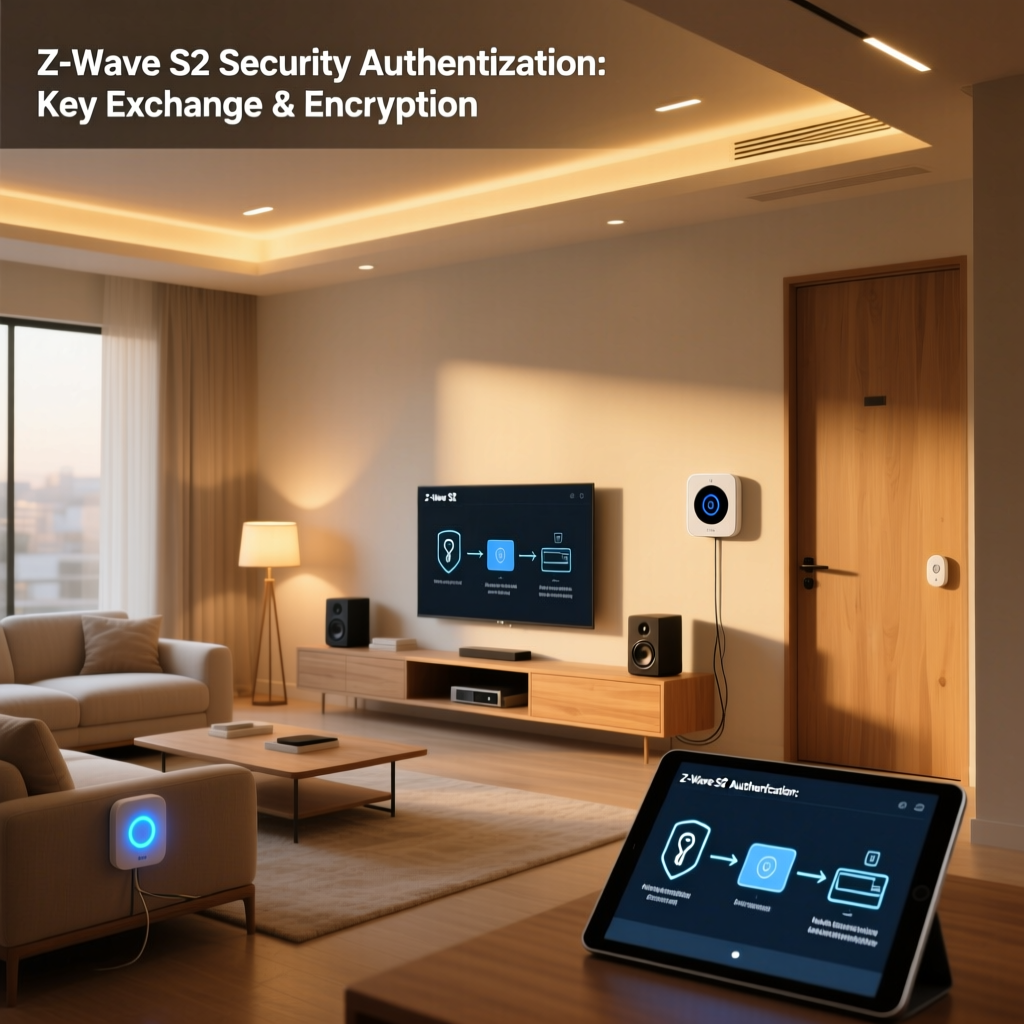
Z-Wave operates in the sub-GHz frequency band (908.42 MHz in the US, 868.42 MHz in Europe). This is its greatest advantage: it completely avoids the crowded 2.4 GHz spectrum, meaning your Wi-Fi router, microwave, and Bluetooth devices will never interfere with your smart home commands. According to the Z-Wave Alliance, the Z-Wave Plus v2 (800 series) standard offers up to 100 meters of outdoor range, enhanced S2 security, and SmartStart for easy provisioning.
Top Pick: Aeotec Smart Switch 7 (Z-Wave Plus v2)
The Aeotec Smart Switch 7 is the ultimate Z-Wave utility device. It features an 800-series chip, providing superior range and S2 authenticated security. It includes a built-in power meter and acts as a Z-Wave mesh repeater, strengthening the network for battery-powered sensors further away from the hub.
- Price: $35.99
- Protocol: Z-Wave Plus v2 (900 MHz)
- Max Load: 15A / 1800W
- Compatibility: SmartThings, Hubitat, Home Assistant, Ring Alarm
Pros: Zero Wi-Fi interference, excellent range, robust mesh repeating, highly accurate energy monitoring.
Cons: Requires a Z-Wave hub, regional frequency locks mean you cannot import devices from other countries.
Top Pick: Ring Alarm Security Kit (2nd Gen)
Ring's security ecosystem relies heavily on Z-Wave for its contact sensors, motion detectors, and keypads. The 2nd Gen sensors are compact, offer excellent battery life, and integrate seamlessly with the Ring Base Station, which acts as the Z-Wave hub. This is an ideal entry point for users who want a managed, secure Z-Wave network without tinkering with open-source hubs.
Wi-Fi: The High-Bandwidth Heavyweight
Wi-Fi (802.11ac/ax) is ubiquitous and offers massive bandwidth, making it mandatory for devices that stream video, audio, or require high-speed data transfers. However, Wi-Fi uses a star topology (all devices connect directly to the router), which can lead to network congestion if you have dozens of smart plugs and bulbs. Modern Wi-Fi 6 (802.11ax) routers with MU-MIMO and OFDMA technologies have mitigated this, making Wi-Fi a viable option for more than just cameras and thermostats.
Top Pick: Ecobee SmartThermostat Premium
The Ecobee SmartThermostat Premium is a powerhouse that utilizes Wi-Fi for high-speed cloud communication, firmware updates, and integration with voice assistants. It features a built-in speaker and microphone for Alexa and Siri, requiring the high bandwidth and low latency that only Wi-Fi can provide. It also includes a remote room sensor to balance temperatures across your home.
- Price: $249.99
- Protocol: Wi-Fi (2.4 GHz & 5 GHz)
- Features: Built-in Alexa/Siri, air quality monitor, remote room sensor
- Compatibility: Apple HomeKit, Amazon Alexa, Google Assistant, Samsung SmartThings
Pros: Rich feature set, dual-band Wi-Fi for reliability, excellent app interface, energy savings reports.
Cons: High price point, relies on cloud connectivity for advanced features.
Top Pick: Wyze Cam v3
For budget-friendly home security, the Wyze Cam v3 is unmatched. It streams 1080p video with color night vision and two-way audio directly over your 2.4 GHz Wi-Fi network. While it lacks the local processing of high-end PoE cameras, its reliance on Wi-Fi keeps the hardware cost incredibly low while leveraging your existing router infrastructure.
Protocol Comparison and Device Specifications
To help you visualize the differences between these curated picks and their underlying protocols, refer to the comparison table below:
| Protocol | Top Device Pick | Frequency | Max Indoor Range | Avg. Cost |
|---|---|---|---|---|
| Matter (Thread) | Eve Energy Smart Plug | 2.4 GHz | 30m (Mesh) | $39.99 |
| Zigbee | Aqara Door & Window Sensor | 2.4 GHz | 20m (Mesh) | $19.99 |
| Z-Wave | Aeotec Smart Switch 7 | 900 MHz | 40m (Mesh) | $35.99 |
| Wi-Fi | Ecobee SmartThermostat | 2.4 / 5 GHz | 50m (Star) | $249.99 |
Battery Life Efficiency by Protocol
One of the most critical factors for wireless sensors (like door contacts, motion detectors, and leak sensors) is battery longevity. The chart below illustrates the average expected battery life in months for a standard wireless sensor across the four major protocols, assuming average daily triggers and optimal network conditions.
Average battery life in months for wireless sensors across major smart home protocols
As the data demonstrates, Thread and Z-Wave lead the pack in power efficiency, making them the superior choices for set-and-forget sensors. Wi-Fi sensors, while convenient due to hub-less setups, require frequent battery changes or hardwiring.
Expert Tips for Mixing Protocols
"The most resilient smart homes do not rely on a single protocol. By strategically assigning high-bandwidth devices to Wi-Fi, lighting to Zigbee or Thread, and critical security sensors to Z-Wave, you create a fault-tolerant network that survives router reboots and spectrum congestion."
Mixing protocols requires a central hub capable of bridging these diverse languages. Platforms like Home Assistant (running on a Raspberry Pi or mini PC with a multi-protocol dongle like the SkyConnect) or the Samsung SmartThings Hub allow you to unify Matter, Zigbee, Z-Wave, and Wi-Fi devices into a single dashboard. This enables cross-protocol automations, such as using a Zigbee motion sensor to trigger a Wi-Fi smart plug, or a Z-Wave door lock to unlock a Matter-compatible smart deadbolt.
When planning your network, map out your device density. If you have over 40 devices, offloading the mesh networking to Zigbee and Z-Wave will dramatically improve your Wi-Fi performance for laptops, phones, and streaming devices. Always prioritize local control where possible—Matter over Thread and local Zigbee/Z-Wave hubs ensure your automations continue to run even if your internet connection drops.
Final Verdict
Selecting the best smart home devices requires looking past the brand name and focusing on the underlying protocol. For future-proofing and local control, invest in Matter over Thread devices like the Eve Energy plug. For expansive, low-power sensor networks, Zigbee and Z-Wave remain undefeated champions, with Aqara and Aeotec leading their respective categories. Finally, reserve your Wi-Fi bandwidth for heavy-hitters like the Ecobee thermostat and high-definition cameras. By curating your device picks based on protocol strengths, you build a smart home that is not just intelligent, but fundamentally reliable.