The Matter Milestone: Interoperability Achieved, But at What Cost?
For over a decade, the smart home industry was plagued by a frustrating era of fragmentation. Consumers were forced to choose between competing ecosystems, dealing with proprietary hubs, conflicting apps, and devices that refused to communicate. The introduction of the Matter standard, spearheaded by the Connectivity Standards Alliance (CSA), fundamentally solved this interoperability crisis. By providing a unified application layer that runs over existing transport protocols like Wi-Fi, Ethernet, and Thread, Matter ensured that a smart bulb from one brand could seamlessly interact with a smart speaker from another, regardless of the underlying hardware.
However, while Matter successfully standardized how devices communicate, it did not address two of the most significant physical limitations of the modern smart home: power dependency and spatial awareness. Matter tells your smart home what a device is and what state it is in, but it relies on legacy transport layers that demand constant power and lack precise physical context. As we look toward the next decade of home automation, the industry is pivoting toward two revolutionary paradigms that will define the post-Matter era: Ambient IoT (Batteryless Communication) and Ultra-Wideband (UWB) Spatial Computing.
The Hidden Cost of Connectivity: The Battery Bottleneck
The current smart home relies heavily on battery-powered sensors. Door/window contacts, motion detectors, temperature sensors, and smart locks predominantly use CR2032 coin cells, AA, or AAA batteries. While low-power protocols like Zigbee and Thread have extended battery life to a year or two, the environmental and maintenance costs are staggering.
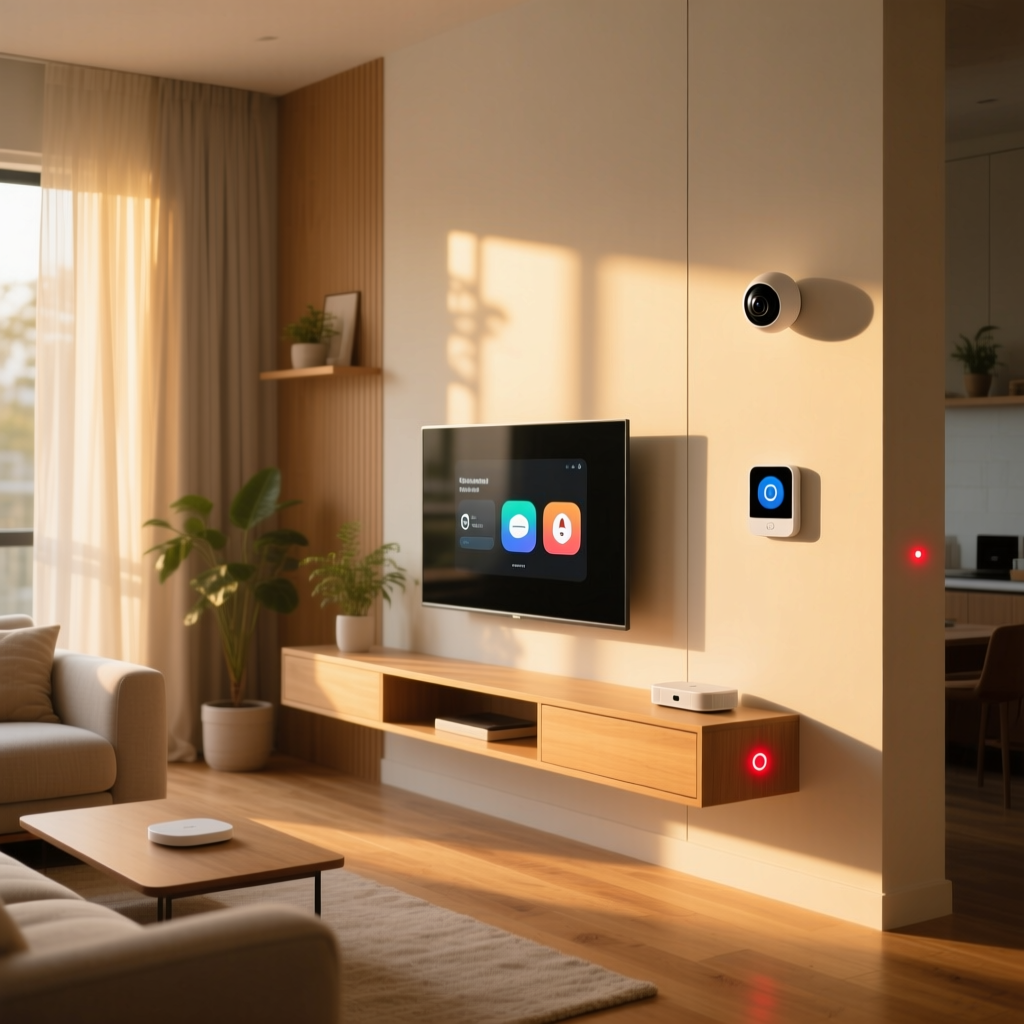
Consider a moderately equipped smart home with 40 to 50 sensors. Replacing batteries across dozens of devices annually generates significant electronic waste and creates a frustrating maintenance burden for the user. Furthermore, when a battery dies, the device drops off the network, potentially compromising home security or disrupting automated routines. The ultimate goal of smart home evolution is the 'install-and-forget' paradigm—a state where devices never require a battery replacement because they do not use batteries at all.
Beyond Matter: The Rise of Ambient IoT
Ambient IoT represents the next massive leap in wireless standards, currently being studied and standardized by organizations like 3GPP (in Releases 18 and 19) and championed by hardware innovators. Ambient IoT refers to devices that harvest energy from their surrounding environment to power microchips and transmit data, completely eliminating the need for chemical batteries.
According to pioneers like Wiliot, which develops stamp-sized 'IoT Pixels', the future of sensing lies in harvesting ambient radio frequency (RF) waves, indoor light, thermal gradients, and kinetic vibrations. These devices consume mere microwatts of power, enabling them to operate indefinitely in a typical home environment.
The Physics of Backscatter Communication
To understand how a device can transmit data without a battery, one must understand backscatter communication. Traditional wireless protocols (Wi-Fi, Bluetooth, Thread) require a device to generate its own radio waves using a power-hungry oscillator and amplifier. Backscatter, on the other hand, works like a mirror.
An Ambient IoT tag contains a specialized antenna and a microchip. When a reader (like a smart home hub or even a standard Wi-Fi router) broadcasts an RF signal, the tag's antenna captures a tiny fraction of that energy to wake up its logic circuits. Instead of generating a new radio wave, the tag modulates its antenna's impedance—essentially changing how much of the incoming signal it absorbs versus how much it reflects back. The reader detects these minute changes in the reflected signal (the backscatter) and decodes them into data. This process reduces power consumption by a factor of 10,000 compared to active Bluetooth Low Energy (BLE) transmission.
Energy Harvesting Modalities in the Smart Home
- RF Harvesting: Captures ambient energy from existing Wi-Fi, cellular, and TV broadcast signals. Ideal for indoor tags and sensors.
- Photovoltaic (Indoor Solar): Uses highly sensitive amorphous silicon cells to harvest energy from standard LED and fluorescent indoor lighting.
- Thermoelectric (Peltier Effect): Generates micro-watts from the temperature differential between a surface (like a window or HVAC vent) and the ambient room air.
- Piezoelectric (Kinetic): Harvests energy from physical movement, such as the pressing of a light switch or the vibration of a washing machine.
Ultra-Wideband (UWB): The Missing Spatial Layer
While Ambient IoT solves the power problem, Ultra-Wideband (UWB) solves the context problem. Current smart home presence detection relies on Passive Infrared (PIR) sensors or millimeter-wave radar. PIR sensors only detect motion, not presence (which is why lights turn off if you sit still on the couch). Radar is better but struggles with multipath interference and cannot easily distinguish between multiple people in a room.
UWB, standardized and promoted by the FiRa Consortium, operates by sending billions of ultra-short radio pulses across a wide spectrum of frequencies (typically 6.5 GHz to 8 GHz). Because the pulses are so short, UWB is virtually immune to multipath fading (signal bouncing off walls). This allows UWB anchors to calculate the exact Time-of-Flight (ToF) and Angle-of-Arrival (AoA) of a signal with centimeter-level precision.
Centimeter-Level Precision vs. RSSI Guesswork
Legacy protocols like Bluetooth and Wi-Fi estimate distance using Received Signal Strength Indicator (RSSI). RSSI is notoriously inaccurate because a signal weakens not just over distance, but also when it passes through a human body, a wall, or a piece of furniture. UWB measures the actual time it takes for light-speed radio waves to travel from a tag to an anchor. In the post-Matter smart home, UWB will enable true spatial computing: the HVAC system will know exactly which quadrant of the room you are sitting in, and directional audio will follow you as you walk from the kitchen to the living room.
Protocol Comparison Matrix
To understand how these emerging technologies fit alongside current standards, review the comparison matrix below. This illustrates why a multi-protocol approach is necessary for the future smart home.
| Feature | Matter over Thread | Matter over Wi-Fi | Ultra-Wideband (UWB) | Ambient IoT (Backscatter) |
|---|---|---|---|---|
| Primary Role | Low-power control & sensing | High-bandwidth data & hubs | Spatial awareness & security | Batteryless micro-sensing |
| Power Source | Battery / Mains | Mains Power | Battery / Mains | Energy Harvesting (Zero Battery) |
| Peak Power Draw | ~30 mW | ~500+ mW | ~100 mW | < 0.05 mW (50 µW) |
| Range | ~30m (Mesh extended) | ~50m | ~10m - 25m (Line of Sight) | ~5m - 15m (Hub dependent) |
| Precision | Room-level (RSSI) | Room-level (RSSI) | Centimeter-level (ToF/AoA) | Zone-level |
| Cost per Node | $15 - $40 | $20 - $100+ | $10 - $30 (IC level) | $0.10 - $2.00 (at scale) |
Power Consumption Visualization
The following chart illustrates the vast disparity in peak power consumption across smart home protocols. Note the logarithmic scale, which highlights how Ambient IoT operates in a completely different physical realm compared to traditional active radios.
Protocol Power Comparison
Future-Proofing Your Home: Actionable Steps for Early Adopters
While fully realized Ambient IoT smart homes are still a few years away from mainstream retail availability, the foundational infrastructure for the post-Matter era is being laid today. If you are building or upgrading a smart home, here is how you can future-proof your investment to seamlessly integrate UWB and batteryless technologies as they mature.
1. Invest in UWB-Enabled Hubs and Anchors
To prepare for spatial computing, begin integrating UWB anchors into your home layout. Devices like the Samsung SmartThings Station and high-end smartphones (iPhone 15 Pro, Samsung Galaxy S24 Ultra) already contain UWB silicon (such as the Qorvo DW3000 or NXP SR150). When purchasing smart locks, prioritize models that support UWB for secure, precise passive entry (e.g., the Aqara U200 or upcoming Matter-certified UWB locks). Position these hubs in central, elevated locations to ensure clear line-of-sight for accurate Angle-of-Arrival calculations.
2. Deploy Thread Border Routers for Local Mesh Density
Ambient IoT backscatter tags will eventually rely on local hubs to bounce RF signals off of them. A dense Thread mesh network acts as the perfect backbone for this. By deploying multiple Thread Border Routers (such as the Eve Energy smart plugs, Apple TV 4K, or Aqara Hub M3), you not only ensure low-latency Matter communication but also create a dense web of local RF energy that future Ambient IoT devices can harvest and utilize for backscatter reflection.
3. Transition to Kinetic and Solar-Powered Switches
Bridge the gap to batteryless living by adopting early energy-harvesting devices. The Eltako kinetic switches and EnOcean based sensors (like the Eve MotionBlinds with solar charging) utilize the exact mechanical and photovoltaic harvesting principles that will power the Ambient IoT explosion. Replacing hard-to-reach battery sensors with kinetic alternatives today saves maintenance time and aligns your home with the zero-battery philosophy.
4. Demand Local Processing and Edge AI
UWB generates a massive amount of spatial data (continuous ToF and AoA streams). Sending this raw data to the cloud for processing introduces unacceptable latency and privacy risks. Ensure your primary smart home controllers (like Home Assistant Green or Apple HomePod) support robust local Edge AI processing. The post-Matter home will rely on local neural engines to interpret UWB spatial data and Ambient IoT sensor triggers in milliseconds, keeping your physical movements strictly off the cloud.
Conclusion
Matter was a necessary and triumphant evolution for the smart home, effectively ending the tribalism of incompatible ecosystems. However, it is merely the application layer. The true revolution—the transition from a home of connected gadgets to an invisible, intuitive, and sustainable living environment—relies on what comes next. By eliminating the chemical battery through Ambient IoT and backscatter communication, and by granting the home centimeter-level spatial awareness via Ultra-Wideband, the next generation of protocols will make the smart home truly ambient. The devices of the future will not demand our attention, require our maintenance, or guess our location; they will simply exist in harmony with our physical space, powered by the very environment they inhabit.