The Matter Plateau: Why Interoperability is Just the Beginning
The introduction of the Matter protocol was a watershed moment for the smart home industry. By uniting fragmented ecosystems under a single, IP-based interoperability standard, Matter effectively ended the 'walled garden' wars between Apple, Google, Amazon, and Samsung. Consumers can now buy a smart plug or a motion sensor with the confidence that it will work seamlessly across platforms. However, as the dust settles on Matter's initial rollout, industry architects and engineers are already looking toward the horizon. Matter solved the problem of communication, but it did not solve the problems of context and power constraints.
Matter relies primarily on Wi-Fi, Ethernet, and Thread. While Thread is an exceptionally efficient mesh networking protocol, it still requires devices to have a reliable power source—either a wired connection or a battery that must eventually be replaced or recharged. Furthermore, Matter devices are largely 'context-blind.' A Matter-enabled motion sensor knows that movement occurred in a room, but it does not know who is moving, where they are looking, or what their exact spatial relationship is to the environment.
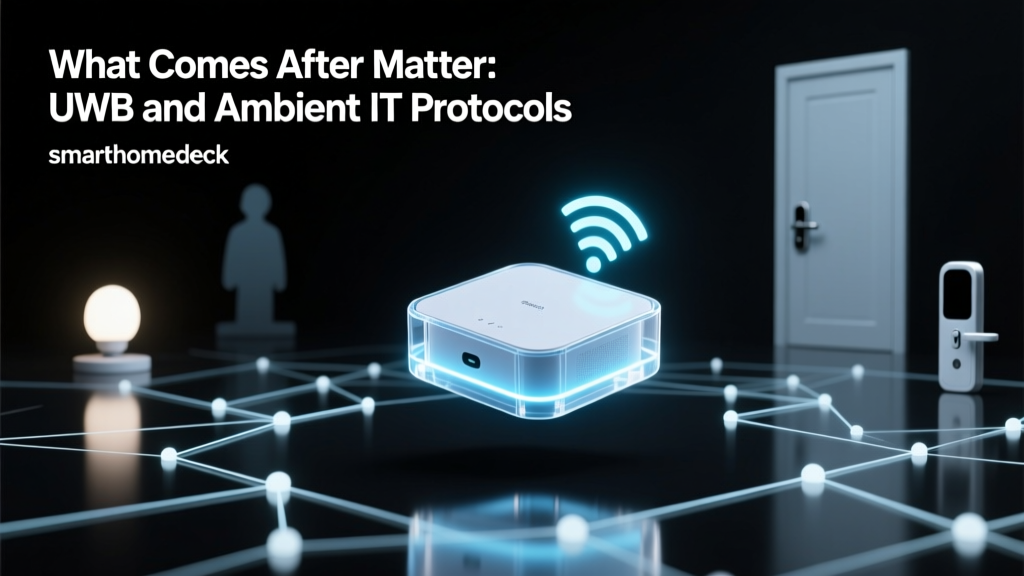
The post-Matter era will not be defined by a new messaging protocol, but by the integration of advanced physical-layer technologies that provide spatial awareness and eliminate the need for batteries altogether. The future of the smart home rests on two emerging pillars: Ultra-Wideband (UWB) for precision spatial computing, and Ambient IoT for zero-power, ubiquitous sensing.
Ultra-Wideband (UWB): The Spatial Computing Layer
Ultra-Wideband is not a new technology, but its application in the smart home is on the cusp of a massive expansion. Standardized under IEEE 802.15.4z and championed by the FiRa Consortium, UWB operates by transmitting billions of incredibly short radio pulses across a wide spectrum of frequencies. By measuring the precise Time-of-Flight (ToF) and Angle of Arrival (AoA) of these pulses, UWB can determine the distance and direction of a device with centimeter-level accuracy.
Unlike Bluetooth Low Energy (BLE) or Wi-Fi, which rely on signal strength (RSSI) to estimate distance—a method easily skewed by walls, human bodies, and furniture—UWB's pulse-based timing is highly resistant to multipath fading and interference. It doesn't just know you are in the living room; it knows you are sitting exactly 1.4 meters away from the left speaker, facing the television.
Practical Applications and Current Hardware
Currently, UWB is best known for consumer item tracking, such as Apple's Precision Finding for AirTags and digital car keys. However, its smart home implications are profound:
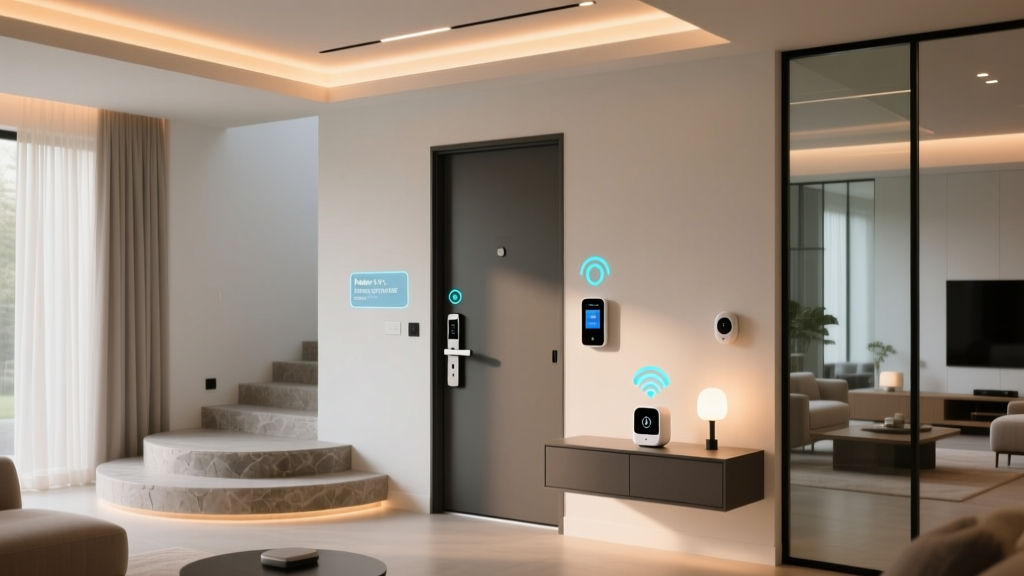
- Directional Point-and-Click Control: Instead of scrolling through an app to find the right light switch, you simply point your UWB-enabled smartphone or smart remote at the lamp. The spatial awareness layer identifies the exact device you are targeting and brings up its controls instantly.
- Hyper-Local Audio and HVAC Routing: Multi-room audio systems can automatically transfer playback to the speaker closest to the user as they walk through the house. Similarly, smart HVAC vents can adjust micro-climates based on the exact location and body temperature of occupants.
- Secure, Relay-Proof Access: UWB's ToF measurements make it virtually impossible for hackers to use 'relay attacks' to trick smart locks into thinking the homeowner is standing at the door when they are actually a mile away.
To prepare your home for UWB, you need 'anchors'—devices with UWB transceivers that map the space. The Samsung SmartThings Station (retailing around $59) acts as a UWB anchor and a Matter/Thread border router, allowing compatible Samsung Galaxy devices to interact spatially with the home. Apple's HomePod mini ($99) also contains a U1 UWB chip, laying the groundwork for future spatial interactions within the HomeKit ecosystem.
Ambient IoT and Backscatter: The Zero-Power Revolution
While UWB solves the context problem, Ambient IoT solves the power problem. The smart home of the future will require thousands of sensors per household—embedded in wallpaper, window frames, furniture, and even packaging. Maintaining batteries for thousands of nodes is logistically and environmentally impossible. Enter Ambient IoT, a paradigm where devices harvest energy from their surroundings to operate indefinitely without batteries.
According to telecommunications giant Qualcomm, Ambient IoT represents the next massive leap in connectivity, targeting the 'missing middle' of devices that need to be connected but cannot support the cost or power draw of traditional cellular or Wi-Fi radios. The upcoming 3GPP Release 18 and 19 (5G-Advanced) standards are actively formalizing Ambient IoT, ensuring it will integrate seamlessly with existing 5G and Wi-Fi infrastructure.
How RF Energy Harvesting and Backscatter Work
Ambient IoT devices utilize microscopic 'rectennas' (rectifying antennas) to capture ambient Radio Frequency (RF) energy from existing Wi-Fi routers, cellular towers, and even broadcast television signals. This harvested energy—often measured in microwatts—is stored in supercapacitors to power ultra-low-energy microcontrollers and sensors.
More importantly, these devices often communicate using backscatter modulation. Instead of generating their own radio waves (which requires significant power), an Ambient IoT tag simply reflects and modulates the existing RF signals bouncing off it from a nearby router or dedicated reader. It essentially 'hitches a ride' on existing Wi-Fi or 5G signals to transmit its data back to the network.
Companies like Wiliot are already pioneering this space with their 'Clover' IoT Pixels. These are stamp-sized, batteryless Bluetooth harvesting tags that cost between $2 and $5 each. They can monitor temperature, humidity, and location, drawing enough ambient energy from passing smartphones and Wi-Fi routers to transmit data packets. In the near future, expect to see Ambient IoT sensors embedded directly into the drywall of new homes to monitor structural integrity, moisture intrusion, and thermal insulation efficiency—sensors that will outlive the mortgage on the house.
Protocol Showdown: Thread vs. UWB vs. Ambient IoT
To understand how these protocols will coexist, it is essential to view them not as competitors, but as complementary layers of a unified smart home stack. Below is a comparative analysis of the networking layers defining the post-Matter era.
| Feature | Thread (Matter Transport) | Ultra-Wideband (UWB) | Ambient IoT (Backscatter) |
|---|---|---|---|
| Primary Function | Reliable, low-latency device control | Precision spatial awareness & secure access | Mass-scale, zero-power environmental sensing |
| Range | ~30m (indoor mesh) | ~10m to 50m (Line of Sight optimized) | ~5m to 15m (dependent on RF harvester) |
| Data Rate | 250 kbps | Up to 27 Mbps | 1 kbps to 10 kbps |
| Power Source | Mains or large batteries (AA/CR123) | Rechargeable batteries (smartphones/hubs) | RF Energy Harvesting (Zero Battery) |
| Accuracy | Room-level (via RSSI) | Centimeter-level (via ToF/AoA) | Zone/Proximity-level |
| Estimated Node Cost | $15 - $50+ | $5 - $15 (chip level) | $1 - $5 |
Practical Guide: Future-Proofing Your Home Today
While Ambient IoT is still largely in the enterprise and logistics pilot phase, UWB is available to consumers right now. If you want to build a smart home that is ready for the spatial computing revolution, here is an actionable roadmap.
Step 1: Invest in UWB Anchors and Hubs
Do not rely solely on your smartphone to act as a UWB anchor; the network needs fixed reference points to calculate spatial geometry accurately.
- For Samsung/Android Users: Purchase the Samsung SmartThings Station ($59). Place one in the center of your primary living space and one near your entryway. This creates a baseline UWB mesh that enables precise presence detection and directional control for compatible Galaxy devices.
- For Apple Users: Ensure your home is equipped with at least two HomePod minis ($99 each) or full-size HomePods. Apple is heavily investing in spatial audio and UWB handoff features, and these devices serve as the foundational anchors for HomeKit's future spatial awareness features.
Step 2: Upgrade to UWB-Enabled Access Control
If you are investing in a smart lock, look for models that support or are preparing for UWB integration. While many current locks use BLE or Wi-Fi, the next generation of premium locks (from brands like Yale, Schlage, and Level) will integrate UWB to prevent relay attacks and enable true 'hands-free' unlocking that only triggers when you are literally touching the doorknob, not just standing on the porch. Expect to pay a premium of $250 to $350 for these advanced, multi-protocol locks.
Step 3: Prepare for the Batteryless Ecosystem
While you cannot yet buy a Wiliot Ambient IoT starter kit at your local hardware store, you can begin adopting ultra-low-power harvesting technologies. Look into EnOcean kinetic switches and solar-powered indoor sensors. EnOcean's technology uses mechanical energy from a button press or indoor photovoltaic cells to send Zigbee/BLE signals. Integrating these now trains your automation logic for the eventual influx of thousands of batteryless Ambient IoT nodes.
The Privacy Paradox of Spatial Awareness
The transition from 'connected' homes to 'aware' homes introduces massive privacy implications. A Matter motion sensor tells the system that a room is occupied. A UWB network tells the system exactly how many people are in the room, their precise physical dimensions, their breathing rates (via micro-Doppler radar effects), and their exact movements.
To mitigate this, the industry is pushing for Edge-Based Spatial Processing. This means the raw UWB coordinate data must be processed locally on the hub (like the SmartThings Station or HomePod) and only abstracted state data (e.g., 'User A is reading on the couch') should be sent to the cloud or automation engine. When evaluating future UWB and Ambient IoT devices, consumers must prioritize brands that guarantee local-only processing for spatial and biometric telemetry.
Conclusion
Matter was the necessary foundation—a universal language that allowed disparate devices to finally speak to one another. But a language alone does not create intelligence. The future of the smart home lies in the physical layer: Ultra-Wideband will give the home 'eyes' to understand space, context, and intent, while Ambient IoT will provide an infinite, invisible nervous system of zero-power sensors. By understanding and strategically investing in these emerging protocols today, early adopters can ensure their smart homes evolve from simple automated boxes into truly responsive, ambient living environments.