The Ceiling of Matter: Why We Need More
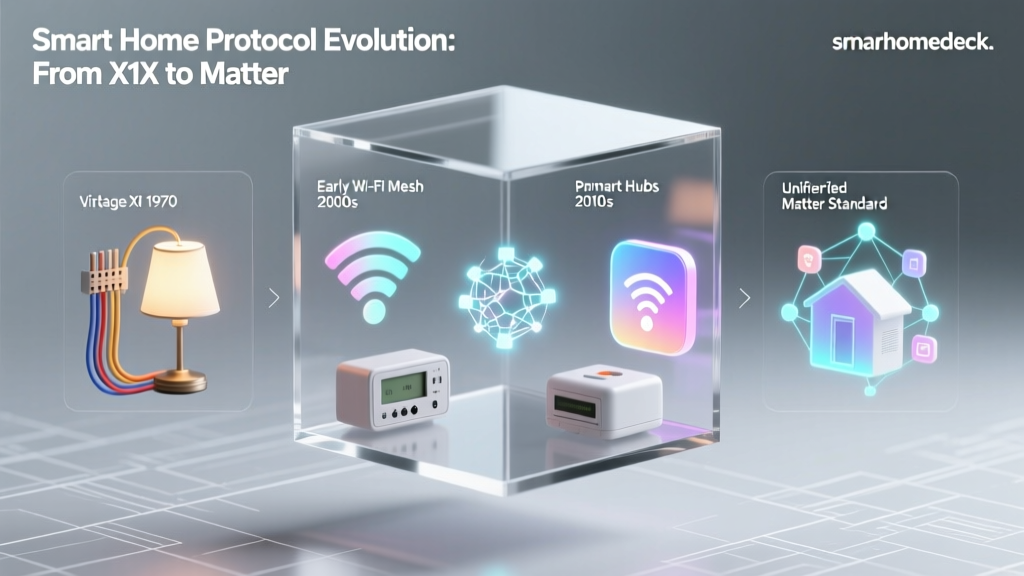
When the Connectivity Standards Alliance (CSA) launched Matter, it was heralded as the holy grail of smart home interoperability. By providing a unified application layer, Matter solved the most pressing consumer pain point: the fragmented ecosystem. Today, a Matter-certified smart lock from Yale can seamlessly communicate with a Hubitat or Apple TV hub, regardless of the underlying brand. However, as the dust settles on this monumental achievement, industry engineers and smart home enthusiasts are already asking a critical question: What comes after Matter?
Matter is fundamentally an application-layer protocol. It dictates how devices interpret commands (syntax), but it relies entirely on underlying transport layers like Thread, Wi-Fi, and Ethernet to move the data. While Thread offers excellent low-power mesh networking and Wi-Fi provides high bandwidth, neither natively provides the centimeter-level spatial awareness or the ultra-secure, high-speed optical data transmission required for the next generation of ambient computing. The future of the smart home is not just about devices talking to each other; it is about devices understanding context, location, and intent.
To build a truly predictive, context-aware smart home, we must look beyond traditional RF mesh networks. The successors and complements to Matter are already emerging in the form of Ultra-Wideband (UWB), Light Fidelity (Li-Fi), and AI-native semantic protocols. Here is a deep dive into the technologies that will define the smart home over the next decade.
Ultra-Wideband (UWB): The Era of Spatial Awareness
Current smart home presence detection relies heavily on Passive Infrared (PIR) sensors or mmWave radar. PIR sensors only detect motion, meaning if you sit still reading a book, the lights will turn off. mmWave radar solves the stillness problem but struggles with precise room-to-room tracking and multi-user differentiation. Enter Ultra-Wideband (UWB).
UWB is a radio technology standardized under IEEE 802.15.4z that uses extremely short pulses of radio energy across a wide spectrum of frequencies (typically 6.5 GHz to 8 GHz). Because the pulses are so short, UWB can measure the Time-of-Flight (ToF) and Angle-of-Arrival (AoA) of a signal with astonishing accuracy.
How UWB Transforms the Smart Home
Unlike Bluetooth Low Energy (BLE) RSSI (Received Signal Strength Indicator), which estimates distance based on signal degradation and is highly susceptible to interference from walls and human bodies, UWB measures the exact time it takes for a signal to travel. This allows for spatial precision down to 10 to 30 centimeters. In a smart home context, UWB enables:
- Micro-Location Automations: The home knows you are sitting on the left side of the sofa, adjusting the left reading lamp to 4000K and 80% brightness, while dimming the rest of the room.
- Secure, Passive Access: Smart locks equipped with UWB anchors can detect your phone or UWB key fob approaching the door, unlocking it precisely when you are within 1 meter, eliminating the need to pull out your phone or rely on unreliable geofencing.
- Gesture Control: By bouncing UWB signals off hands, future hubs could detect micro-gestures (like a finger snap or a swipe) without the privacy concerns of optical cameras.
Current UWB Devices and Costs
The FiRA Consortium is the governing body pushing UWB adoption. While automotive (digital car keys) has led the charge, smart home integration is accelerating. The Samsung SmartThings Station (retailing around $59) acts as a UWB anchor, allowing users to create precise 'presence zones' in the SmartThings app when paired with a Galaxy phone or SmartTag+. Apple has embedded its U1 and U2 UWB chips into the HomePod mini ($99) and iPhone lineup, currently used for Handoff and precise AirTag tracking, but the infrastructure is in place for future HomeKit spatial automations. Expect standalone UWB smart home anchors from brands like Aqara and Shelly to hit the market in the $40-$80 range over the next two years.
Li-Fi (IEEE 802.11bb): Light as a Data Protocol
As smart homes become saturated with RF signals (Wi-Fi routers, Zigbee meshes, Thread border routers, Bluetooth beacons), the 2.4 GHz spectrum is increasingly congested, leading to latency spikes and packet loss. The solution to RF congestion might just be the lightbulb above your head.
Li-Fi (Light Fidelity) is an optical wireless communication technology that uses rapid, imperceptible flickering of LED lights to transmit binary data. In 2023, the IEEE officially released the 802.11bb standard, legitimizing Li-Fi as a mainstream networking protocol alongside Wi-Fi and 5G.
Speed, Security, and Limitations
In laboratory settings, Li-Fi has achieved speeds exceeding 224 Gbps. In commercial and high-end consumer deployments, speeds of 1 Gbps to 10 Gbps are currently viable. But speed isn't Li-Fi's primary advantage for the smart home; security and interference immunity are.
- Zero RF Interference: Li-Fi does not interfere with Wi-Fi, Thread, or medical equipment, making it ideal for dense apartment buildings or homes with heavy IoT deployments.
- Physical Security: Light cannot penetrate opaque walls. A Li-Fi network is physically contained within the room where the light is shining. External hackers cannot intercept your smart home data from a van parked outside your house.
- Ultra-Low Latency: Li-Fi boasts microsecond latency, crucial for real-time audio synchronization and high-speed camera feeds in security systems.
The primary limitation is the requirement for Line-of-Sight (LoS) and the inability to pass through walls. Therefore, Li-Fi will not replace Thread for whole-home sensor meshes. Instead, it will serve as a high-speed, secure backbone for specific rooms. Companies like Signify (Trulifi) and pureLiFi are currently targeting enterprise and high-end residential markets. A consumer-grade Li-Fi enabled desk lamp and corresponding USB-C receiver dongle currently costs between $300 and $600, but as the 802.11bb standard is adopted by smartphone and laptop manufacturers, this cost will plummet.
AI-Native Semantic Protocols: The Software Successor
While UWB and Li-Fi address the physical transport of data, the logical layer of the smart home is also evolving. Matter ensures that a command like 'Set Light to 50%' is understood by any bulb. But the future belongs to Semantic Interoperability driven by AI and the W3C Web of Things (WoT) ontology.
Current protocols are syntax-based. The future protocol layer will be intent-based. Instead of a user creating a rigid IFTTT routine ('If motion detected after 6 PM, turn on lights'), an AI-native protocol layer will ingest data from UWB anchors, ambient light sensors, and smart thermostats to build a real-time semantic graph of the home. The protocol will understand the concept of 'Reading' or 'Hosting a Dinner Party' and dynamically orchestrate the underlying Matter devices to fulfill that intent, adjusting to the specific users present in the room based on their UWB profiles.
Protocol Comparison: Matter vs. Next-Gen Standards
To understand how these technologies will coexist, it is essential to compare their physical capabilities. Matter is an application layer, so the table below compares the transport/networking layers that Matter and future AI hubs will rely upon.
| Protocol | Primary Smart Home Use Case | Typical Indoor Range | Max Bandwidth | Spatial Precision |
|---|---|---|---|---|
| Matter (over Thread) | Low-power sensor & switch mesh | 30m (Mesh) | 250 Kbps | Room-level (via RSSI) |
| UWB (802.15.4z) | Spatial awareness, secure access | 10m - 30m | 27 Mbps | 10cm - 30cm |
| Li-Fi (802.11bb) | Secure, high-speed room data | Line of Sight (Room) | 1 - 10 Gbps | Light-cone boundary |
| Wi-Fi 7 | High-bandwidth video & hubs | 50m | Up to 46 Gbps | 1m - 3m (via FTM) |
Charting the Future: Bandwidth vs. Precision
The following visualization highlights the trade-offs between spatial precision (lower is better, measured in centimeters) and network latency (lower is better, measured in milliseconds) across emerging smart home protocols. This data illustrates why a multi-protocol approach is mandatory for the future ambient home.
How to Future-Proof Your Smart Home Today
You do not need to wait for the next decade to prepare your home for the post-Matter era. By making strategic hardware choices today, you can ensure your infrastructure is ready for spatial computing and optical networking.
1. Invest in Thread Border Routers with UWB Potential
When purchasing smart speakers or hubs, prioritize devices that already contain dormant UWB silicon. The Apple HomePod mini and the second-generation Apple TV 4K contain U1/U2 chips. While Apple has not fully opened HomeKit to UWB spatial automations yet, the hardware is in your home, waiting for a software update. Similarly, Samsung's SmartThings ecosystem is actively deploying UWB anchors. Buying into these ecosystems now ensures you won't need to rip and replace your hubs when spatial awareness becomes the standard.
2. Deploy Local AI Hubs for Semantic Control
To prepare for AI-native semantic protocols, you need local processing power that doesn't rely on cloud latency. Investing in a local smart home server like a Home Assistant Green ($99) or an Intel NUC running Home Assistant allows you to integrate experimental AI models (like local LLMs) via the Connectivity Standards Alliance (CSA) Matter bridges. This gives you a sandbox to test intent-based automations long before major tech companies roll them out to the masses.
3. Run Cat6A Fiber and Conduit for Li-Fi
If you are building or renovating, run Cat6A ethernet to your ceiling light fixtures and desk lamps. Li-Fi requires a hardwired data connection to the LED driver to achieve gigabit speeds. By pre-wiring your light fixtures for high-speed data, you eliminate the need for future drywall repairs when Li-Fi consumer bulbs finally hit the mass market.
Conclusion: The Ambient Horizon
Matter was the necessary foundation—a universal language that stopped the smart home industry from fracturing into incompatible walled gardens. But a common language does not equal intelligence. The future of smart home protocols is moving away from manual commands and basic connectivity, shifting toward an ambient, invisible layer of spatial and optical awareness. UWB will give the home eyes to see exactly where you are, Li-Fi will provide a secure, congestion-free nervous system, and AI semantic protocols will provide the brain to understand what you need before you even ask. The post-Matter era isn't about more devices; it's about a home that finally understands you.