The Post-Matter Era: What Happens When Interoperability is Solved?
The introduction of the Matter standard was a watershed moment for the smart home industry. Backed by the Connectivity Standards Alliance (CSA), Matter finally bridged the fragmented walled gardens of Apple, Google, Amazon, and Samsung. By creating a unified application layer, Matter ensured that a smart bulb from one brand could seamlessly communicate with a smart speaker from another. However, while Matter solved the language barrier, it did not reinvent the physical transport layers that carry the data. Matter relies on existing protocols like Thread, Wi-Fi, and Ethernet.
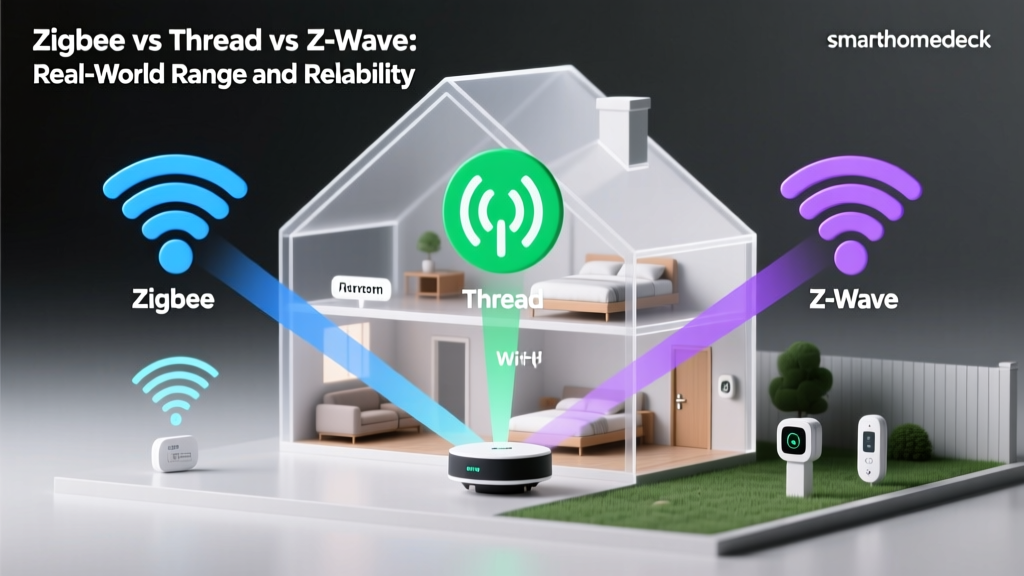
As we look toward the future, the limitations of these underlying transport protocols are becoming apparent. Thread is excellent for low-power indoor mesh networking but struggles with bandwidth and outdoor range. Wi-Fi offers high bandwidth but drains batteries and suffers from poor wall penetration at 5 GHz and 6 GHz frequencies. Bluetooth is ubiquitous but limited in range and mesh reliability.
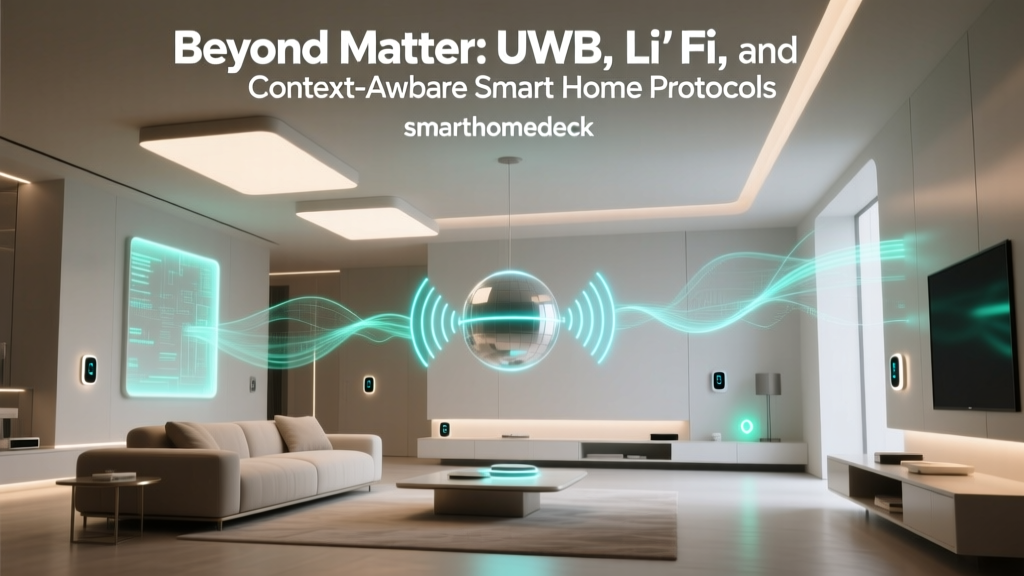
So, what comes after Matter? The future of smart home protocols is not about creating another application-layer standard; it is about introducing hyper-spatial awareness and extreme-range, low-power physical layers. The next frontier belongs to Ultra-Wideband (UWB) and Wi-Fi HaLow (802.11ah). These technologies will shift the smart home from reactive automation (triggered by motion or voice) to proactive, context-aware environments that understand exactly where you are, what you are pointing at, and how to reach the farthest corners of your property.
The Limitations of Current Smart Home Transport Layers
To understand why new protocols are necessary, we must look at the physical constraints of today's dominant networks:
- Thread and Zigbee (2.4 GHz): While mesh networking extends their theoretical range, each hop introduces latency. Furthermore, the 2.4 GHz spectrum is incredibly congested, leading to signal degradation in dense urban environments or homes with dozens of IoT devices.
- Wi-Fi (2.4 / 5 / 6 GHz): High-frequency Wi-Fi is terrible at penetrating solid obstacles like concrete, brick, and earth. It is also far too power-hungry for battery-operated sensors that need to last for years.
- PIR Motion Sensors: Traditional smart homes rely on Passive Infrared (PIR) sensors to detect occupancy. PIR only detects changes in heat signatures. If you sit still on the couch reading a book, the lights turn off because the PIR sensor assumes the room is empty. This is a fundamental flaw in reactive automation.
The post-Matter era demands protocols that offer centimeter-level indoor positioning and kilometer-level outdoor coverage without destroying battery life.
Ultra-Wideband (UWB): Adding the Z-Axis to Smart Homes
Ultra-Wideband (UWB) is a radio technology that uses a very wide spectrum (typically between 6.5 GHz and 8 GHz) to transmit data in short, low-power pulses. Unlike Bluetooth or Wi-Fi, which measure signal strength (RSSI) to guess distance, UWB measures the exact Time of Flight (ToF) of the radio waves. Because radio waves travel at the speed of light, measuring the time it takes for a pulse to bounce back allows UWB to calculate distance with an accuracy of 10 to 30 centimeters.
How UWB Transforms Home Automation
UWB replaces the binary "motion vs. no motion" paradigm with precision presence and spatial awareness. According to the FiRa Consortium, the governing body driving UWB adoption, this technology enables devices to understand their exact physical relationship to one another in three-dimensional space.
- Directional Control: Imagine pointing your smartphone or a smart remote at a specific lamp, and the interface on your screen automatically brings up the controls for that exact lamp, ignoring the dozens of other devices in the room.
- True Occupancy Detection: UWB anchors can detect the micro-movements of human breathing. The lights will never turn off while you are reading, even if you are perfectly still.
- Secure Spatial Access: UWB is virtually immune to relay attacks (a common hack where thieves amplify a key fob signal to steal a car or unlock a door). A UWB smart lock will only open if the authenticated device is physically within 12 inches of the door.
Current UWB Products and Ecosystem
UWB is already silently entering the smart home. Apple has included its U1 and U2 chips in the HomePod mini and iPhone, enabling precise Handoff features and spatial audio tracking. Samsung’s SmartThings Station acts as a UWB hub, allowing users to locate SmartTags with pinpoint accuracy and trigger automations based on exactly which room a user enters. The Philips Hue Tap Dial Switch utilizes UWB to detect which room you are in and which specific lights you are facing, adjusting its dial controls dynamically.
Cost and Implementation: Currently, UWB requires dedicated anchor nodes (hubs) to triangulate position. Expect to pay between $50 and $100 for UWB-enabled hubs and $25 to $40 for UWB tags or switches. As the technology matures, UWB radios will be integrated directly into high-end smart speakers and lighting fixtures.
Wi-Fi HaLow (802.11ah): Conquering the Great Outdoors
If UWB is the master of indoor precision, Wi-Fi HaLow is the undisputed king of outdoor range and penetration. Ratified by the IEEE and championed by the Wi-Fi Alliance, Wi-Fi HaLow operates in the sub-1 GHz ISM bands (typically 900 MHz in the Americas and 868 MHz in Europe).
The Physics of Sub-1 GHz
In wireless physics, lower frequencies travel further and penetrate solid objects far better than higher frequencies. While standard Wi-Fi operates at 2.4 GHz or 5 GHz and struggles to pass through a single brick wall, Wi-Fi HaLow’s sub-1 GHz waves can easily penetrate concrete, foliage, and earth. Furthermore, HaLow utilizes advanced Orthogonal Frequency-Division Multiplexing (OFDM) and aggressive power-saving sleep modes, allowing battery-operated sensors to last for years while maintaining a native IP connection.
Use Cases for the Large Property
For homeowners with large estates, detached garages, driveways, or agricultural setups, Thread and Zigbee simply cannot reach the perimeter without a daisy-chain of repeaters. Wi-Fi HaLow solves this:
- Perimeter Security: Deploying solar-powered HaLow cameras and gate sensors at the edge of a 5-acre property, connecting directly back to a single HaLow router at the main house (up to 1 kilometer away).
- Detached Structures: Providing smart lighting, HVAC control, and security to a detached garage, workshop, or guest house buried behind thick walls and trees.
- Smart Agriculture & Landscaping: Connecting soil moisture sensors, automated irrigation valves, and weather stations across vast outdoor areas without relying on expensive cellular subscriptions or fragile mesh networks.
Hardware and Cost Expectations
Consumer-facing Wi-Fi HaLow products are just beginning to hit the market, driven by semiconductor companies like Morse Micro (MM6108 chip) and Newracom (NRC7292). Currently, early adopters can purchase HaLow access points and bridge kits from enterprise and prosumer networking brands for $150 to $300. As Matter continues to evolve, we expect future Matter over Thread routers to include secondary HaLow radios specifically dedicated to outdoor and perimeter IoT devices.
Protocol Comparison: Matter, UWB, and Wi-Fi HaLow
To understand how these protocols will coexist in the future smart home, it is essential to view them not as competitors, but as complementary layers of a unified ecosystem.
| Protocol | Frequency Band | Max Range | Power Draw | Primary Smart Home Use Case |
|---|---|---|---|---|
| Matter (over Thread) | 2.4 GHz | ~30m (per node) | Very Low | Indoor lighting, locks, thermostats, basic sensors |
| Ultra-Wideband (UWB) | 6.5 - 8 GHz | ~150m | Low (Pulsed) | Precision presence, directional control, secure access |
| Wi-Fi HaLow (802.11ah) | Sub-1 GHz | ~1000m | Low | Outdoor cameras, perimeter gates, detached buildings |
| Z-Wave (Legacy Sub-GHz) | ~900 MHz | ~100m | Very Low | Legacy indoor mesh, basic outdoor sensors (being replaced by HaLow) |
The Next Horizon: Li-Fi and AI-Native Networks
Beyond UWB and HaLow, researchers and early-stage startups are developing technologies that will define the smart home of the 2030s.
Li-Fi (Light Fidelity)
Li-Fi uses the visible light spectrum, transmitted via rapidly flickering LED bulbs, to carry data. Because light cannot pass through walls, Li-Fi offers absolute physical security and zero electromagnetic interference. In the future, your smart home's lighting fixtures will double as ultra-high-speed, localized data networks. A Li-Fi enabled desk lamp could beam gigabit internet directly to your laptop or smart display, completely offloading the congested Wi-Fi spectrum.
AI-Native Protocol Management
The future of smart home standards is not just about the radio waves; it is about how the network manages itself. AI-driven routers will dynamically shift devices between Thread, Wi-Fi 6, and HaLow based on real-time environmental conditions. If a tree grows and blocks a HaLow signal, the AI will automatically reroute the data through a secondary mesh node or adjust the modulation scheme to maintain the connection without human intervention.
"The smart home of the future will not require manual network configuration. AI-driven edge computing will manage the physical transport layers invisibly, ensuring that Matter commands are delivered via the most efficient, low-latency radio available at any given millisecond."
Actionable Advice: Future-Proofing Your Home Today
While the post-Matter era is exciting, you do not need to rip out your existing infrastructure to prepare for it. Here is how to strategically future-proof your smart home today:
- Establish a Matter over Thread Foundation: Ensure your primary indoor devices (lights, plugs, switches) are Matter-compatible and connected via a robust Thread border router (like the Apple TV 4K or Nest Hub). This guarantees that your core indoor ecosystem will remain interoperable as new protocols emerge.
- Invest in a UWB Hub for Presence: If you are frustrated by PIR motion sensors turning off the lights while you are watching a movie, purchase a Samsung SmartThings Station or utilize Apple HomePods. Pair them with UWB tags or compatible smartwatches to enable true, micro-movement presence detection in your most-used rooms.
- Use Sub-GHz for the Outdoors: Do not rely on 2.4 GHz Wi-Fi or Thread for outdoor perimeter devices. Until Wi-Fi HaLow routers become mainstream in consumer packages, utilize Z-Wave or specialized Sub-GHz proprietary protocols (like those used by Ambient Weather or specialized gate controllers) to ensure reliable outdoor connectivity.
- Wait on Li-Fi: Li-Fi is still in the commercial infancy stage. Avoid expensive "Li-Fi ready" bulbs that currently lack a mature ecosystem of receiving devices. Stick to high-quality Matter-over-Thread smart lighting for now.
Conclusion
Matter was never the end of smart home innovation; it was merely the beginning of a unified ecosystem. By standardizing the application layer, the Connectivity Standards Alliance has freed up the industry to focus on the physical limitations of wireless technology. Ultra-Wideband will give our homes eyes and spatial awareness, transforming automation from reactive guesses to proactive, context-aware actions. Meanwhile, Wi-Fi HaLow will break down the walls of our homes, extending the smart ecosystem to the very edges of our properties. As these technologies mature and integrate with AI-driven network management, the smart home will finally become truly invisible, intuitive, and omnipresent.