The Application Layer Ceiling: Why Matter Needs a Successor
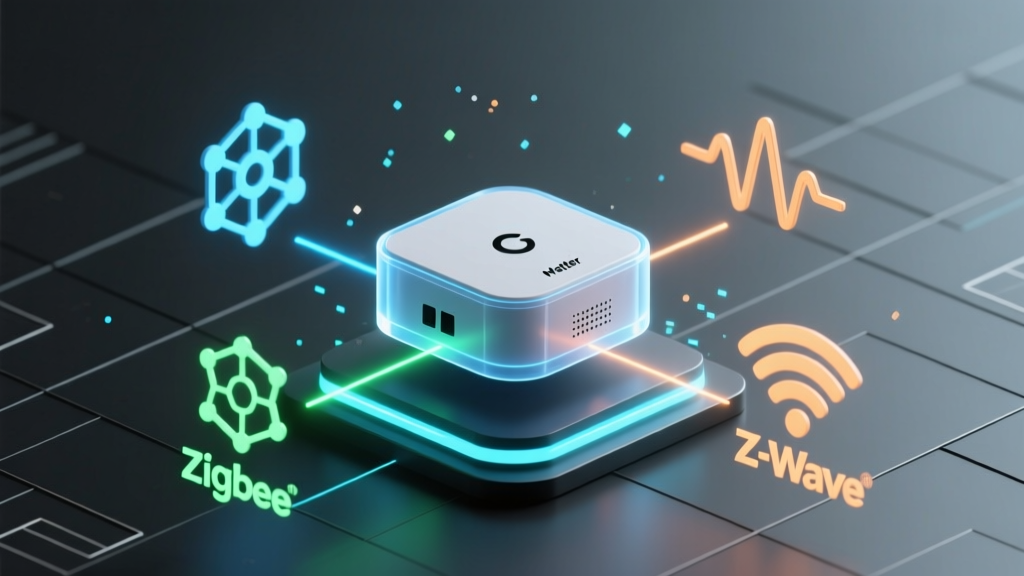
When the Connectivity Standards Alliance (CSA) launched Matter, it fundamentally solved the smart home's biggest crisis: interoperability. By creating a unified application layer, Matter allowed devices from Apple, Google, Amazon, and Samsung to speak the same language. However, as the CSA outlines in its technical documentation, Matter is not a physical radio protocol. It relies entirely on underlying transport layers—primarily Thread, Wi-Fi, and Bluetooth Low Energy (BLE)—to move data through the air.
While Thread offers excellent low-power mesh networking and Wi-Fi provides high bandwidth, both have strict physical limitations. Thread lacks the bandwidth for high-resolution outdoor video, standard Wi-Fi drains batteries and struggles with long-range penetration, and BLE is confined to short-radius proximity. As smart homes expand into smart estates, agricultural outposts, and context-aware spatial environments, the current transports are hitting a ceiling.
So, what comes after Matter? The future of smart home protocols isn't necessarily about replacing Matter's application layer; it is about revolutionizing the physical and context layers beneath it. Enter Wi-Fi HaLow (802.11ah) and Ultra-Wideband (UWB). These two emerging standards are poised to solve the extreme range and millimeter-precision problems that current protocols simply cannot handle.
Wi-Fi HaLow (802.11ah): The Sub-1 GHz Long-Range Champion
Technical Basics and The Physics of Sub-1 GHz
Standard Wi-Fi operates on the 2.4 GHz, 5 GHz, and 6 GHz bands. While these high frequencies carry massive amounts of data, they are notoriously bad at penetrating solid objects like concrete walls, earth, and dense foliage. Wi-Fi HaLow, officially designated as IEEE 802.11ah, shifts Wi-Fi into the sub-1 GHz spectrum (typically 900 MHz in the US).
According to the Wi-Fi Alliance, operating in the sub-1 GHz band allows HaLow signals to travel significantly further and penetrate obstacles with ease. By utilizing narrow channel bandwidths (1, 2, 4, and 8 MHz) and advanced OFDM (Orthogonal Frequency-Division Multiplexing), HaLow achieves a remarkable balance of range and power efficiency.
Range, Speed, and Reliability
- Range: Up to 1 kilometer (3,280 feet) outdoors, and vastly superior indoor penetration compared to 2.4 GHz Wi-Fi.
- Speed: Ranges from 150 Kbps to over 8 Mbps, depending on channel width and distance. This is more than enough for telemetry, audio, and compressed 1080p security video.
- Power Efficiency: HaLow utilizes Target Wake Time (TWT), allowing IoT sensors to sleep for hours or days, waking only for milliseconds to transmit data. A battery-powered HaLow sensor can last for years.
Practical Use Cases and Hardware
Wi-Fi HaLow is the ultimate solution for the 'smart estate' and outdoor perimeter. Imagine a smart gate controller at the end of a 500-foot driveway, or a network of soil moisture sensors across a large property. With standard Wi-Fi, you would need expensive mesh repeaters or hardwired Ethernet. With HaLow, a single router can cover the entire acreage.
Hardware to watch: Companies like Morse Micro are leading the charge with chipsets like the MM6108. For early adopters, Alfa Network offers HaLow-capable routers and access points. Expect to pay between $150 and $300 for a HaLow gateway, with endpoint modules dropping below $15 as production scales.
Ultra-Wideband (UWB): The Spatial Awareness Pioneer
Precision, Time-of-Flight, and Security
If Wi-Fi HaLow solves the 'how far' problem, Ultra-Wideband (UWB) solves the 'exactly where' problem. UWB is a radio technology that uses very low energy for short-range, high-bandwidth communications across a very wide portion of the radio spectrum (typically 6.5 to 8 GHz).
Unlike Bluetooth RSSI (Received Signal Strength Indicator), which guesses distance based on signal degradation, UWB measures Time-of-Flight (ToF). By calculating the exact nanoseconds it takes for a radio pulse to travel between two antennas, UWB can determine spatial positioning down to 10 to 30 centimeters. Furthermore, because UWB relies on precise timing rather than signal strength, it is virtually immune to relay attacks—a critical security flaw in older smart locks and keyless entry systems where hackers amplify a BLE signal to trick a lock into opening.
The FiRa Consortium and Smart Home Applications
The FiRa Consortium is the governing body driving UWB interoperability, ensuring that a UWB chip from NXP can communicate seamlessly with one from Qorvo or Apple. In the post-Matter smart home, UWB will serve as the ultimate context-aware trigger.
- Frictionless Smart Locks: Your front door unlocks only when your phone crosses the exact 1-meter threshold of the porch, ignoring you if you are just walking past the house on the sidewalk.
- Directional Audio and Lighting: Multi-room audio systems that track your exact location in the house, dynamically shifting the 'sweet spot' of the speakers to follow you from the kitchen to the living room.
- Gesture Control: UWB's micro-Doppler radar capabilities can detect subtle hand gestures from across the room, allowing you to silence an alarm or dim lights with a wave of your hand.
Protocol Comparison: Matter Transports vs. Next-Gen Standards
To understand where these protocols fit into your smart home architecture, it is essential to compare their physical capabilities. Below is a structured breakdown of how the current Matter transports stack up against the emerging HaLow and UWB standards.
| Protocol | Primary Role | Max Range | Bandwidth | Power Draw | Spatial Precision |
|---|---|---|---|---|---|
| Thread (Matter) | Mesh IoT Control | ~30m (per hop) | 250 Kbps | Very Low | Low (Room-level) |
| Wi-Fi 6 (Matter) | High-Bandwidth Data | ~50m | Up to 9.6 Gbps | High | Low (Zone-level) |
| BLE (Matter) | Provisioning / Proximity | ~15m | 2 Mbps | Low | Medium (RSSI-based) |
| Wi-Fi HaLow | Long-Range IoT / Video | 1000m+ | Up to 8 Mbps | Low (via TWT) | Low (Zone-level) |
| UWB | Spatial Context / Security | ~10-50m | High (Short bursts) | Low-Medium | Extreme (10-30cm) |
Visualizing the Next Generation of Smart Home Protocols
The following radar chart visualizes the capability profiles of these protocols across five critical dimensions: Range, Bandwidth, Power Efficiency, Spatial Precision, and Wall Penetration. This illustrates why a multi-protocol approach is mandatory for the future smart home.
How to Prepare Your Smart Home for the Post-Matter Era
While Matter is currently dominating the retail shelves at Apple, Amazon, and Best Buy, the transition to HaLow and UWB is already beginning in the enterprise and high-end residential sectors. As a smart home enthusiast or professional installer, here is how you can future-proof your infrastructure and begin experimenting today.
1. Pre-Wire for UWB Anchors
UWB requires a network of 'anchors' (fixed receivers) to triangulate the position of a 'tag' (your phone or a smart remote). For true whole-home spatial awareness, you will need 3 to 4 anchors per floor. If you are building or renovating, run Cat6a Ethernet to high, central points on your ceilings in the living room, kitchen, and hallways. This will allow you to plug in PoE (Power over Ethernet) UWB anchors in the future without relying on battery power or messy wall adapters.
2. Experiment with HaLow Evaluation Kits
You don't have to wait for consumer-grade HaLow routers to hit the mass market. Companies like Morse Micro offer evaluation kits (such as the MM6108-EKH) that allow developers and advanced hobbyists to set up sub-1 GHz IP networks today. Priced around $300, these kits are invaluable for testing long-range IP camera placements at the edges of your property before committing to a permanent installation.
3. Look for 'UWB Ready' Smart Locks and Hubs
While Apple has utilized UWB in its AirTags and HomePod mini for years, the smart lock market is just catching up. When shopping for your next entryway upgrade, look beyond standard BLE or NFC proximity. Brands integrating NXP's SR150 or Qorvo's DW3000 chipsets are beginning to surface. These locks will eventually integrate with the Matter standard via a UWB bridge, providing cryptographic spatial security that Bluetooth simply cannot match.
4. Deploy Hybrid Gateways
The ultimate smart home hub of the future will not just be a Matter-over-Thread border router. It will be a hybrid gateway capable of translating Matter commands into HaLow for the outdoor perimeter, while simultaneously polling local UWB anchors to determine who is in the room and where they are facing. Keep an eye on high-end networking brands like Ubiquiti and TP-Link Omada, which are historically first to integrate emerging IEEE standards into their prosumer gateway lineups.
The Spatial Computing Paradigm: 'The smart home of the past decade was reactive—you pressed a button, and a light turned on. The post-Matter smart home will be predictive and spatial. By fusing Matter's universal language with UWB's millimeter precision and HaLow's boundless range, your home will know exactly where you are, what you need, and how to reach the furthest corners of your property without missing a beat.'
Conclusion
Matter was the necessary unifying treaty that ended the smart home's tribal wars. But a treaty is only as good as the infrastructure that supports it. As our homes expand outward to gates, gardens, and garages, and inward to the granular, spatial awareness of individual rooms, the physical limitations of 2.4 GHz Wi-Fi and Bluetooth become glaringly obvious.
Wi-Fi HaLow and Ultra-Wideband represent the next great leap in smart home protocols. HaLow will push the boundaries of our digital perimeters, ensuring that no sensor is too far to connect. Meanwhile, UWB will give our homes eyes and ears, transforming dumb rooms into context-aware environments that react to our precise physical presence. By understanding and preparing for these standards now, you ensure that your smart home won't just be connected—it will be truly intelligent.