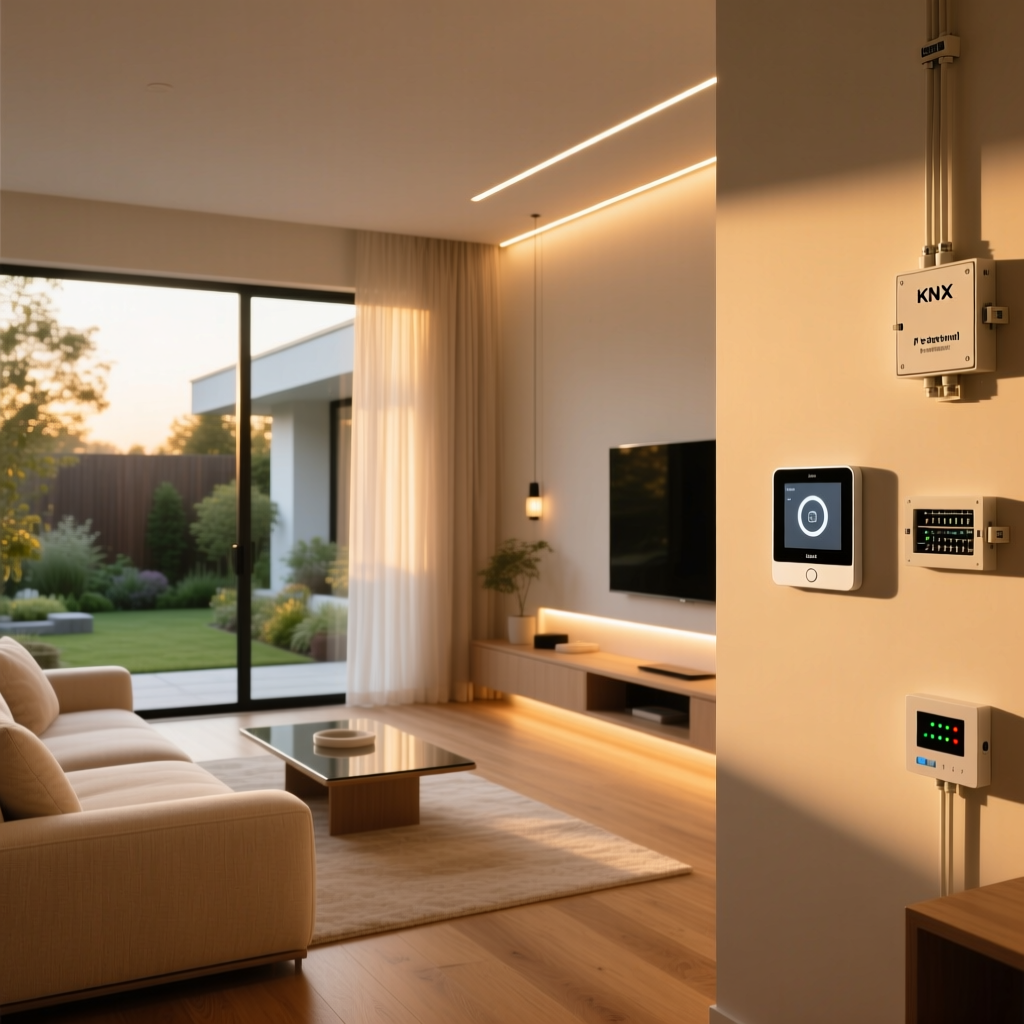
The evolution of building automation has transformed how we interact with our physical environments, but as smart buildings become more interconnected, the need for robust cybersecurity has never been more critical. At the forefront of this evolution is the KNX protocol, the global standard for home and building control. While legacy KNX Classic revolutionized the industry with its decentralized, multi-vendor approach, it was designed in an era where physical access to the bus cable was the primary security perimeter. Today, with IP routing, RF extensions, and remote access, that perimeter has vanished. Enter KNX Secure, and more specifically, the complex and vital mechanism of KNX Secure Data Security Multicast.
Multicast messaging is the absolute backbone of the KNX philosophy. Unlike traditional IT networks that rely heavily on point-to-point (unicast) communication, KNX utilizes group addresses to send a single command to multiple devices simultaneously. When you press a single 'All Lights Off' button, a single multicast telegram is dispatched to the bus, and every actuator listening to that specific group address reacts instantly. Securing this one-to-many communication without introducing crippling network latency or overwhelming the physical bus topology is one of the most significant engineering achievements in modern building automation. This comprehensive guide explores the cryptographic foundations, operational mechanics, and practical implementation of KNX Secure Data Security Multicast.
How KNX Secure Multicast Works
To understand the brilliance of KNX Secure Multicast, we must first dissect the underlying cryptographic framework of KNX Data Security. The protocol relies on the Advanced Encryption Standard (AES) with a 128-bit key length, operating in Counter with CBC-MAC (CCM) mode. CCM is a highly efficient authenticated encryption algorithm that provides both confidentiality (encrypting the payload so eavesdroppers cannot read it) and data origin authenticity (ensuring the command actually came from an authorized sensor and was not tampered with in transit).
In a standard unicast scenario, Device A and Device B share a unique, symmetric encryption key. If Device A wants to send a secure command to Device B, it encrypts the payload using their shared key. However, multicast introduces a fundamental cryptographic challenge: How do you securely send a single encrypted message to fifty different devices, ensuring that all fifty can decrypt it, while preventing an unauthorized device on the same bus from reading it?
The solution is the implementation of Secure Group Keys. During the commissioning phase, the Engineering Tool Software (ETS) generates a unique, randomized 128-bit Group Key for every secure group address in the project. This Group Key must then be securely distributed to every device assigned to that group. Because the physical KNX Twisted Pair (TP) bus cannot be trusted to carry these keys in plain text, the ETS utilizes a Security Proxy. The Security Proxy establishes individual, secure unicast tunnels with each target device and securely injects the Group Key into their respective memory banks.
Once the Group Key is established, the multicast communication can begin. When a secure sensor triggers a multicast command, it constructs a Secure APCI (Application Protocol Control Unit) telegram. This telegram includes the encrypted payload, a Message Authentication Code (MAC) to verify integrity, and a crucial 48-bit Sequence Number. The Sequence Number is the linchpin of the protocol's anti-replay protection. Every time a device sends a secure telegram, the sequence number increments. Receiving devices track the sequence numbers of their peers; if a malicious actor records a 'lights off' multicast telegram and attempts to re-transmit it later (a replay attack), the receiving actuators will recognize that the sequence number is outdated and will silently drop the packet, maintaining the security and integrity of the smart home environment.
Compatibility and Ecosystem Integration
One of the most pressing concerns for system integrators and facility managers is backward compatibility. The KNX Association designed KNX Secure to coexist with KNX Classic, allowing for gradual migrations and hybrid topologies. However, integrating Secure Multicast into an existing ecosystem requires a deep understanding of how the ETS handles mixed environments and the role of boundary devices like IP Routers.
Within the ETS environment, lines and areas can be configured as 'Secure' or 'Classic'. When a multicast telegram originates from a Secure sensor and is destined for a group containing both Secure and Classic actuators, the ETS and the network topology must handle the translation. A Secure actuator will expect an encrypted telegram with a valid MAC and sequence number. A Classic actuator, lacking the cryptographic hardware and the Group Key, will simply ignore the Secure APCI telegram, treating it as an unknown or unsupported command. Therefore, to control a Classic device securely, the command must often be routed through a Secure IP Router or a dedicated security proxy that decrypts the multicast message on the IP backbone and re-transmits it as a Classic telegram on the local TP line. This boundary translation is vital for maintaining security perimeters while ensuring legacy hardware remains functional.
Furthermore, KNX Secure Multicast is not limited to the Twisted Pair (TP) physical layer. It extends seamlessly into KNX IP Secure and KNX RF Secure. In KNX IP environments, multicast is natively supported via IP multicast routing protocols (like IGMP). Securing IP multicast requires the IP backbone to utilize DTLS (Datagram Transport Layer Security) or the specific KNX IP Secure encapsulation methods. When a secure multicast telegram transitions from the TP bus to the IP backbone via a Secure IP Router, the router acts as a trusted gateway. It decrypts the TP-level secure telegram, verifies the MAC and sequence number, and then re-encrypts it for the IP backbone using the appropriate IP Secure multicast keys. This layered compatibility ensures that whether a command is traveling across a copper cable in a residential villa or across a fiber-optic backbone in a commercial skyscraper, the data remains secure and the multicast efficiency is preserved.
Performance and Network Overhead
Security is never free; it always exacts a toll on performance, bandwidth, and latency. In the context of KNX, which was originally designed for extremely low-bandwidth, low-latency control signaling, the overhead introduced by AES-128 CCM encryption is a critical design consideration. Understanding this overhead is essential for designing stable, high-performance building automation networks.
A standard KNX Classic telegram is remarkably compact, often consisting of just a few dozen bytes. When KNX Data Security is applied, the telegram expands significantly. The addition of the Secure APCI header, the 48-bit sequence number, the initialization vector, and the 6-byte MAC adds substantial bytes to the payload. On a KNX TP1-256 network, which operates at a modest 9600 baud, this expansion increases the transmission time of each telegram. If an integrator were to use Unicast Secure messaging to turn off fifty lights, the sensor would have to generate, encrypt, and transmit fifty individual telegrams. This would cause a 'network storm,' saturating the bus, introducing severe latency, and potentially causing collisions and dropped packets.
This is exactly why KNX Secure Data Security Multicast is an engineering necessity. By utilizing a Group Key, the sensor only needs to generate and transmit a single encrypted multicast telegram. While this single telegram is larger than its Classic counterpart, it is exponentially more efficient than fifty separate secure unicast telegrams. The bus load is minimized, and the latency is kept to an acceptable threshold. However, integrators must still account for the increased processing time required by the Bus Coupling Units (BCUs) inside the devices. Encrypting and decrypting AES-128 payloads requires computational power. Older or lower-tier microcontrollers may introduce slight processing delays. In modern, high-end commercial building automation systems, manufacturers utilize dedicated cryptographic co-processors within the BCU to handle the CCM calculations in hardware, ensuring that the decryption of a secure multicast telegram occurs in milliseconds, preserving the instant-response feel that end-users expect from premium light switches and climate controls.
Security Architecture and Threat Mitigation
The threat landscape for building automation is diverse, ranging from casual eavesdropping to sophisticated man-in-the-middle (MITM) attacks and malicious replay injections. KNX Secure Data Security Multicast was architected specifically to neutralize these vectors while maintaining the decentralized nature of the KNX bus.
The primary threat to any multicast protocol is the compromise of the Group Key. If an attacker obtains the Group Key, they can decrypt all traffic for that group and, worse, inject forged commands. To mitigate this, KNX employs a strict key management hierarchy. The Group Keys never traverse the bus in plain text. They are generated locally within the secure enclave of the ETS software and are pushed to the devices via the Security Proxy using individual, device-specific Unicast Keys. These Unicast Keys are derived from the Factory Default Setup Key (FDSK). The FDSK is a unique, factory-installed key printed on the device label or encoded in a QR code. During the initial commissioning, the integrator scans the QR code or manually enters the FDSK into the ETS. The ETS uses this FDSK to establish a secure, authenticated tunnel with the device, allowing it to safely provision the Toolkey and the subsequent Group Keys. This ensures that even if an attacker is physically tapping the bus cable during the commissioning phase, they cannot intercept the Group Keys.
Another critical threat is the Replay Attack, where an attacker records a valid 'unlock door' or 'disable alarm' multicast telegram and re-broadcasts it later. As mentioned, the 48-bit Sequence Number prevents this. However, managing sequence numbers in a multicast environment introduces the challenge of synchronization. If a device is powered off or disconnected from the bus for an extended period, it may miss thousands of sequence number increments. When it powers back on, it might reject valid new multicast telegrams because their sequence numbers appear 'too far ahead' of its last known state. To resolve this, KNX Secure defines specific synchronization mechanisms. Devices can request sequence number synchronization via the Security Proxy, or the ETS can push a synchronization telegram during a maintenance visit. This delicate balance between strict anti-replay enforcement and practical network resilience is what makes KNX Secure a robust, enterprise-grade security protocol.
Best Devices and Implementation Strategies
Implementing KNX Secure Data Security Multicast successfully requires selecting the right hardware and adhering to best practices during the design and commissioning phases. Not all KNX devices are created equal, and the cryptographic demands of Secure Multicast separate premium, future-proof devices from legacy or budget alternatives.
When specifying devices for a secure multicast environment, the first component to evaluate is the Secure IP Router or USB Interface. These devices act as the Security Proxy and the gateway to the ETS. High-quality interfaces from manufacturers like Gira, Jung, ABB, and MDT feature dedicated secure elements (hardware cryptographic chips) that accelerate the key distribution process. Commissioning a large project with hundreds of secure group addresses can take considerable time if the Security Proxy relies on software-based encryption; hardware-accelerated proxies drastically reduce ETS programming times.
Next, consider the actuators and sensors. For actuators (such as dimmers, blind controllers, and HVAC valves), look for devices that explicitly support KNX Data Security and feature adequate memory allocation for multiple Group Keys. A single lighting actuator might be part of a local room group, a floor-wide 'all-off' group, and a building-wide 'emergency scene' group. The BCU must be capable of storing and rapidly referencing multiple secure group contexts. For sensors, particularly KNX RF Secure devices like wireless glass break detectors or outdoor motion sensors, secure multicast is vital. RF transmissions are inherently broadcast in nature and easily intercepted. Utilizing KNX RF Secure Multicast ensures that a wireless security sensor can trigger a hardwired alarm siren and a lighting scene simultaneously, with absolute cryptographic certainty that the signal was not spoofed by an intruder with a software-defined radio.
Best practices dictate that integrators should segment their topologies logically. Keep high-security multicast groups (like access control and alarm systems) on dedicated, physically secure TP lines, separated from general comfort controls (like standard lighting scenes) by Secure IP Routers. This limits the blast radius of any potential physical compromise and optimizes the bus load, ensuring that the encryption overhead does not impact the responsiveness of the broader building automation system.
Frequently Asked Questions
Can I mix KNX Classic and KNX Secure Multicast devices on the same line?
Yes, you can mix them on the same physical TP line, but they will not interact securely. A KNX Classic device lacks the cryptographic hardware and the Group Keys required to decrypt a KNX Secure Multicast telegram. If a secure sensor sends an encrypted multicast command, the secure actuators will decrypt and execute it, while the classic actuators will simply ignore it as an unrecognized APCI type. To bridge the gap, you must use a Secure IP Router or a dedicated proxy device configured to decrypt the secure multicast message on one side and re-transmit it as a classic, unencrypted multicast message on the local line, though this reduces the end-to-end security of that specific command.
What happens if a device loses its sequence number synchronization?
If a device is disconnected from the bus or loses power for an extended period, it may miss a significant number of multicast sequence number increments. Upon rebooting, if it receives a new secure multicast telegram with a sequence number that falls outside its acceptable synchronization window, it will reject the telegram to prevent potential replay attacks. To fix this, the device must undergo a sequence number resynchronization. In many modern implementations, the device will automatically request a sync from the Security Proxy, or the integrator can manually trigger a synchronization download via the ETS software during a maintenance visit.
Does KNX Secure Multicast work over KNX RF?
Absolutely. In fact, KNX Secure Multicast is highly recommended for KNX RF environments. Because radio frequencies broadcast through the air, they are inherently susceptible to eavesdropping and spoofing. KNX RF Secure utilizes the same AES-128 CCM encryption and sequence numbering as the TP bus. When a secure RF sensor sends a multicast command, it is encrypted before transmission. A Secure RF-to-TP coupler receives the RF signal, verifies the MAC and sequence number, and then securely routes the multicast command onto the wired TP backbone, ensuring seamless and secure integration of wireless peripherals into the broader building automation ecosystem.
How are group keys updated if a secure device is replaced?
Key management during hardware replacement is handled entirely by the ETS software. When a secure device fails and needs to be replaced, the integrator connects the new device to the bus and uses its Factory Default Setup Key (FDSK) to onboard it into the ETS project. The ETS recognizes that the new device is taking the place of an existing participant in various secure multicast groups. The ETS then uses the Security Proxy to securely push the existing, active Group Keys to the new device via a secure unicast tunnel. The rest of the devices on the bus do not need to be reprogrammed or have their keys changed, making hardware maintenance efficient and secure.
Is KNX Secure mandatory for all new building automation installations?
While the KNX Association highly recommends KNX Secure for all new installations, it is not strictly mandatory for basic functionality. KNX Classic devices are still manufactured and widely used, particularly in low-risk residential applications where the physical security of the bus cable is guaranteed and no IP routing is utilized. However, for any commercial building, public infrastructure, or residential project utilizing KNX IP Secure, remote access, or RF extensions, implementing KNX Data Security and Secure Multicast is considered an absolute industry best practice to protect against modern cyber threats and ensure compliance with stringent building security standards.