The Dawn of a Unified Smart Home
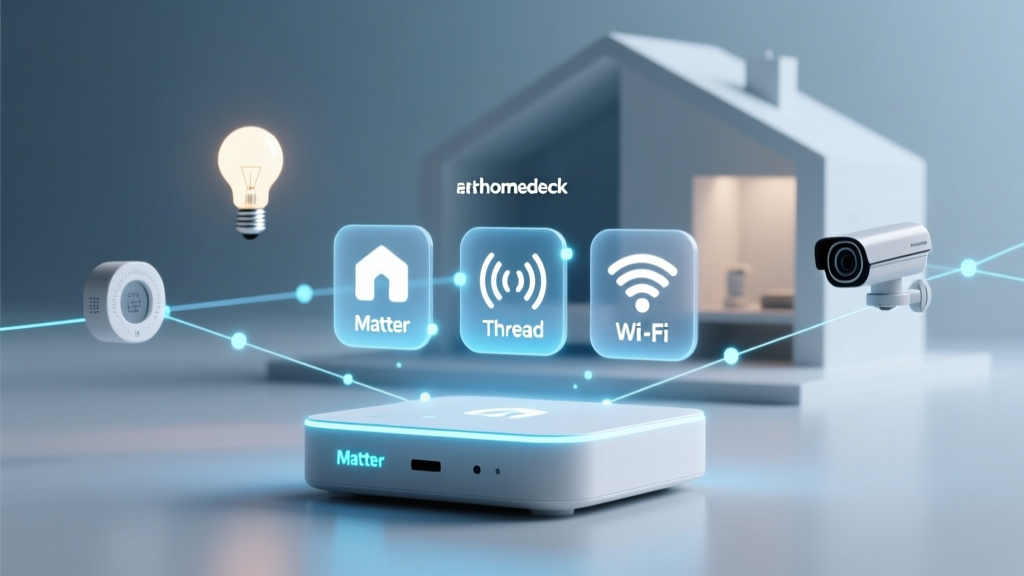
For over a decade, the smart home industry has been plagued by a frustrating reality: walled gardens. Consumers were forced to choose between Amazon Alexa, Apple HomeKit, Google Home, or Samsung SmartThings, often finding that a smart bulb purchased for one ecosystem would completely fail to communicate with a smart speaker from another. This fragmentation not only confused consumers but also stunted the growth of home automation. Enter Matter, the industry-wide standard that promises to tear down these walls, and Thread, the low-power mesh networking protocol that serves as its ideal foundation.
In this complete guide, we will explore the technical architecture of Matter over Thread, compare it to legacy protocols, and provide a comprehensive buyer’s guide to building a reliable, future-proof smart home network. Whether you are upgrading a single room or automating a multi-story property, understanding how these two technologies interact is the key to achieving a truly seamless smart home experience.
Understanding the Architecture: Matter and Thread
To understand why this combination is revolutionary, we must separate the application layer from the transport layer. According to the Connectivity Standards Alliance (CSA), Matter is an application layer protocol. It dictates how devices communicate, how they are securely provisioned, and how they interpret commands (e.g., what the command for "dim to 50%" actually looks like). Matter can run over Wi-Fi, Ethernet, or Thread.
Thread, on the other hand, is a transport layer protocol. The Thread Group defines Thread as an IP-based, low-power mesh networking protocol built on the IEEE 802.15.4 standard. Unlike Zigbee or Z-Wave, Thread is natively IPv6, meaning every single sensor or bulb gets its own unique IP address on your network. There is no central hub that can act as a single point of failure; instead, the network is a self-healing mesh where every mains-powered device acts as a router.
Developers utilizing the official Matter SDK can leverage Thread to ensure that battery-powered sensors and smart locks communicate with the same IP-based reliability as your laptop or smartphone, but at a fraction of the power consumption.
Matter over Thread vs. Legacy Protocols
How does Matter over Thread stack up against the protocols that dominated the last decade? Below is a detailed comparison matrix evaluating network topology, power requirements, and IP addressability.
| Feature | Matter over Thread | Matter over Wi-Fi | Zigbee 3.0 | Z-Wave Plus |
|---|---|---|---|---|
| Topology | Self-Healing Mesh | Star (Hub Dependent) | Mesh (Hub Dependent) | Mesh (Hub Dependent) |
| Power Consumption | Ultra-Low | High | Low | Low |
| IP Addressable | Yes (Native IPv6) | Yes (IPv4/IPv6) | No (Requires Hub Translation) | No (Requires Hub Translation) |
| Range / Scalability | Extensible via Mesh | Limited by Wi-Fi Router | Extensible via Mesh | Extensible via Mesh |
| Hub Required | Thread Border Router Only | No | Proprietary Ecosystem Hub | Proprietary Ecosystem Hub |
| Multi-Admin Support | Yes (Native to Matter) | Yes (Native to Matter) | No (Usually locked to one app) | No (Usually locked to one app) |
As the table illustrates, Matter over Thread offers the mesh reliability of Zigbee with the IP-based universality of Wi-Fi. This eliminates the need for proprietary USB dongles or brand-specific bridges.
The Crucial Component: Thread Border Routers
A Thread network cannot connect to the internet or your home Wi-Fi on its own. It requires a Thread Border Router (TBR). A TBR bridges the 802.15.4 Thread mesh network to your Wi-Fi or Ethernet LAN, translating the low-power mesh traffic into standard IP packets. Fortunately, you likely do not need to buy a dedicated hub; many modern smart speakers already have TBRs built-in.
Top Thread Border Routers (Buyer's Guide)
- Apple TV 4K (Ethernet Model) - $149: Widely considered the gold standard for Thread reliability. The Ethernet backhaul ensures that Thread traffic is offloaded from your Wi-Fi bands, reducing congestion. Essential for Apple HomeKit users.
- Apple HomePod (2nd Gen) - $299 / HomePod Mini - $99: Both feature robust Thread radios. The Mini is an affordable way to add a Border Router to a specific room to extend mesh range.
- Google Nest Hub (2nd Gen) - $99: Google's premier TBR. It integrates seamlessly with Google Home and supports the Thread 1.2+ multi-router mesh unification standard.
- Amazon Echo (4th Gen) - $99: The spherical 4th-generation Echo was Amazon's first device to include a Thread Border Router and a Zigbee hub, making it a versatile bridge for mixed-protocol homes.
Pro Tip: For large homes, deploy at least two Border Routers from the same ecosystem (e.g., two Apple TVs or two Nest Hubs). While Thread is designed to unify meshes across brands, real-world testing shows that keeping Border Routers within the same manufacturer's firmware environment drastically reduces routing loops and latency spikes.
Top Matter over Thread Devices to Buy
Now that your Border Router is established, you need Thread end-devices. Remember: battery-powered devices (sensors, locks) must use Thread, while mains-powered devices (plugs, bulbs) can use either Thread or Wi-Fi. We recommend Thread for all devices to strengthen your mesh network.
1. Eve Energy Smart Plug ($39.95)
Eve was one of the first manufacturers to go all-in on Thread. The Eve Energy plug not only controls appliances but also provides real-time energy monitoring (voltage, current, wattage) directly in the Apple Home or Eve app. Because it is mains-powered, it acts as a Thread mesh router, extending the range of your network to the far corners of your room.
2. Nanoleaf Essentials A19 Bulb ($24.99)
Nanoleaf's Essentials line is unique because it supports both Bluetooth and Thread. During setup, it uses Bluetooth Low Energy (BLE) for rapid pairing, then seamlessly transitions to the Thread mesh. It supports adaptive lighting and Circadian rhythm adjustments natively through Matter.
3. Aqara Door and Window Sensor P2 ($39.99)
Battery-powered sensors are where Thread truly shines. The Aqara P2 uses a standard CR2032 coin cell but achieves a battery life of up to two years thanks to Thread's ultra-low sleep currents. It also features Matter-native tamper alerts and local automation capabilities.
Visualizing Protocol Performance
When designing a smart home, latency and power consumption are the two most critical metrics. The chart below visualizes how Matter over Thread compares to Wi-Fi and legacy mesh protocols in real-world response times and relative power draw.
As the data shows, Matter over Thread delivers latency that is nearly on par with wired solutions and vastly superior to Wi-Fi, which often suffers from 2.4GHz band congestion. Furthermore, its power draw index is exceptionally low, making it the undisputed champion for battery-operated security and environmental sensors.
Network Setup and Optimization Guide
Building a Thread mesh is not a "set it and forget it" process. Improper placement of Border Routers can lead to orphaned devices and delayed automations. Follow these actionable steps for optimal deployment:
Step 1: Optimize Your Wi-Fi for Provisioning
Matter uses Bluetooth Low Energy (BLE) and your 2.4GHz Wi-Fi network to provision new Thread devices. Ensure your smartphone is connected to the 2.4GHz band during setup. If you use a mesh Wi-Fi system (like Eero or Orbi), temporarily disable "band steering" or create a dedicated 2.4GHz IoT SSID to prevent provisioning timeouts.
Step 2: Strategic Border Router Placement
Do not hide your Thread Border Router inside a media cabinet or behind a television. The 802.15.4 radio operates on 2.4GHz and is highly susceptible to interference from USB 3.0 cables, microwaves, and thick masonry walls. Place your TBR in a central, elevated location. If you have a multi-story home, place one TBR on the main floor and a second TBR on the upper floor to ensure vertical mesh coverage.
Step 3: Seed the Mesh with Mains-Powered Devices
Thread networks rely on "Router Eligible End Devices" (REEDs) to pass messages. These are almost always mains-powered devices like smart plugs and light bulbs. Before installing a battery-powered Thread lock on your front door, ensure there is at least one Thread smart plug or bulb within 30 feet of the door to act as a signal repeater.
Uncompromising Security Architecture
Security is not an afterthought in Matter; it is the foundation. Matter utilizes a blockchain-style Device Attestation Certificate (DAC) system. Every single Matter-certified device contains a unique cryptographic certificate signed by the manufacturer and verified by the CSA. When you scan a Matter QR code, your phone verifies this certificate against a distributed ledger to ensure the device is genuine and has not been tampered with.
Furthermore, all Thread communications are secured with AES-128 encryption at the network layer, and Matter adds an additional layer of end-to-end encryption at the application layer. Even if a malicious actor intercepts the radio waves in your living room, the payload remains entirely unreadable. This dual-layer security model makes Matter over Thread significantly more secure than legacy Zigbee implementations, which were often vulnerable to key-extraction attacks.
The Future: Thread 1.4 and Matter 1.3
The smart home landscape is evolving rapidly. The upcoming Thread 1.4 specification aims to solve the current friction of multi-admin meshes, allowing Border Routers from Apple, Google, and Amazon to seamlessly share network credentials and form a single, unified mesh without user intervention. Meanwhile, Matter 1.3 expands device categories beyond lighting and locks, introducing support for water leak detectors, EV chargers, and solar inverters.
By investing in Thread Border Routers and Matter-certified end devices today, you are not just buying smart home gear; you are investing in an IP-based infrastructure that will natively support the next decade of home energy management and environmental monitoring.
Conclusion
Matter over Thread represents the maturation of the smart home industry. By combining the universal language of Matter with the resilient, low-power mesh of Thread, consumers can finally build automation networks that are fast, reliable, and independent of proprietary hubs. Start by auditing your current smart speakers to see if they support Thread, strategically place your Border Routers, and prioritize Thread-native devices for your next smart home upgrade. The era of the walled garden is over; the era of the unified mesh has begun.