The Application Layer Triumph and the Physical Layer Ceiling
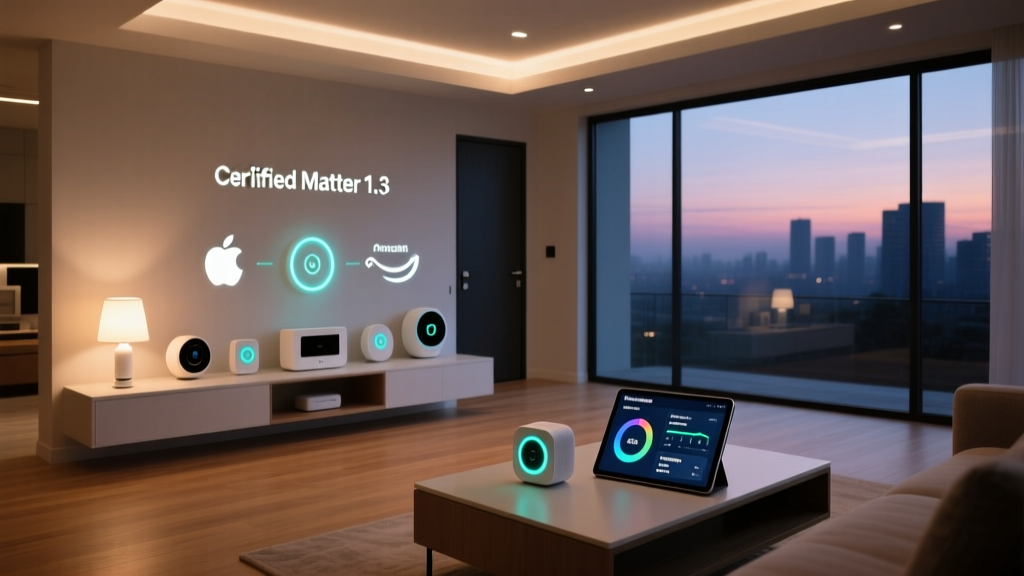
The introduction of the Matter standard was a watershed moment for the smart home industry. By unifying the application layer, the Connectivity Standards Alliance (CSA) effectively eliminated the walled gardens that previously forced consumers to choose between Apple HomeKit, Google Home, and Amazon Alexa ecosystems. As detailed by the CSA's official Matter overview, the protocol ensures that a smart lock or a lighting fixture can communicate seamlessly across different platforms using a common language. However, Matter is fundamentally an application layer protocol; it does not dictate the physical radio frequencies or the MAC layer transport mechanisms. Instead, it relies on existing underlying networks: primarily Wi-Fi, Thread, and Ethernet.
While Thread and Wi-Fi have served the industry well, they possess inherent physical limitations. Thread (based on IEEE 802.15.4) operates on the crowded 2.4 GHz spectrum, offering excellent low-power mesh capabilities but severely limited bandwidth (capping around 250 kbps) and restricted range through dense building materials. Wi-Fi offers immense bandwidth for high-definition video but is notoriously power-hungry, making it unsuitable for battery-operated sensors intended to last for years. Furthermore, neither protocol is optimized for expansive outdoor perimeters or deep structural penetration. This physical layer ceiling has prompted the industry to look toward the next frontier of wireless communication: Wi-Fi HaLow and Ambient IoT.
Wi-Fi HaLow (802.11ah): The Sub-1GHz Powerhouse
Wi-Fi HaLow, officially designated as IEEE 802.11ah, represents a paradigm shift in how we think about Wi-Fi. Unlike traditional Wi-Fi 6 or Wi-Fi 7, which operate in the 2.4 GHz, 5 GHz, and 6 GHz bands, HaLow operates in the sub-1 GHz unlicensed spectrum (typically 902-928 MHz in the United States). According to the Wi-Fi Alliance, this lower frequency provides superior diffraction and penetration characteristics, allowing signals to pass through concrete walls, brick, soil, and dense foliage with minimal degradation.
Technical Specifications and Smart Home Use Cases
Wi-Fi HaLow is engineered specifically for the Internet of Things. It utilizes narrower channel bandwidths (ranging from 1 MHz to 8 MHz) compared to traditional Wi-Fi, which drastically reduces power consumption while extending range. A single HaLow access point can theoretically reach devices up to 1 kilometer away, though in a dense residential environment, a realistic expectation is 100 to 300 meters of reliable indoor/outdoor penetration.
- Bandwidth: Ranges from 150 kbps to 8.67 Mbps, sufficient for low-framerate security cameras, audio streaming, and high-frequency sensor telemetry.
- Power Efficiency: Features advanced sleep modes (Target Wake Time) allowing battery-operated sensors to last for several years on a single charge.
- Security: Natively supports WPA3-SAE, ensuring enterprise-grade encryption that rivals Matter's security requirements.
In a practical smart home context, Wi-Fi HaLow is the ultimate solution for the 'outer perimeter.' Consider a smart water leak sensor buried under a concrete slab, a driveway LiDAR sensor, or a high-definition HomeKit Secure Video camera positioned at the edge of a large property. Traditional Thread meshes would require multiple outdoor repeaters, and standard Wi-Fi would drain the camera's battery in weeks. HaLow bridges this gap, offering native IP connectivity (meaning it integrates directly with Matter bridges without complex translation hubs) over vast distances.
Ambient IoT: The Zero-Power Frontier
If Wi-Fi HaLow solves the range and penetration problem, Ambient IoT solves the power problem entirely. Currently being standardized under 3GPP Release 18 and 19, Ambient IoT (often referred to as Zero-Power or Backscatter IoT) represents a leap toward devices that require no batteries whatsoever. The 3GPP Release 18 specifications outline the framework for devices that harvest energy from ambient sources—such as RF signals, indoor lighting, thermal gradients, or kinetic vibration—and use backscatter modulation to communicate.
How Backscatter Communication Works
Instead of generating its own radio frequency signal (which requires significant energy), an Ambient IoT tag reflects and modulates an existing RF signal from a nearby router or cellular tower. By altering the antenna's impedance, the tag encodes data onto the reflected wave. This process consumes mere microwatts of power, enabling the creation of 'smart dust' or pixel-sized sensors that can be embedded into everyday objects.
For the smart home, Ambient IoT unlocks use cases that were previously economically and logistically unfeasible:
- Smart HVAC Filters: A postage-sized Ambient sensor embedded in an air filter can monitor particulate buildup and airflow resistance, alerting your smart thermostat exactly when a replacement is needed, powered entirely by the airflow and ambient indoor light.
- Structural and Seal Monitors: Sensors embedded within window frames or door seals can detect micro-warps or moisture intrusion, reporting back via backscatter to a central hub.
- Pantry and Inventory Tracking: Smart labels on consumables can interact with a UWB or RF reader in your smart pantry, automatically updating your grocery list without the need for barcode scanning or battery-powered RFID tags.
Comparative Analysis: Matter Transport vs. Next-Gen Protocols
To understand where Wi-Fi HaLow and Ambient IoT fit into the broader ecosystem, it is essential to compare their physical characteristics against the current standards that carry Matter traffic.
| Protocol | Frequency Band | Max Range (Indoor) | Peak Speed | Primary Power Source |
|---|---|---|---|---|
| Wi-Fi 6 (Matter) | 2.4 / 5 / 6 GHz | ~50 meters | 9.6 Gbps | Mains / High-Capacity Battery |
| Thread (Matter) | 2.4 GHz | ~30 meters (Mesh) | 250 kbps | Standard Batteries (AA/CR2032) |
| Z-Wave (Legacy) | Sub-1 GHz | ~40 meters (Mesh) | 100 kbps | Standard Batteries |
| Wi-Fi HaLow | Sub-1 GHz | ~150+ meters | 8.67 Mbps | Small Batteries / Energy Harvesting |
| Ambient IoT | Sub-6 GHz (Backscatter) | ~10-50 meters | ~50 kbps | Zero-Power (RF/Solar/Thermal) |
Security and Privacy Implications
As we expand the perimeter of the smart home with HaLow and embed zero-power sensors into our private spaces with Ambient IoT, security becomes paramount. Wi-Fi HaLow benefits from decades of Wi-Fi security evolution, natively supporting WPA3-SAE (Simultaneous Authentication of Equals). This protects against offline dictionary attacks, ensuring that an outdoor HaLow camera cannot be easily compromised by a neighbor or a passerby intercepting the sub-1 GHz signal.
Ambient IoT presents a unique security challenge. Because these tags lack the processing power for traditional cryptographic handshakes, security relies on physical layer encryption and ultra-lightweight cryptographic algorithms. The 3GPP is actively developing lightweight authentication frameworks to prevent 'spoofing' or 'replay attacks,' where a malicious actor might record a backscatter signal and replay it to trick a smart lock or inventory system. For the consumer, this means early Ambient IoT devices will likely be restricted to non-critical telemetry (like temperature or presence detection) until hardware-backed lightweight encryption matures.
Practical Buyer's Guide: What to Do Today vs. Tomorrow
The transition from Matter's current physical layers to HaLow and Ambient IoT will not happen overnight. If you are building or upgrading a smart home today, here is how you should approach your network infrastructure:
1. Invest in Thread Border Routers Now
Thread remains the undisputed king of indoor, low-power mesh networking. Devices like the Apple TV 4K, Amazon Echo (4th Gen), and Google Nest Hub act as Thread Border Routers, bridging the 802.15.4 mesh to your Wi-Fi network and the Matter ecosystem. Building a dense Thread mesh today ensures your indoor lighting, blinds, and climate sensors are future-proofed and highly responsive.
2. Wait on Wi-Fi HaLow (Unless You Have Acreage)
Currently, Wi-Fi HaLow hardware is primarily targeted at industrial, agricultural, and enterprise logistics. Consumer-grade HaLow routers and smart home endpoints are just beginning to emerge from silicon vendors like Morse Micro and Newracom. If you have a large property, a detached garage, or extensive outdoor landscaping, expect to see prosumer HaLow kits hitting the market in the $150 to $300 range over the next 18 to 24 months. For standard suburban homes, existing Wi-Fi and Thread meshes are sufficient for now.
3. Monitor UWB and Ambient Synergies
Ultra-Wideband (UWB) is currently used for precise spatial awareness (like finding lost tags or unlocking cars). In the future, UWB readers will likely double as the RF illuminators for Ambient IoT backscatter tags. When shopping for high-end smart home hubs or routers in the coming years, look for devices that advertise both UWB spatial radios and sub-1 GHz capabilities, as these will serve as the foundational gateways for the post-Matter era.
Conclusion
Matter successfully solved the language barrier in the smart home, but it did not rewrite the laws of physics. The 2.4 GHz spectrum is congested, and batteries are finite. Wi-Fi HaLow and Ambient IoT represent the necessary evolution of the physical layer, pushing smart home capabilities beyond the drywall and into the environment itself. By leveraging sub-1 GHz penetration and zero-power backscatter, the next generation of protocols will enable a truly ubiquitous, maintenance-free, and expansive smart ecosystem that makes today's Matter devices look like mere stepping stones.