The Dawn of Home Automation: X10 and Powerline Communication
Before the advent of wireless mesh networks and cloud-connected hubs, the concept of the "smart home" was born on the copper wiring hidden behind our walls. In 1975, Pico Electronics developed the X10 protocol, a groundbreaking communication standard that allowed devices to talk to one another using a home's existing electrical wiring. X10 works by superimposing a 120 kHz radio frequency burst onto the standard 60 Hz AC power line at the zero-crossing point. These bursts encoded simple commands, such as turning a specific lamp on or off, dimming lights, or triggering basic macros.
While revolutionary for its time, X10 was fraught with technical limitations that plague legacy users to this day. The primary issue is signal degradation and noise. Modern household appliances, particularly those with Switch-Mode Power Supplies (SMPS) like LED drivers, laptop chargers, and flat-screen TVs, generate massive amounts of electrical noise that drown out X10's fragile 120 kHz signals. Furthermore, X10 signals cannot cross the 240V split-phase center tap of a standard North American electrical panel without a hardware phase coupler. This resulted in command latencies often exceeding 800 milliseconds, missed commands, and the infamous "ghost switching" where lights would turn on or off seemingly at random due to line noise.
Despite its flaws, X10 laid the foundational philosophy for home automation: the desire for centralized control of decentralized devices. However, as consumer expectations shifted toward reliability and instant response times, the industry recognized the need to cut the cord and move to wireless frequencies.
The Wireless Mesh Revolution: Zigbee and Z-Wave
The transition from powerline to wireless communication marked the first major paradigm shift in smart home history. Instead of relying on noisy copper wires, engineers turned to dedicated radio frequencies to create localized mesh networks. This era was defined by two dominant, yet fiercely competing, protocols: Zigbee and Z-Wave.
Z-Wave: The Sub-GHz Specialist
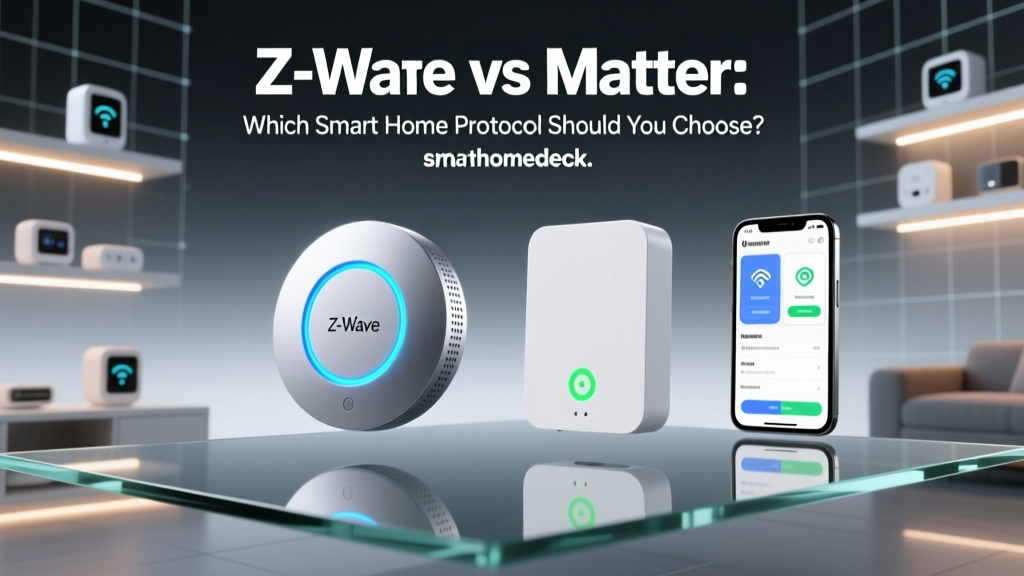
Developed in the early 2000s, Z-Wave operates in the sub-gigahertz spectrum (908.42 MHz in the US, 868.42 MHz in Europe). This strategic frequency choice allows Z-Wave signals to easily penetrate walls, floors, and furniture, completely bypassing the congested 2.4 GHz band occupied by Wi-Fi and Bluetooth. The Z-Wave Alliance mandates strict interoperability testing, meaning a Z-Wave switch from GE Cync will seamlessly communicate with a Hubitat Elevation hub or an Aeotec range extender, regardless of the manufacturer.
The modern iteration, Z-Wave Plus V2 (700 and 800 series), represents a massive leap in efficiency. The 800 series boasts a point-to-point range of up to 100 meters, utilizes beamforming technology to direct RF energy precisely to the target node, and requires so little power that battery-operated door sensors can last upwards of three to five years on a single CR123A cell. Furthermore, Z-Wave S2 security utilizes Elliptic Curve Diffie-Hellman (ECDH) key exchange, ensuring that physical proximity is required for inclusion, completely neutralizing remote hacking vectors.
Zigbee: The High-Bandwidth Mesh
Zigbee, operating on the IEEE 802.15.4 standard at 2.4 GHz, offers higher data throughput than Z-Wave but suffers from the same crowded airspace as Wi-Fi and Bluetooth. To mitigate interference, smart home installers must carefully select Zigbee channels (typically 11, 15, 20, or 25) that do not overlap with the primary Wi-Fi network. Zigbee 3.0 unified various fragmented application profiles into a single standard, enabling devices like the Philips Hue lighting ecosystem and Amazon's Echo Plus to act as coordinators for hundreds of low-power sensors.
The Wi-Fi and Bluetooth Era: High Bandwidth, High Power
As home internet speeds increased and router capabilities expanded, manufacturers realized that for certain devices, a dedicated hub was an unnecessary barrier to entry. Wi-Fi smart plugs and Bluetooth-enabled smart bulbs flooded the market, offering direct-to-consumer connectivity without the need for a Z-Wave or Zigbee bridge. Brands like TP-Link (Kasa), Shelly, and Wyze capitalized on this by embedding ESP8266 and ESP32 microcontrollers directly into their products.
While Wi-Fi is unparalleled for high-bandwidth applications like smart cameras (e.g., Ring, Nest) and video doorbells, it is a poor choice for battery-operated sensors. Wi-Fi's overhead and power-hungry radio states drain AA batteries in a matter of weeks. Consequently, the smart home industry remained fragmented: Wi-Fi for plugs and cameras, Z-Wave for security sensors and locks, and Zigbee for lighting. This fragmentation created a frustrating user experience, requiring multiple apps and hubs to automate a single room.
The Unification: Thread and Matter
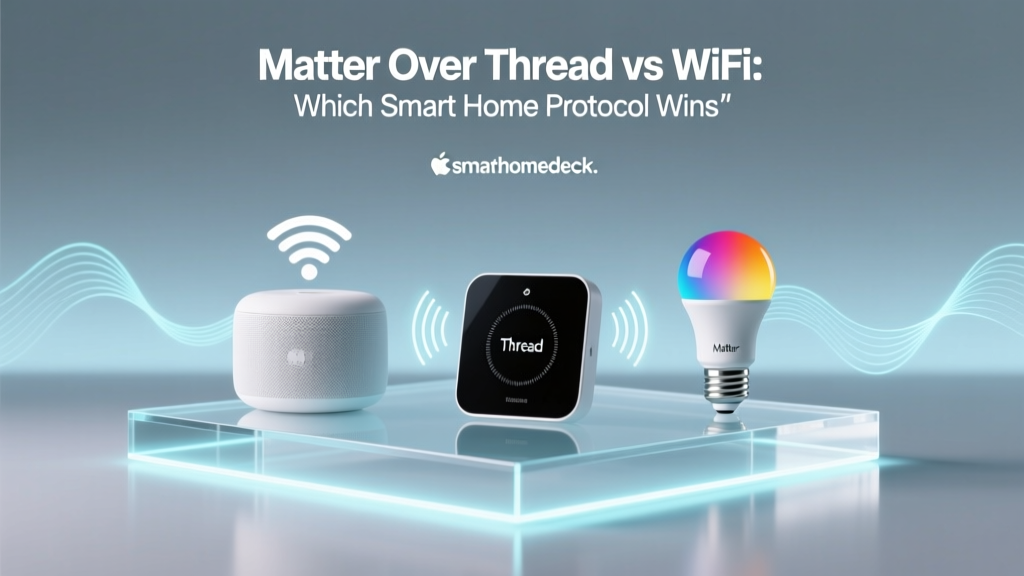
The most significant evolution in smart home history is the recent introduction of Matter and its underlying networking protocol, Thread. According to the Connectivity Standards Alliance (CSA), Matter is not a new wireless radio technology; rather, it is an application layer that standardizes how devices communicate, regardless of whether they are using Wi-Fi, Ethernet, or Thread.
Thread is an IPv6-native, low-power mesh networking protocol built on the same IEEE 802.15.4 radio standard as Zigbee. However, unlike Zigbee, Thread does not rely on a single central coordinator. Instead, Thread networks utilize "Border Routers" (such as the Apple HomePod Mini, Apple TV 4K, or Nest Hub) to bridge the local mesh network to your home's IP network. Because Thread is IP-based, your smart home devices are treated as first-class citizens on your network, allowing for direct, local communication with smartphones and servers without translating through a proprietary hub.
As noted in The Verge's comprehensive guide to Matter, the true power of Matter lies in its multi-admin fabric and unified data model. A Matter-certified Eve Energy smart plug can be simultaneously controlled by Apple HomeKit, Google Home, and Amazon Alexa without complex cloud-to-cloud linking. Furthermore, Matter enforces strict security requirements, including certificate-based Public Key Infrastructure (PKI) and TLS/DTLS encryption for all local and remote communications.
Protocol Evolution: By the Numbers
To understand how far smart home connectivity has come, we must look at the raw performance metrics. The following chart illustrates the dramatic reduction in command latency and the corresponding increase in network reliability as the industry transitioned from legacy powerline communication to modern IP-based mesh networks.
Protocol Latency and Reliability
Compatibility and Cost Matrix
When designing or upgrading a smart home, understanding the physical limitations and cost structures of each protocol is essential. Below is a comparison matrix detailing the core characteristics of the major protocols discussed.
| Protocol | Topology | Max Range (Indoor) | Hub Required? | Typical Device Cost |
|---|---|---|---|---|
| X10 | Powerline | Wiring Dependent | Yes (Controller) | $15 - $30 (Used/Refurb) |
| Z-Wave (800 Series) | Mesh (Sub-GHz) | ~100m (Point-to-Point) | Yes (Z-Wave Hub) | $35 - $75 |
| Zigbee 3.0 | Mesh (2.4 GHz) | ~30m (Node-to-Node) | Yes (Zigbee Coordinator) | $15 - $50 |
| Wi-Fi (Direct) | Star (2.4/5 GHz) | ~45m (Router Dependent) | No (Uses Wi-Fi Router) | $15 - $40 |
| Matter over Thread | Mesh (2.4 GHz) | ~30m (Node-to-Node) | Yes (Thread Border Router) | $40 - $90 |
Practical Migration Guide: Upgrading Your Legacy Smart Home
If you are currently maintaining a legacy X10 or early-generation Insteon system, or if you are trapped in a fragmented ecosystem of Wi-Fi plugs and isolated Zigbee hubs, migrating to a modern, unified architecture is highly recommended. Here is a practical, actionable roadmap for upgrading your smart home infrastructure.
Step 1: Audit and Replace Powerline Devices
X10 and Insteon (which shuttered its operations in 2022) are no longer viable for critical home automation. Begin by replacing legacy powerline switches with modern, neutral-wire-required smart switches. For rock-solid reliability independent of Matter adoption, Lutron Caseta (using proprietary Clear Connect RF) remains the gold standard, costing approximately $60 per switch and $120 for the Pro Hub. If you prefer an open-standard approach, look toward Matter-over-Thread switches from brands like Inovelli or Eve, which typically range from $70 to $100 per unit.
Step 2: Consolidate Hubs with Home Assistant
The most cost-effective and powerful way to bridge your legacy devices into the modern Matter era is by deploying a local automation server. The Home Assistant Green appliance ($99) provides a robust, local-first brain for your home. To connect your existing Z-Wave and Zigbee sensors, purchase the Home Assistant Connect ZBT-1 (formerly SkyConnect) for approximately $30. This multiprotocol USB dongle supports both Zigbee and Thread/Matter natively, allowing you to slowly phase out proprietary hubs like the Samsung SmartThings v3 or the Wink Hub 2.
Step 3: Establish a Thread Mesh Backbone
Matter over Thread requires Border Routers to function. Before purchasing Thread-enabled devices like the Nanoleaf Essentials A19 bulbs ($25 each) or Eve Motion sensors ($50), ensure you have at least two Thread Border Routers on your network to prevent single points of failure. If you are an Apple user, an Apple TV 4K (Wi-Fi + Ethernet model, $129) acts as a premier Thread Border Router and Matter controller. For Google users, the Nest Hub (2nd Gen, $99) fulfills the same role.
Step 4: Reserve Wi-Fi for High-Bandwidth Tasks
Do not attempt to run battery-powered door sensors or light switches over Wi-Fi. Reserve your 2.4 GHz Wi-Fi spectrum exclusively for high-bandwidth, mains-powered devices such as smart cameras, video doorbells, and smart displays. Utilize Shelly Plus relays ($15-$20) behind dumb switches for lighting if you prefer Wi-Fi over Thread, ensuring you configure them with static IP addresses to reduce DHCP lease strain on your router.
Conclusion
The journey from the noisy, unreliable powerline signals of X10 to the encrypted, IP-native mesh networks of Matter and Thread represents one of the most significant technological evolutions in consumer electronics. While early adopters were forced to become amateur electricians and RF engineers just to turn off their living room lamps, today's standards prioritize interoperability, local control, and robust security. By understanding the history and technical limitations of each protocol, homeowners can make informed, future-proof investments that ensure their smart homes remain responsive, secure, and seamlessly integrated for decades to come.