The Evolution of Multi-Family Smart Infrastructure
The transition of smart home technology from single-family residences to Multi-Dwelling Units (MDUs) and commercial buildings represents a massive shift in both scale and complexity. In a single-family home, a dropped connection or a proprietary hub failure is a minor inconvenience. In a 300-unit apartment complex or a multi-story commercial office, that same failure translates to hundreds of support tickets, compromised security, and severe tenant dissatisfaction. For property managers, building owners, and system integrators, choosing the right wireless protocol is no longer just about consumer convenience; it is a critical infrastructure decision that impacts Capital Expenditure (CapEx), Operational Expenditure (OpEx), and long-term asset value.
Historically, the smart building sector relied on a fragmented mix of proprietary Radio Frequency (RF) solutions, hardwired systems, and early mesh networks. However, the emergence of Thread and Matter is fundamentally rewriting the playbook for multi-family and commercial deployments. By decoupling the networking layer from the application layer, these standards offer a unified, scalable, and secure foundation that legacy protocols simply cannot match in high-density environments.
The Legacy Landscape: Zigbee and Proprietary RF in MDUs
For the past decade, Zigbee 3.0 has been the undisputed workhorse of the multi-family smart home industry. Platforms like SmartRent and Latch built their early MDU ecosystems on Zigbee due to its low power consumption and mesh networking capabilities. In a Zigbee network, devices act as routers, passing signals from one to another until they reach a central coordinator or hub.
While effective in isolated homes, Zigbee reveals significant structural weaknesses in high-density MDUs:
- Hub Dependency and Single Points of Failure: Zigbee networks require a central coordinator. If the hub in a specific apartment unit fails or loses power, the entire local mesh collapses, locking tenants out or disabling climate control.
- Mesh Congestion and Routing Loops: In a building with hundreds of units, overlapping Zigbee meshes can cause routing confusion, leading to latency and dropped commands.
- Proprietary Silos: A Zigbee lock from one vendor often cannot communicate with a Zigbee thermostat from another without a proprietary cloud bridge, forcing property managers to juggle multiple software dashboards.
Wi-Fi was briefly considered as an alternative, but connecting 15 to 20 smart devices per apartment unit quickly overwhelms standard commercial Wi-Fi access points, leading to severe 2.4 GHz spectrum congestion and high power draw on battery-operated devices like smart locks and leak sensors.
Enter Thread: The IPv6 Mesh Networking Standard
To solve the networking limitations of Zigbee, the industry developed Thread. Built on the IEEE 802.15.4 standard, Thread utilizes the same low-power 2.4 GHz radio hardware as Zigbee but completely overhauls the networking protocol by natively supporting IPv6 and 6LoWPAN (IPv6 over Low-Power Wireless Personal Area Networks).
Why Thread Excels in High-Density Buildings
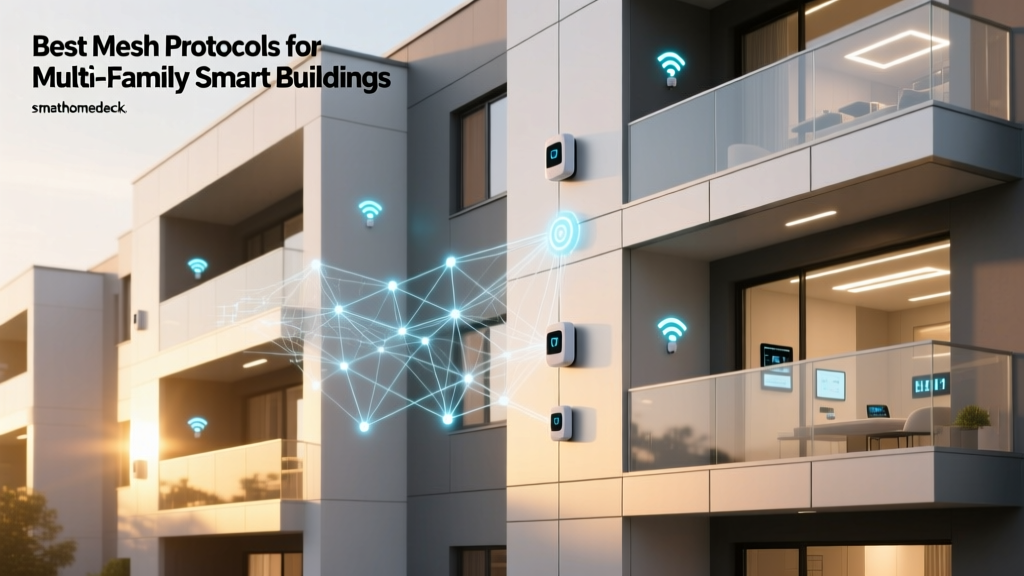
Unlike Zigbee, Thread has no central coordinator. Every Thread Border Router (TBR) acts as an equal gateway to the IP network. In a multi-family building, this means you can deploy TBRs in common areas, hallways, and select units to create a massive, building-wide mesh network. If one Border Router goes offline, the mesh instantly self-heals and routes data through the next available node. This eliminates the single point of failure that plagues legacy Zigbee deployments.
Furthermore, because Thread devices have native IP addresses, they can communicate directly with local servers or cloud services without requiring a proprietary translation hub. This drastically reduces latency for critical commercial applications, such as automated lighting in office spaces or instant-unlock mechanisms in secure multi-tenant corridors.
Matter: The Universal Application Layer
While Thread solves the networking layer, Matter, developed by the Connectivity Standards Alliance (CSA), solves the application layer. Matter is an open-source, royalty-free standard that sits on top of IP-based networks like Thread, Wi-Fi, and Ethernet. It defines a common language for smart devices, ensuring that a Matter-certified smart lock will work seamlessly with a Matter-certified smart thermostat, regardless of the manufacturer.
The Multi-Admin Feature: A Game Changer for MDUs
The most revolutionary aspect of Matter for commercial and multi-family buildings is its native Multi-Admin capability. In a traditional smart home, only one user or ecosystem "owns" the device. In an MDU, ownership is split: the tenant wants to control the thermostat via their personal Apple Home or Google Home app, but the property manager needs administrative access to prevent pipes from freezing or to reset the system between tenant turnovers.
Matter allows a single device to be securely commissioned into multiple "fabrics" simultaneously. A tenant can control their smart blinds using their personal smartphone, while the building's centralized facility management system retains a secure, secondary administrative token to override the blinds in the event of a fire or severe weather emergency. This dual-control architecture was previously impossible without expensive, proprietary cloud integrations.
Technical Comparison: Protocol Scalability in MDUs
When planning a deployment for a 300-unit building, integrators must weigh the physical and logical limits of each protocol. The table below outlines how the primary wireless standards compare in high-density environments.
| Protocol | Frequency | Topology | Max Nodes (Approx) | Hub Required? | MDU Suitability |
|---|---|---|---|---|---|
| Zigbee 3.0 | 2.4 GHz | Mesh | 200 | Yes (Coordinator) | High (Legacy Standard) |
| Thread (Matter) | 2.4 GHz | Mesh (IPv6) | 250+ | Border Router | Very High (Future-Proof) |
| Wi-Fi 6 | 2.4/5/6 GHz | Star | 50-100 | Access Point | Low (Spectrum Congestion) |
| Z-Wave | 908 MHz (US) | Mesh | 232 | Controller | Medium (High Hardware Cost) |
Overcoming the 2.4 GHz Spectrum Crunch
A common concern among commercial network engineers is the 2.4 GHz spectrum. In a modern apartment building, the 2.4 GHz band is already saturated by tenant Wi-Fi routers, Bluetooth devices, and microwaves. How can Thread, which also operates on 2.4 GHz, survive this environment?
Thread utilizes a low duty cycle and adaptive frequency hopping to minimize interference. Unlike Wi-Fi, which transmits large packets of data continuously, Thread devices send tiny, infrequent bursts of telemetry data (e.g., a temperature sensor reporting a 1-degree change). Furthermore, Thread Border Routers can dynamically shift channels to avoid congested Wi-Fi frequencies. When properly deployed alongside enterprise-grade Wi-Fi 6 access points that utilize the 5 GHz and 6 GHz bands for tenant data, Thread operates harmoniously in the background without degrading the building's primary internet infrastructure.
Bridging Tenant IoT and Building Management Systems (BMS)
In large commercial buildings and high-end MDUs, the Building Management System (BMS) is the brain of the operation, controlling heavy HVAC chillers, air handling units (AHUs), and elevator systems. Historically, these systems rely on wired protocols like BACnet or KNX. BACnet/IP is the gold standard for commercial automation, but it is entirely unsuited for consumer-facing, battery-operated IoT devices.
Thread and Matter do not aim to replace BACnet; rather, they act as the vital bridge between the tenant's living space and the building's core infrastructure. Emerging commercial gateways are now being deployed that translate Matter commands into BACnet objects. For example, if a tenant uses a Matter-over-Thread smart thermostat to lower the temperature in their penthouse, the local Matter bridge translates this request into a BACnet command, which the central BMS processes to adjust the variable air volume (VAV) box for that specific floor. This separation of IT (tenant IoT) and OT (operational technology) ensures building security while delivering a premium smart home experience.
Real-World Deployment: Hardware and Cost Analysis
Transitioning to Thread and Matter requires strategic hardware selection. Unlike Wi-Fi devices, which require expensive internal radios and constant power, Thread devices are cheaper to manufacture and can run on coin-cell batteries for years.
Recommended Hardware for MDU Integrators
- Smart Locks: The Schlage Encode Plus (Matter over Thread) is a premier choice for MDU entryways. It connects directly to the building's Thread mesh, eliminating the need for a Wi-Fi bridge inside every unit. It retails around $250-$300, but bulk commercial pricing reduces this significantly.
- Smart Thermostats: The Eve Thermo or Aqara Smart Radiator Thermostat utilize Thread for low-latency, low-power climate control, ideal for retrofits in older buildings with radiator heating.
- Border Routers: Instead of dedicated hubs, integrators can leverage devices that already exist in the unit. The Apple TV 4K and Google Nest Hub (2nd Gen) act as powerful Thread Border Routers. Alternatively, the Aqara Hub M3 ($100) serves as a dedicated commercial-grade Border Router and Matter bridge for Zigbee legacy devices.
Protocol Scalability and Cost in MDUs
While the initial CapEx for Thread/Matter hardware (Index 60) is slightly higher than legacy Zigbee (Index 45) due to the inclusion of secure enclave chips, the OpEx savings are substantial. The elimination of proprietary cloud fees, reduced hub replacement costs, and lower battery replacement frequencies result in a significantly lower Total Cost of Ownership (TCO) over a 5-year deployment cycle.
Security and Privacy in Multi-Tenant Environments
Security in a multi-family building extends beyond physical locks; it encompasses network security and data privacy. A major vulnerability in early IoT deployments was the use of default passwords and unencrypted local traffic, allowing malicious actors to intercept commands or infiltrate the building's corporate network via a tenant's smart plug.
Matter addresses this through Device Attestation Certificates (DAC). Every Matter-certified device contains a hardware-backed cryptographic certificate that proves its authenticity to the network. When a device is commissioned, it undergoes a rigorous handshake, ensuring that a rogue, uncertified device cannot join the building's Matter fabric. Furthermore, Matter operates on a localized, encrypted mesh. Even if the building's primary internet connection goes down, the local Thread mesh continues to function securely, ensuring that smart locks and emergency lighting remain operational during network outages.
Actionable Blueprint for Property Managers and Integrators
If you are planning a smart building retrofit or a new multi-family construction project, follow this blueprint to leverage Thread and Matter effectively:
- Audit the RF Environment: Before deployment, conduct a 2.4 GHz spectrum analysis. Configure the building's enterprise Wi-Fi access points to prioritize 5 GHz and 6 GHz bands, leaving channels 15, 20, and 25 open for the Thread mesh network.
- Deploy Strategic Border Routers: Do not rely on tenant-provided hardware. Install dedicated Thread Border Routers (like the Aqara M3 or Nanoleaf smart panels) in common areas, hallways, and maintenance closets to create a pervasive, building-wide mesh backbone.
- Standardize on Matter-Certified Devices: Mandate that all procured IoT hardware (locks, leak sensors, thermostats) carries the official Matter logo. This guarantees multi-admin capabilities and prevents vendor lock-in.
- Implement a Matter-to-BMS Bridge: Work with your BMS provider to install a local gateway that translates Matter telemetry into BACnet/IP, allowing your facility management team to monitor building-wide energy usage without compromising individual tenant privacy.
Conclusion
The era of fragmented, hub-dependent smart home ecosystems in multi-family and commercial buildings is drawing to a close. Thread provides the robust, self-healing, IP-based networking layer required to penetrate the concrete and drywall of large structures, while Matter delivers the secure, interoperable application layer that property managers and tenants demand. By adopting these standards, building owners can drastically reduce operational overhead, future-proof their real estate assets, and deliver a seamless, premium living experience that sets their properties apart in an increasingly competitive market.