The Dawn of True Smart Home Interoperability
For over a decade, the smart home industry has been fractured by walled gardens. Consumers were forced to choose between Apple HomeKit, Google Home, Amazon Alexa, or Samsung SmartThings, often buying incompatible hardware in the process. Enter Matter. Developed by the Connectivity Standards Alliance (CSA), Matter is an open-source, royalty-free connectivity protocol that operates at the application layer. According to the Connectivity Standards Alliance, Matter is designed to unify the smart home, ensuring that devices communicate securely, reliably, and locally, regardless of the brand or ecosystem you prefer.
Matter is not a wireless radio protocol itself; rather, it runs over existing transport layers like Wi-Fi, Thread, and Ethernet, while utilizing Bluetooth Low Energy (BLE) for secure device commissioning. This means a Matter-certified smart plug can be added to an Apple HomePod and a Google Nest Hub simultaneously—a feature known as Multi-Admin—without requiring complex workarounds or cloud-to-cloud linking.
In this comprehensive roundup, we evaluate the best Matter-compatible smart home devices currently on the market. We focus on practical performance, underlying transport protocols (Thread vs. Wi-Fi), latency, and real-world reliability to help you build a future-proof smart home.
Top Matter-Compatible Smart Lights
Smart lighting is the most popular entry point into home automation. With Matter, the latency of local commands is drastically reduced, meaning lights respond instantly when triggered by a local sensor or switch.
Nanoleaf Essentials A19 Smart Bulb (Thread)
The Nanoleaf Essentials A19 was among the very first smart bulbs to receive native Matter support via a firmware update. Utilizing the Thread protocol, this bulb requires a Thread Border Router (such as an Apple TV 4K or Nest Hub) to connect to your network. It produces up to 1100 lumens, features a color temperature range of 2700K to 6500K, and boasts a high Color Rendering Index (CRI) of 90+, making colors look natural and vibrant.
- Protocol: Matter over Thread
- Max Brightness: 1100 Lumens
- Power: 11W
- Price Range: $20 - $30
Because it uses Thread, the Nanoleaf bulb does not congest your Wi-Fi network. Furthermore, Thread's mesh networking capabilities mean that every mains-powered Nanoleaf bulb acts as a router, strengthening the overall reliability of your smart home mesh as you add more devices.
Philips Hue System (via Matter Bridge)
While Philips Hue bulbs natively use Zigbee, the Philips Hue Bridge received a massive firmware update enabling it to act as a Matter bridge. This allows your entire Zigbee mesh of Hue bulbs, light strips, and sensors to be exposed to Matter-compatible ecosystems. It remains the gold standard for reliability, color accuracy, and entertainment syncing, even if the Matter integration relies on a bridge rather than native Thread support on the bulbs themselves.
Best Matter-Compatible Smart Plugs
Smart plugs offer the easiest way to automate 'dumb' appliances, from coffee makers to floor lamps. Matter over Thread has revolutionized smart plugs by enabling local energy monitoring and sub-100-millisecond response times.
Eve Energy Smart Plug
Eve has been a pioneer in the Thread ecosystem, and the Eve Energy Smart Plug is a masterpiece of local control. It features built-in energy monitoring, allowing you to track voltage, current, and wattage directly within your preferred smart home app without sending your power consumption data to a third-party cloud server. The plug supports 15A / 1800W, making it suitable for heavy-duty appliances like space heaters or window air conditioners.
Local control is the cornerstone of Matter. When your internet goes down, your Eve Energy plug and Thread mesh will continue to execute automations flawlessly because the processing happens on your local hub, not a distant server.
Aqara Smart Plug (Matter Version)
Aqara's Matter-compatible smart plug is a compact, budget-friendly alternative that doesn't compromise on build quality. It includes overload protection and energy tracking. Aqara's integration with Matter is notably stable, and the plug's physical footprint is designed to avoid blocking adjacent wall outlets—a common grievance with bulkier smart plugs.
Essential Matter Sensors and Hubs
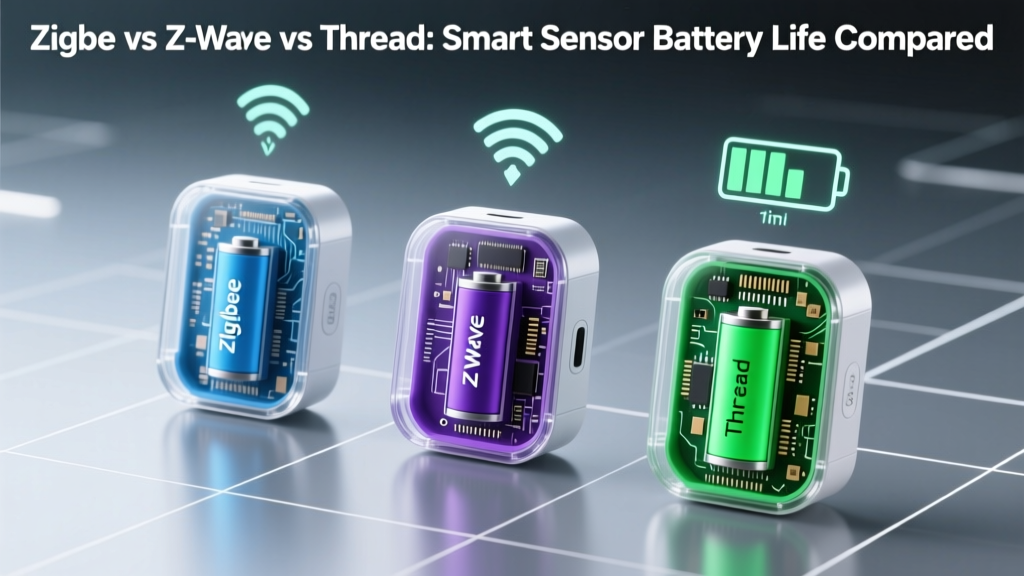
Sensors are the eyes and ears of your smart home. Battery-powered sensors benefit immensely from Thread's low-power consumption, often lasting up to two years on a single coin cell battery.
Aqara Door and Window Sensor P2
The Aqara P2 is a native Matter-over-Thread contact sensor. It is remarkably compact and utilizes a CR2032 battery. Thanks to Thread's efficient packet delivery, the P2 reports open/close states with virtually zero perceptible delay. It also features a tamper alert and can be used to trigger complex multi-step automations locally via a Thread Border Router.
SwitchBot Hub 2
While not a sensor itself, the SwitchBot Hub 2 is a vital piece of the Matter puzzle. It functions as a Wi-Fi to Matter bridge, an Infrared (IR) blaster for legacy AV equipment, and crucially, a Thread Border Router. It includes built-in temperature and humidity sensors and a lux sensor for triggering automations based on ambient room conditions. If you have older SwitchBot Bluetooth devices, the Hub 2 bridges them into the Matter ecosystem seamlessly.
Device Comparison Matrix
When building a Matter ecosystem, understanding the underlying transport protocol and hub requirements is critical. Below is a comparison of our top recommended devices.
| Device | Category | Transport Protocol | Hub/Border Router Required? | Key Feature |
|---|---|---|---|---|
| Nanoleaf Essentials A19 | Smart Lighting | Thread | Yes | High CRI, Mesh Routing |
| Philips Hue System | Smart Lighting | Zigbee (Bridged) | Yes (Hue Bridge) | Color Accuracy, Entertainment |
| Eve Energy | Smart Plug | Thread | Yes | Local Energy Monitoring |
| Aqara Smart Plug | Smart Plug | Thread | Yes | Compact, Overload Protection |
| Aqara P2 Sensor | Contact Sensor | Thread | Yes | 2-Year Battery, Tamper Alert |
| SwitchBot Hub 2 | Hub / Sensor | Wi-Fi / Thread BR | No (Acts as Hub) | IR Blaster, Lux Sensor |
Visualizing the Matter Market
One of the most common questions consumers have when upgrading to Matter is how pricing scales across different device categories. The chart below illustrates the typical price ranges you can expect when shopping for native Matter-compatible hardware.
Thread vs. Wi-Fi: The Underlying Transport Layers
To truly master the Matter ecosystem, you must understand the difference between Matter over Thread and Matter over Wi-Fi. Both are officially supported by the CSA, but they serve fundamentally different use cases.
Matter over Wi-Fi
Wi-Fi is ideal for high-bandwidth devices or devices that already require a constant, robust connection to the internet. Smart displays, smart TVs, and primary hubs (like the SwitchBot Hub 2) utilize Matter over Wi-Fi. However, Wi-Fi is power-hungry and can suffer from network congestion if you connect dozens of low-power IoT devices to a standard consumer router.
Matter over Thread
Thread is a low-power, low-latency mesh networking protocol based on the same 802.15.4 radio standard as Zigbee. According to Apple's official Matter support documentation, Thread devices create a self-healing mesh network that does not rely on a central hub for local device-to-device communication. This makes Thread the superior choice for battery-powered sensors, smart locks, and smart bulbs. The only caveat is that Thread requires a Border Router to bridge the 802.15.4 mesh network to your home's Wi-Fi/Ethernet network.
Security and the Device Attestation Certificate
Security is not an afterthought in Matter; it is baked into the silicon. Every Matter-certified device must possess a Device Attestation Certificate (DAC). When you scan the Matter QR code on a new device, your smartphone uses BLE to initiate a secure handshake. The DAC verifies that the device was manufactured by a certified CSA member and that its firmware has not been tampered with.
Furthermore, all Matter communications are encrypted using AES-128-CCM. Unlike older protocols where local API keys could be intercepted or spoofed, Matter's cryptographic foundations ensure that rogue devices cannot inject commands into your smart home mesh. This enterprise-grade security is a massive leap forward for consumer IoT.
Actionable Buying Advice for Matter Adopters
If you are ready to transition your home to Matter, follow these actionable steps to ensure a smooth deployment:
- Audit Your Border Routers: Before buying Thread-based Matter devices, ensure you have a compatible Border Router. The Apple TV 4K (Wi-Fi + Ethernet), HomePod Mini, Nest Hub (2nd Gen), and Nest Wifi Pro all function as Thread Border Routers.
- Start with a Hub/Bridge: If you have existing Zigbee or Bluetooth devices, invest in a Matter-compatible bridge like the Philips Hue Bridge or SwitchBot Hub 2 to bring your legacy gear into the new ecosystem without replacing everything at once.
- Check for the Logo: Only purchase devices bearing the official CSA Matter logo. Some manufacturers use confusing terminology like 'Works with Alexa' or 'HomeKit compatible'—these are not the same as native Matter support.
- Update Firmware First: Many existing devices (like Nanoleaf lights and Eve plugs) gained Matter support via over-the-air firmware updates. Before throwing away old smart home gear, check the manufacturer's app for Matter-enabling updates.
Conclusion
Matter has fundamentally shifted the smart home landscape from a fragmented mess of proprietary apps to a unified, interoperable ecosystem. By prioritizing local control, robust mesh networking via Thread, and enterprise-grade security, Matter delivers the reliable smart home experience consumers have been promised for years. Whether you are automating your lighting with Nanoleaf, tracking energy usage with Eve, or securing your perimeter with Aqara, building a Matter-compatible home is the smartest long-term investment you can make in modern home technology. As more manufacturers adopt the standard, the era of walled gardens is finally coming to an end, putting the control firmly back in the hands of the user.
For further reading on smart home standards, industry experts recommend keeping an eye on the evolving comprehensive guides to the Matter standard as new device categories, such as robotic vacuums and EV chargers, are added to the specification in upcoming releases.