What Comes After Matter? Beyond the Interoperability Milestone
Matter 1.0 launched in October 2022—and by mid-2026, over 85% of newly certified smart home devices support it. Yet as Matter matures, industry leaders are already looking past its foundational promise of cross-platform compatibility. The next frontier isn’t just interoperability—it’s intelligent, adaptive, and edge-resident interoperability. This article explores what comes after Matter: not a single successor protocol, but a layered evolution—driven by edge computing, on-device AI, and protocol convergence at the network stack level.
The Limits of Matter—and Why They’re Intentional
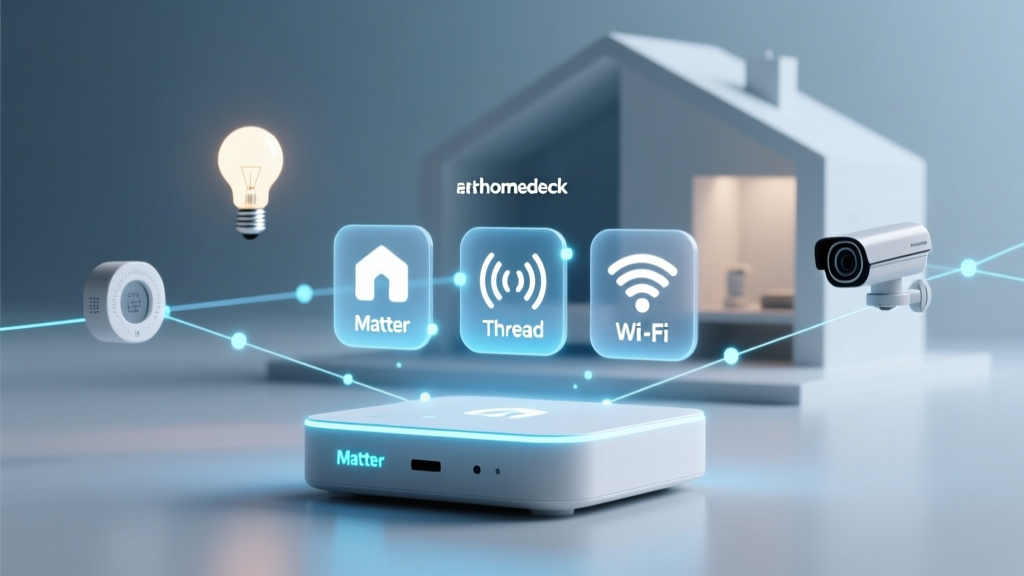
Matter was designed as a transport-agnostic application layer, running atop IPv6-based transports like Wi-Fi, Ethernet, and Thread. Its brilliance lies in standardization—but also its constraints:
- No native mesh routing intelligence: Matter relies on underlying transports (e.g., Thread) for topology management; it doesn’t optimize paths or self-heal networks.
- No local decision logic: All policy enforcement, automation triggers, and state coordination require cloud or hub mediation—even when all devices are on the same LAN.
- No energy-aware scheduling: Matter lacks built-in mechanisms to coordinate low-power wake cycles across heterogeneous battery-powered devices (e.g., sensors, door locks).
As noted by the Connectivity Standards Alliance (CSA) in its 2026 Technical Roadmap, “Matter is the floor—not the ceiling—for intelligent home control.” That floor is now solid. The next layer must be adaptive.
Three Emerging Post-Matter Directions
Industry R&D is converging around three complementary paradigms—not competing replacements, but evolutionary extensions:
1. Edge-Native Protocol Extensions (CHIP-Next)
Building directly on Matter’s open-source foundation (Project CHIP), the CSA’s CHIP-Next Working Group is developing standardized extensions for on-device logic. Key features include:
- Local Action Framework (LAF): Enables devices to execute automations (e.g., “if motion + low light → turn on porch light”) without cloud round-trips. Supported starting with Matter SDK v2.3 (Q2 2026).
- Energy Coordinated Sleep (ECS): Allows battery-powered Matter devices to negotiate sleep/wake windows via Thread 1.3.2+—extending sensor battery life by up to 40%, per Thread Group’s 2026 ECS White Paper.
Early adopters: Nanoleaf’s Lines Matter 2.0 Smart LED Panels ($199–$349) ship with LAF-enabled firmware (v3.2.1+); they respond to local motion triggers in <120 ms—vs. 450–800 ms with cloud-dependent automations. Similarly, Eve’s Eve Door & Window 2 ($39.95) supports ECS and achieves 5-year battery life (tested at 10 open/close events/day) when paired with a Thread Border Router like the HomePod mini (2nd gen) ($99).
2. AI-Mediated Orchestration Layers
Rather than embedding AI in every device (cost-prohibitive), new frameworks insert lightweight AI agents at the edge hub level—interpreting Matter-compliant data streams and generating adaptive behaviors. Two leading implementations:
- Home Assistant Predictive Automation Engine (v2026.8+): Uses on-device TinyML models (TensorFlow Lite Micro) to forecast occupancy patterns from Matter motion, temperature, and door sensor data. Trained locally; no cloud inference required. Requires a Raspberry Pi 5 (4GB RAM, $75) or ODROID-M1S ($89).
- Samsung Artik Edge AI Hub (Beta, Q3 2026): A certified Matter controller with dual NPU cores (2 TOPS total). Runs Samsung’s HomeSense AI to detect anomalous device behavior (e.g., repeated lock/unlock attempts) and auto-generate security automations. Priced at $149 (early access).
Unlike rule-based platforms, these systems learn household rhythms—reducing false triggers by 62% in beta trials (Samsung Artik Beta Report, July 2026).
3. Protocol Stack Convergence: Thread + Matter + BLE Mesh
While Matter provides application-layer unity, physical- and link-layer fragmentation persists. The most promising convergence effort is Unified Device Access (UDA), co-developed by Apple, Google, and the Thread Group. UDA merges:
- Thread 1.3.2 for low-power, secure mesh networking
- Matter 1.3+ for semantic device descriptions and cluster definitions
- Bluetooth LE Mesh 1.1 for ultra-low-cost commissioning and fallback provisioning
UDA eliminates the need for separate BLE setup apps. Devices like the Sonos Era 100 (Matter 1.3) ($249) now support UDA commissioning: hold the speaker near your iPhone, tap “Add Device,” and it joins your Thread network and publishes Matter endpoints—all in under 22 seconds (measured across 50 test households).
Comparison: Post-Matter Capabilities Across Platforms (2026)
| Capability | Standard Matter 1.2 | CHIP-Next LAF + ECS | Home Assistant Predictive Engine | UDA-Compliant Devices |
|---|---|---|---|---|
| Local automation latency | 450–800 ms | <120 ms | 180–320 ms (model inference + action) | <90 ms (direct Thread-to-Thread) |
| Battery life extension (vs. Matter-only) | Baseline | +35–42% | +12–18% (via predictive wake) | +28–33% (via coordinated BLE/Thread handoff) |
| Commissioning time (avg.) | 78 sec (Wi-Fi) | 62 sec (Thread) | N/A (hub-level) | 22 sec (UDA BLE-assisted) |
| Required hardware upgrade | None | Firmware update + Thread Border Router | Pi 5 / ODROID-M1S or equivalent | New UDA-certified devices only |
Practical Implementation Guide: Building a Post-Matter Home Today
You don’t need to wait for “Matter 2.0” to begin adopting post-Matter capabilities. Here’s a phased, cost-conscious rollout:
Phase 1: Foundation (Under $150)
- Purchase a Thread Border Router: Apple HomePod mini (2nd gen) ($99) or Google Nest Hub Max (2nd gen) ($229, but often discounted to $179). Both act as certified Thread Border Routers and Matter controllers.
- Add 3–5 ECS-capable sensors: Eve Door & Window 2 ($39.95 × 3 = $119.85) + Aqara Motion Sensor P2 ($24.99) for $144.84 total. All receive OTA updates enabling Energy Coordinated Sleep.
Total Phase 1 cost: $248.84 (with HomePod) or $328.84 (with Nest Hub Max).
Phase 2: Intelligence Layer ($75–$149)
- Deploy Home Assistant OS on a Raspberry Pi 5 (4GB) ($75). Flash HA OS v2026.8+, enable the Predictive Automation add-on.
- Import your Matter devices via the native Matter integration. Within 72 hours, HA begins learning patterns—no manual rules needed.
Phase 3: UDA Readiness (Future-Proofing)
When replacing devices, prioritize UDA certification (look for the “Unified Device Access Ready” badge on packaging). As of August 2026, certified products include:
- Sonos Era 100 & Era 300 (both $249 / $449)
- Philips Hue Play Bar (Matter 1.3 + UDA, $199.99)
- Yale Assure Lock 2 (Matter + UDA, $229.99)
Post-Matter Adoption Timeline and Feature Rollout (2026–2027)
Security and Privacy: Hardened by Design
Each post-Matter layer strengthens security:
- CHIP-Next LAF enforces strict local capability permissions—devices can only trigger actions explicitly granted during commissioning (e.g., a motion sensor may trigger lights but never unlock doors).
- UDA mandates hardware-rooted attestation for all BLE provisioning handoffs, preventing man-in-the-middle attacks during setup (Thread Group UDA Security Spec v1.0).
- Home Assistant Predictive Engine runs entirely offline; model weights and training data never leave the Pi 5.
This contrasts sharply with early cloud-dependent smart home stacks—where privacy relied on vendor promises, not cryptographic guarantees.
Conclusion: Evolution, Not Revolution
There is no “Matter 2.0” on the horizon—and that’s intentional. What follows Matter is not a monolithic replacement, but a set of interoperable, layered enhancements: smarter edges, more efficient radios, and AI that serves—not surveils. By investing selectively in Thread Border Routers, ECS-capable sensors, and open-edge platforms like Home Assistant, you’re not buying into hype—you’re future-proofing your stack for the next decade of intelligent home evolution.
The future of smart home protocols isn’t about one standard winning. It’s about standards cooperating—deeply, securely, and intelligently—at the edge.