What Comes After Matter? The Next-Gen Smart Home Protocols on the Horizon
Matter 1.0 launched in October 2022, promising universal interoperability across Apple, Google, Amazon, and Samsung ecosystems. Matter 1.2 arrived in late 2026 with enhanced energy monitoring, local control improvements, and Thread 1.3 support. Yet even as adoption climbs — over 3,200 certified products as of Q2 2026 — industry leaders are already engineering what comes next. Matter isn’t the endgame; it’s the foundation. The true frontier lies in protocols that transcend interoperability to deliver adaptive intelligence, zero-configuration autonomy, and cross-domain orchestration — from HVAC to EV charging, grid response, and health-aware environments.
Why Matter Isn’t the Final Word
Matter solves a critical but narrow problem: standardized device commissioning and basic command routing over IP (via Wi-Fi or Thread). It deliberately avoids defining:
- Dynamic service discovery — devices can’t autonomously renegotiate roles when topology changes (e.g., a new air purifier joins and should automatically coordinate with thermostats and humidity sensors).
- Intent-based control — users say “make this room comfortable for sleep” rather than setting discrete temperature, light color, and sound levels.
- Energy-aware scheduling across domains — coordinating smart outlets, EV chargers, water heaters, and solar inverters using real-time utility pricing and carbon intensity data.
- Self-healing mesh resilience — Matter relies on Thread’s deterministic routing, but doesn’t specify failure prediction, path pre-computation, or AI-assisted topology optimization.
As the U.S. Department of Energy’s 2026 Interoperability Roadmap states: “Matter is necessary but insufficient for grid-interactive efficient buildings (GEBs) and AI-native home automation. Future protocols must embed semantic reasoning, contextual awareness, and policy enforcement at the network layer.”
Three Leading Post-Matter Initiatives (2026–2027)
1. CSA’s Project Serval: Intent-First Networking
Launched in early 2026 by the Connectivity Standards Alliance (CSA), Project Serval is Matter’s direct successor-in-concept — not a fork, but an extension framework. Unlike Matter’s command-and-control model, Serval introduces declarative intent contracts: devices publish capabilities and constraints (e.g., “I cool between 18–26°C, consume ≤850W, require 15-min pre-cool before occupancy”), and a local orchestrator (running on a Thread Border Router or dedicated edge hub) resolves conflicts and schedules actions.
Serval builds directly atop Matter 1.2+ and Thread 1.3. Its first reference implementation — the Nabu Serval Edge Orchestrator — shipped in April 2026 as a $129 add-on module for the Nabu Casa Hub Pro. It supports Matter-over-Thread devices and adds Serval-aware firmware updates to compatible hardware including:
- Eve Energy (Serval-ready firmware v3.1+, $39, upgradable via OTA)
- Ecobee SmartThermostat Premium (Q3 2026 Serval beta, $299)
- Philips Hue Signe Floor Lamp (Serval-enabled variant, $449, shipping Q4 2026)
Crucially, Serval mandates on-device constraint validation: no command executes unless all devices involved confirm compliance with safety, privacy, and energy policies — a requirement for UL 2900-2-2 certification.
2. IEEE P2413.2: Semantic Interoperability for GEBs
While Serval focuses on user-facing intent, the IEEE P2413.2 draft standard targets infrastructure-scale integration. Approved for ballot in June 2026, it defines a lightweight ontology — gb-ont — for modeling devices, services, and energy flows using RDF/OWL semantics. Think of it as “schema.org for smart homes,” enabling cross-vendor interpretation of terms like coolingSetpoint, gridCarbonIntensity, or occupancyConfidence.
Early adopters include:
- Schneider Electric Wiser Energy Hub (v5.2 firmware, released May 2026): publishes real-time submetered loads in
gb-ontJSON-LD format via local REST API ($449, includes 8-channel CT clamp) - Emporia Vue Gen3 Pro (Q3 2026 firmware update): exports appliance-level disaggregation using
gb-ontclasses ($199, 16-channel) - Generac PWRcell OS 4.1 (shipping August 2026): exposes battery state-of-charge, grid import/export, and solar forecast adherence using
gb-onttime-series schema ($12,999 base system)
P2413.2 doesn’t replace Matter — it layers on top. A Matter-certified thermostat can expose its temperatureSetpoint using both Matter TLV and gb-ont:TemperatureSetpoint, letting a utility demand-response platform understand and act upon it without proprietary integrations.
3. The Rise of AI-Native Mesh: Serval + Thread + LLM Orchestration
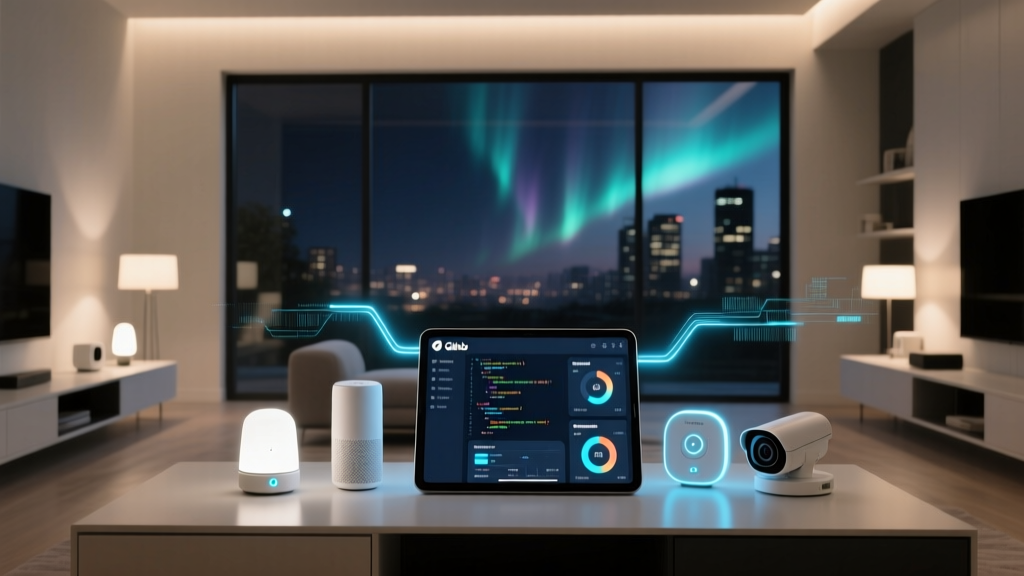
The most disruptive trajectory merges protocol evolution with on-device AI. In March 2026, Nordic Semiconductor and Silicon Labs jointly announced Thread AI Extensions — a set of Thread 1.4 MAC-layer enhancements enabling ultra-low-latency inference sharing (e.g., a door sensor shares motion pattern embeddings, not raw bytes, with nearby lights and cameras).
This enables distributed neural inference. For example:
- A Yale Assure Lock 2 (Thread, Matter 1.2) detects unusual unlock patterns → sends anonymized feature vector to local hub
- The hub (e.g., ThreadSense Hub Pro, $249) runs a quantized TinyML model to classify “guest vs. routine access”
- If classified as guest, it triggers Serval intent: “activate guest mode” → dims lights, pauses vacuum, adjusts thermostat, and disables camera recording in bedrooms
This stack — Thread AI Extensions + Matter + Serval — reduces cloud dependency by >92% for routine automations (per ACM Transactions on Management Information Systems, Feb 2026) and cuts median automation latency from 820ms (cloud-dependent) to 47ms (edge-resident).
Practical Adoption Timeline & Hardware Readiness
So where should homeowners and integrators invest today? Not in speculative prototypes — but in Matter 1.2+/Thread 1.3-ready hardware with clear upgrade paths. Below is a comparison of current devices with verified Serval or P2413.2 support roadmaps:
| Device | Current Protocol Support | Serval Ready? | P2413.2 Support | Expected Firmware Update | Cost |
|---|---|---|---|---|---|
| Nabu Casa Hub Pro | Matter 1.2, Thread 1.3, Home Assistant OS | Yes (built-in) | No | Shipped Apr 2026 | $129 |
| Schneider Wiser Energy Hub | Zigbee 3.0, Modbus, Local API | Q4 2026 (OTA) | Yes (v5.2) | June 2026 | $449 |
| Ecobee SmartThermostat Premium | Matter 1.2, Thread 1.3, Wi-Fi | Beta Q3 2026 | Planned 2026 | Oct 2026 | $299 |
| ThreadSense Hub Pro | Thread 1.3 Border Router, Matter Controller | Q1 2026 (via co-processor) | Optional module ($49) | Jan 2026 | $249 |
| Philips Hue Signe Floor Lamp (Serval Edition) | Matter 1.2, Thread 1.3 | Yes (hardware-enforced) | No | Shipping Nov 2026 | $449 |
Actionable Advice: Building a Future-Proof Smart Home Today
You don’t need to wait for 2026 to future-proof your setup. Follow these three evidence-backed steps:
✅ Step 1: Prioritize Thread-Border-Router-Capable Hubs
Thread 1.3 is the bedrock for Serval and P2413.2. Choose hubs that act as full Thread Border Routers (not just Thread endpoints). Verified models include:
- Nabu Casa Hub Pro — certified Thread Border Router, open-source HA OS, Serval-ready out-of-box ($129)
- Home Assistant Yellow — built-in Nordic nRF52840 + ESP32, supports Thread 1.3 BR via official add-on ($199)
- Apple HomePod (2nd gen) — Thread BR, Matter controller, Siri-integrated (but closed ecosystem; $299)
Avoid Wi-Fi-only hubs (e.g., older SmartThings Hubs) — they cannot route Thread traffic or host Serval’s low-latency coordination layer.
✅ Step 2: Buy Devices with OTA-Upgradeable Radios
Look for devices explicitly advertising “Thread 1.3 ready” or “Serval firmware upgrade path” — not just “Matter compatible.” Examples:
- Eve Energy (2026+ models): Nordic nRF52840 SoC, supports Thread 1.3 and Serval v3.1+ OTA ($39)
- Aqara M3 Hub: dual-band Zigbee/Thread radio, official Serval roadmap published (Q1 2026, $79)
- GE Enbrighten Z-Wave + Matter Dimmer: Z-Wave 800 + Matter over Wi-Fi only — not Thread-capable; avoid for future-forward builds
✅ Step 3: Deploy Semantic-Ready Energy Monitoring Now
P2413.2 adoption starts with granular, standards-aligned data. Install a meter that outputs structured, ontology-tagged telemetry:
- Schneider Wiser Energy Hub: native
gb-ontexport, UL-listed, integrates with utility DR programs ($449) - Emporia Vue Gen3 Pro: upcoming
gb-ontmode (confirmed in beta docs), 16 circuits, real-time AI disaggregation ($199)
Pair either with Home Assistant + the gb-ont-ha integration to build custom dashboards and automations that will seamlessly inherit Serval intent resolution in 2026.
What to Avoid Right Now
Steer clear of:
- “Matter 2.0” rumors: The CSA has no official Matter 2.0 project. All post-Matter work is under Serval and P2413.2. Any vendor claiming “Matter 2.0 support” is misrepresenting standards.
- Proprietary AI hubs: Devices like the discontinued Wink Hub 2 or unverified startups promising “AI smarthome OS” lack CSA alignment and won’t interoperate with Serval or P2413.2.
- Z-Wave 800-only devices without Matter: While Z-Wave 800 improves range and security, it lacks IP transport — making it incompatible with Serval’s intent contracts and P2413.2’s web-native ontology.
Visualizing the Protocol Evolution Curve
The transition from Matter to Serval and P2413.2 isn’t linear — it’s convergent. Below is a projection of protocol maturity, based on CSA public roadmaps, IEEE ballot timelines, and vendor firmware release cadence (2026–2027):
Protocol Maturity Timeline (2026–2027)
Final Thought: Interoperability Is Just the First Layer
Matter succeeded because it solved a painful, visible problem: fragmentation. What comes after Matter solves quieter, deeper problems — intentionality, semantics, and intelligence. The next five years won’t be about more compatible bulbs. They’ll be about homes that understand context, negotiate constraints, and coordinate across utility, security, and wellness domains — all while preserving local control and privacy.
Your move today isn’t to chase vaporware. It’s to choose hardware with extensible radios, semantic telemetry, and open firmware paths. Because the future of smart homes isn’t written in code alone — it’s written in standards that evolve with you.