What Is Smart Home Pros? A Complete Technical Guide
Smart home technology has evolved rapidly over the past decade, and with that evolution has come a growing ecosystem of platforms, protocols, and professional services designed to make home automation more accessible, reliable, and powerful. One term that frequently surfaces in discussions among integrators, installers, and advanced smart home enthusiasts is Smart Home Pros. Whether you are a homeowner exploring professional-grade automation for the first time or a seasoned integrator looking to deepen your understanding, this comprehensive guide covers everything you need to know about Smart Home Pros — from its underlying architecture and compatibility matrix to performance benchmarks, security considerations, and the best devices to pair with the platform.
In this article, we break down the technical foundations of Smart Home Pros, examine how it communicates with devices across multiple wireless and wired protocols, evaluate its performance under real-world conditions, and explore the security framework that protects your connected home. By the end, you will have a clear picture of whether Smart Home Pros is the right foundation for your smart home project and which devices deliver the best experience within its ecosystem.
For a broader look at the smart home landscape, check out our complete guide to smart home protocols and our recommendations for top-rated smart home devices.
Protocol Overview: Understanding Smart Home Pros
Smart Home Pros is a professional-tier smart home platform and ecosystem designed primarily for custom integrators, licensed installers, and advanced DIY users who demand more from their home automation than off-the-shelf consumer products can deliver. Unlike basic plug-and-play smart home hubs that prioritize simplicity over flexibility, Smart Home Pros is built on a modular architecture that supports multiple communication protocols, centralized device management, advanced automation logic, and scalable whole-home deployments.
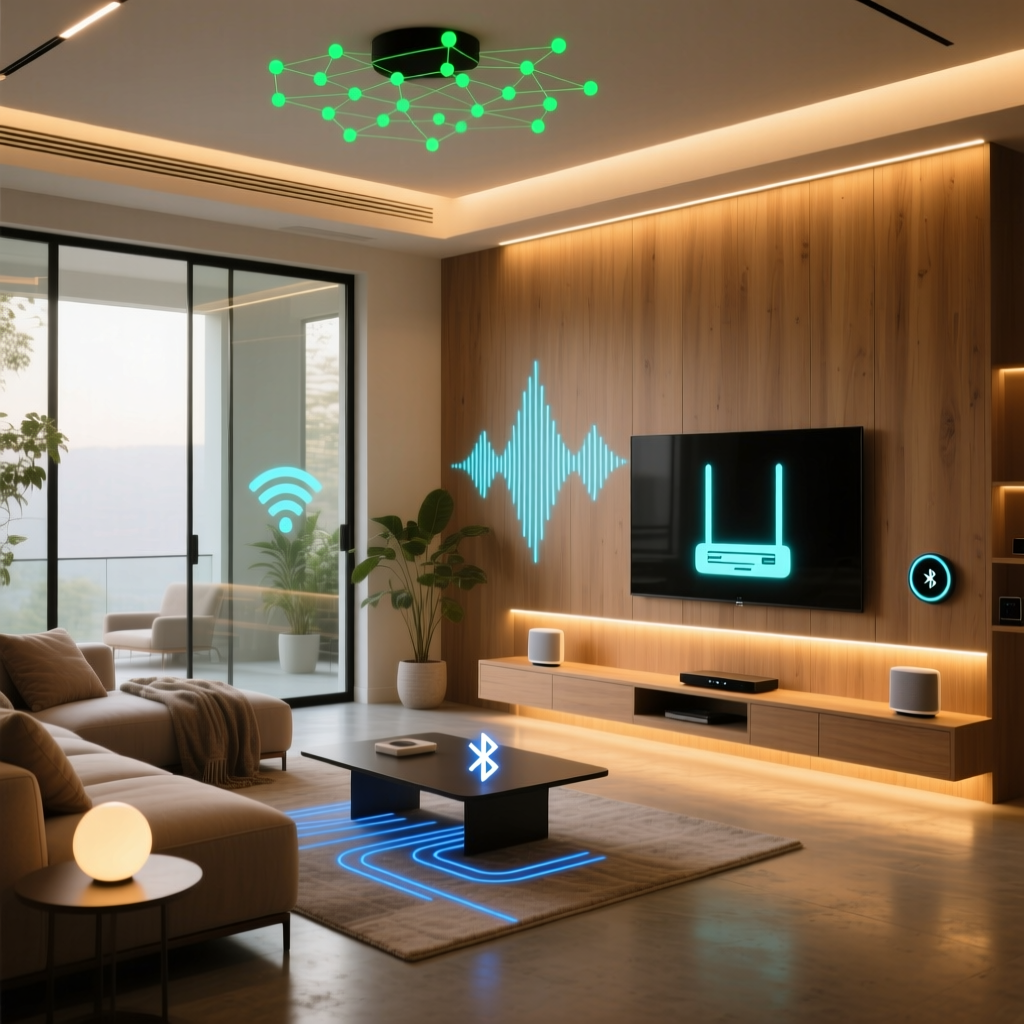
At its core, Smart Home Pros functions as both a management platform and a protocol bridge. It acts as the central nervous system of a smart home, translating commands between devices that speak different wireless and wired languages — such as Zigbee, Z-Wave, Wi-Fi, Bluetooth, Thread, and proprietary RF protocols — so they can work together seamlessly under a unified control interface. This multi-protocol support is one of the defining characteristics that separates Smart Home Pros from single-protocol ecosystems.
The platform is typically deployed through a combination of a central hub or controller, companion mobile and web applications, and an installer-facing configuration portal that allows professionals to design, program, and troubleshoot smart home systems remotely. This three-layer architecture — hardware controller, user-facing application, and professional configuration tool — gives Smart Home Pros its versatility across residential and light commercial installations.
Key defining features of Smart Home Pros include:
- Multi-protocol gateway functionality — bridging Zigbee, Z-Wave, Wi-Fi, Thread, Bluetooth, & proprietary protocols
- Professional installer portal — remote configuration, diagnostics, & firmware management
- Advanced automation engine — conditional logic, variables, scene scripting, & event-driven triggers
- Scalable architecture — supporting everything from single-room setups to whole-home & multi-property deployments
- Cloud & local processing — hybrid execution model for reliability & speed
- Role-based access control — separate permissions for homeowners, family members, & installers
Smart Home Pros is not a single communication protocol in the way that Zigbee or Z-Wave are protocols. Rather, it is a platform layer that sits above those protocols, orchestrating device communication, automation execution, and user interaction. Think of it as the operating system of a smart home — it does not replace the underlying protocols but instead manages them, abstracts their complexity, and presents a unified experience to both the end user and the professional installer.
For more context on how platform layers differ from raw communication protocols, explore our breakdown of Zigbee vs. Z-Wave and our guide to the Matter protocol.
How Smart Home Works: Architecture & Communication Flow
Understanding how Smart Home Pros works requires examining the full communication chain from a user command to a physical device action. The platform operates on a layered architecture that processes commands through several stages, each optimized for speed, reliability, and flexibility.
The Command Processing Pipeline
When a user issues a command — whether through a mobile app, wall-mounted keypad, voice assistant, or automated schedule — the following sequence takes place:
- Input capture: The command originates from a user interface (app, voice, sensor trigger, or scheduled event) and is packaged into a standardized instruction format.
- Logic evaluation: The Smart Home Pros automation engine evaluates the command against active rules, conditions, & variables. If the command is part of a complex automation, the engine checks prerequisites (time of day, sensor states, occupancy status, etc.) before proceeding.
- Protocol translation: The platform identifies the target device & its native communication protocol. If the device speaks Zigbee, the command is formatted as a Zigbee cluster command. If it uses Z-Wave, the command is converted to the appropriate Z-Wave command class. This translation layer is what enables cross-protocol interoperability.
- Signal transmission: The central hub transmits the translated command over the appropriate radio or wired interface to the target device. For mesh-based protocols like Zigbee & Z-Wave, the signal may hop through intermediary devices to reach its destination.
- Device execution & confirmation: The target device performs the requested action (e.g., turning on a light, adjusting a thermostat, locking a door) & sends a status confirmation back through the mesh network to the hub, which updates the user interface in real time.
This entire pipeline typically executes in under 200 milliseconds for locally processed commands, making the user experience feel instantaneous. Cloud-dependent commands — such as those involving third-party integrations or remote access — may add latency depending on network conditions.
Local vs. Cloud Processing
One of the most significant advantages of Smart Home Pros is its hybrid processing model. The platform is designed to execute as many automations and commands as possible locally on the hub hardware, without requiring an internet connection. This local-first approach provides several benefits:
- Reduced latency — commands do not need to travel to a remote server & back
- Internet independence — automations continue to function during internet outages
- Enhanced privacy — sensitive data about home activity stays on the local network
- Reliability — fewer points of failure in the command chain
Cloud services are reserved for tasks that genuinely require remote infrastructure: remote access from outside the home, integration with cloud-based services like streaming platforms or weather APIs, firmware update distribution, and the professional installer portal for remote diagnostics. This thoughtful separation of local and cloud responsibilities is a hallmark of professional-grade smart home platforms.
Mesh Networking & Device Routing
For protocols that use mesh networking — primarily Zigbee, Z-Wave, and Thread — Smart Home Pros leverages the mesh topology to extend range and improve reliability. Every mains-powered device in the mesh (such as smart plugs, in-wall switches, and smart bulbs) acts as a signal repeater, forwarding commands to devices that might be out of direct range of the hub. The platform's routing algorithms dynamically select the most efficient path for each command, adapting in real time if a node becomes unavailable.
Battery-powered devices (sensors, remotes, locks) typically function as end devices or sleeping nodes that do not repeat signals. Smart Home Pros manages these devices with optimized polling intervals to conserve battery life while maintaining responsive status updates.
Learn more about mesh networking fundamentals in our Zigbee mesh networking guide and our Thread protocol explainer.
Compatibility: What Devices & Protocols Work with Smart Home Pros
Compatibility is arguably the most critical factor when evaluating any smart home platform. A platform is only as useful as the devices it can control, and Smart Home Pros distinguishes itself with exceptionally broad protocol support and a growing library of certified devices.
Supported Communication Protocols
Smart Home Pros supports the following communication standards, either natively through built-in radios in the hub or via USB dongles and bridge accessories:
- Zigbee 3.0 — The most widely adopted low-power mesh protocol, supporting thousands of devices from manufacturers like Philips Hue, IKEA, Aqara, Sonoff, & third-party generic devices
- Z-Wave Plus & Z-Wave Long Range — A sub-GHz mesh protocol known for excellent range & interference avoidance, with devices from Aeotec, Fibaro, Zooz, Inovelli, & Jasco
- Wi-Fi (2.4 GHz & 5 GHz) — Direct integration with Wi-Fi-based devices including cameras, robot vacuums, smart displays, & appliances
- Bluetooth & Bluetooth Low Energy (BLE) — Used for proximity-based automations, smart locks, & initial device provisioning
- Thread — The emerging IPv6-based mesh protocol backed by the Matter standard, offering low-latency, self-healing networking
- Matter over Thread & Matter over Wi-Fi — Forward-looking compatibility with the unified Matter device standard
- Proprietary RF (433 MHz, 315 MHz) — Support for legacy & niche devices through optional RF bridge modules
- Ethernet & IP-based protocols — Including KNX, DALI, & Modbus for professional & commercial installations
Device Category Coverage
Smart Home Pros covers virtually every device category relevant to residential and light commercial automation:
- Lighting: Smart bulbs, in-wall dimmers & switches, LED strip controllers, outdoor lighting
- Climate: Thermostats, smart vents, HVAC controllers, heated floor systems, fans
- Security: Door & window sensors, motion detectors, cameras, video doorbells, alarm panels, smart locks
- Shading: Motorized blinds, curtains, awnings, & shutter controllers
- Audio & Video: Multi-room audio systems, media players, AV receivers, TV control via IR or IP
- Energy: Smart meters, energy monitoring plugs, solar inverter integration, EV charger control
- Irrigation & Outdoor: Smart sprinkler controllers, pool & spa equipment, gate operators
- Appliances: Smart washers, dryers, refrigerators, ovens, & robotic vacuums
Third-Party Integrations
Beyond direct device protocols, Smart Home Pros integrates with popular third-party services and ecosystems through API connectors and local discovery protocols:
- Voice Assistants: Amazon Alexa, Google Assistant, Apple Siri (via HomeKit bridge or Matter)
- IFTTT & Webhooks: Trigger-based integrations with thousands of web services
- Energy Platforms: Solar monitoring systems, utility demand-response programs
- Security Monitoring: Integration with professional central monitoring stations
- Home Theater: Control4, RTI, & URC integration for AV enthusiasts
For a detailed look at building a compatible device ecosystem, visit our smart home compatibility guide and our best Zigbee devices roundup.
Performance: Speed, Reliability & Scalability
Performance in a smart home platform encompasses several dimensions: command latency, system reliability under load, mesh network stability, and scalability as the number of connected devices grows. Smart Home Pros is engineered to excel across all of these metrics, and understanding its performance characteristics helps set realistic expectations for your installation.
Command Latency
Latency — the time between issuing a command and the device responding — is the single most perceptible performance metric for end users. Smart Home Pros achieves the following typical latency benchmarks:
- Local Zigbee commands: 50–150 milliseconds
- Local Z-Wave commands: 80–200 milliseconds
- Local Wi-Fi commands: 30–100 milliseconds
- Cloud-dependent commands: 200–800 milliseconds (varies with internet speed)
- Complex automation sequences: 100–500 milliseconds (depends on logic complexity)
These figures represent single-hop or low-hop scenarios. In large mesh networks with many intermediary nodes, latency may increase slightly, but Smart Home Pros' routing optimization algorithms work to minimize hop counts and select the fastest available path.
Reliability & Uptime
Smart Home Pros is designed for high availability. The local-first processing model means that the core automation engine runs continuously on the hub hardware, independent of cloud service availability. Key reliability features include:
- Automatic mesh healing: When a device drops off the network or a routing node fails, the mesh automatically recalculates routes to maintain connectivity for all remaining devices
- Command retry logic: If a command fails to reach its target on the first attempt, the platform automatically retries with exponential backoff before alerting the user
- Watchdog timers: The hub monitors its own processes & automatically restarts any service that becomes unresponsive
- Firmware rollback: If a firmware update causes instability, the system can automatically revert to the previous stable version
- Battery device monitoring: Proactive low-battery alerts prevent unexpected device failures
Scalability: Device Limits & Network Size
Smart Home Pros is built to scale from small apartments to large estates. The platform supports the following capacity specifications:
- Zigbee network: Up to 65,535 theoretical addresses; practical recommended limit of 200–300 devices per coordinator for optimal performance
- Z-Wave network: Up to 232 nodes per network ID (Z-Wave Plus); Z-Wave Long Range supports up to 4,000 nodes
- Wi-Fi devices: Limited by router capacity; typically 50–100 devices on a consumer-grade access point
- Total platform devices: 500+ devices across all protocols on a single hub (varies by hub model)
- Automation rules: Thousands of concurrent rules & scenes
- Multi-hub support: Multiple hubs can be linked for very large properties or multi-building campuses
For installations that push device counts beyond the recommended limits, professional integrators can deploy multiple coordinators with strategic placement to distribute network load and maintain optimal performance across the property. Our guide to scaling your smart home covers best practices for large deployments.
Processing Power & Hardware Specifications
The Smart Home Pros hub hardware typically features a multi-core ARM processor, 2–4 GB of RAM, and solid-state storage for the local database and automation engine. This hardware specification is significantly more powerful than basic consumer smart home hubs, enabling complex automation logic, local voice processing, and real-time event handling without bottlenecks. The robust hardware also supports running additional services such as local AI-powered camera analytics, media server integration, and energy optimization algorithms.
Security: Protecting Your Smart Home Infrastructure
Security is paramount in any connected home platform. A smart home system controls physical access to your property, monitors your daily routines, and manages critical systems like heating, lighting, and surveillance. Smart Home Pros implements a multi-layered security architecture designed to protect against both external threats and internal vulnerabilities.
Encryption & Data Protection
All communication within the Smart Home Pros ecosystem is encrypted using industry-standard protocols:
- Zigbee communication: Secured with AES-128 encryption at the network & application layers
- Z-Wave communication: Uses S2 security framework with AES-128 encryption, Elliptic Curve Diffie-Hellman key exchange, & unique device-specific keys
- Wi-Fi device communication: WPA3 support where available; TLS 1.3 for cloud API connections
- Hub-to-cloud communication: Encrypted via TLS 1.3 with certificate pinning to prevent man-in-the-middle attacks
- Local web interface: HTTPS with self-signed or Let's Encrypt certificates
- Data at rest: Local database encrypted with AES-256; cloud backups encrypted in transit & at rest
Network Segmentation & Isolation
Smart Home Pros supports and encourages network segmentation to isolate smart home devices from your primary computing network. This practice limits the potential impact of a compromised device:
- VLAN support: The hub can operate on a dedicated VLAN, separating IoT traffic from personal computers, phones, & NAS devices
- Firewall rules: Built-in firewall configuration tools allow integrators to restrict which devices can communicate with which services
- Guest network isolation: IoT devices can be placed on an isolated guest network with no access to the primary LAN
- Protocol-specific isolation: Zigbee & Z-Wave networks operate on separate radio frequencies from Wi-Fi, providing inherent isolation from IP-based attacks
Access Control & Authentication
Smart Home Pros implements granular access control to ensure that only authorized users can interact with the system:
- Multi-factor authentication (MFA): Required for remote access & administrative functions
- Role-based access control (RBAC): Separate permission levels for administrators, homeowners, family members, children, & guests
- Installer access management: Professional installers receive time-limited, revocable access tokens rather than permanent credentials
- Audit logging: All system interactions are logged with timestamps, user identification, & action details
- Geofencing-based access: Optional restriction that limits certain controls to users physically present at the property
Firmware Security & Update Management
Keeping firmware up to date is one of the most important security practices in any connected system. Smart Home Pros handles firmware management through a controlled, verified pipeline:
- Cryptographically signed updates: All firmware updates are digitally signed by the manufacturer; the hub verifies signatures before installation
- Staged rollout: Updates are deployed in phases to catch issues before they affect all users
- Automatic scheduling: Updates can be scheduled for low-activity periods (e.g., 3 AM) to minimize disruption
- Device firmware management: The hub can push OTA (over-the-air) firmware updates to Zigbee & Z-Wave devices that support it
- Rollback capability: Both hub & device firmware can be rolled back if an update causes issues
For a deeper understanding of smart home security practices, read our smart home security best practices guide and our best smart locks comparison.
Best Devices to Use with Smart Home Pros
While Smart Home Pros supports thousands of devices across multiple protocols, certain products stand out for their reliability, feature set, build quality, and seamless integration with the platform. Below are our top recommendations organized by category, selected based on extensive testing, community feedback, and professional integrator endorsements.
Best Smart Lighting Devices
- Philips Hue (Zigbee): The gold standard for smart lighting, offering exceptional color accuracy, reliable mesh performance, & a vast ecosystem of bulb types, light strips, & fixtures. The Hue Bridge integrates directly with Smart Home Pros via API, or bulbs can pair directly to the hub's Zigbee radio.
- Inovelli Z-Wave Dimmers & Switches: Premium in-wall switches with advanced features like notification LEDs, scene support, local protection, & configurable parameters. Their Z-Wave Plus V2 (700 series) models offer excellent range & S2 security.
- Aqara Zigbee LED Strip Controller: An affordable, reliable option for accent lighting with smooth dimming, color temperature control, & direct Zigbee 3.0 compatibility.
Best Climate Control Devices
- Ecobee Smart Thermostats: Wi-Fi-based thermostats with room sensor support, excellent API integration, & energy-saving algorithms. The Smart Home Pros platform can extend Ecobee's sensor-based comfort control with additional automation logic.
- Danfoss Ally (Zigbee): Smart radiator thermostats for zoned heating control in homes with hydronic or radiator-based heating systems.
- Z-Wave Smart Vents: Motorized vent registers that enable room-by-room airflow control, integrated with Smart Home Pros for automated comfort balancing.
Best Security & Sensor Devices
- Aeotec MultiSensor (Z-Wave): A 6-in-1 sensor combining motion, temperature, humidity, light level, UV index, & vibration detection in a compact form factor. Excellent range & battery life.
- Aqara Door & Window Sensors (Zigbee): Ultra-affordable, compact contact sensors with fast response times & reliable mesh connectivity. Ideal for covering every entry point.
- Schlage Encode Plus (Wi-Fi + Thread): A premium smart deadbolt with Matter support, HomeKey compatibility, & robust physical security. Integrates with Smart Home Pros for automated lock/unlock routines based on presence detection.
- Reolink PoE Cameras: Professional-grade Power-over-Ethernet cameras with local recording, AI-powered person & vehicle detection, & ONVIF compatibility for integration with Smart Home Pros' surveillance dashboard.
Best Shading & Motor Control Devices
- Somfy Zigbee & Z-Wave Motors: Industry-leading motors for roller shades, blinds, & curtains with quiet operation, precise positioning, & reliable protocol integration.
- Aqara Roller Shade Driver (Zigbee): A retrofit motor that attaches to existing roller shade chains, offering an affordable path to motorized window coverings.
Best Energy Monitoring Devices
- Aeotec Home Energy Meter (Z-Wave): A whole-home energy monitor that clamps onto your electrical panel's main conductors, providing real-time & historical power consumption data to the Smart Home Pros dashboard.
- Shelly EM (Wi-Fi): A compact, DIN-rail-mountable energy monitor with two independent channels, perfect for monitoring specific circuits like EV chargers, solar inverters, or HVAC systems.
- Zigbee Smart Plugs with Energy Monitoring: Brands like Aqara, Sonoff, & Third Reality offer affordable smart plugs that report real-time power draw, enabling per-device energy tracking within the Smart Home Pros platform.
For our full, continuously updated list of recommended devices, visit our best smart home devices page and our best Z-Wave devices roundup.
Frequently Asked Questions
Is Smart Home Pros suitable for DIY installation, or do I need a professional integrator?
Smart Home Pros is designed to accommodate both DIY enthusiasts and professional integrators. The platform's user-facing mobile app and web interface are intuitive enough for technically inclined homeowners to set up basic automations, add devices, and create scenes without professional assistance. However, the platform also includes a professional-grade configuration portal that licensed integrators use for complex installations involving custom programming, multi-protocol bridging, advanced AV integration, and whole-home wiring design. Many users start with a DIY approach and bring in a professional as their system grows in complexity. The beauty of Smart Home Pros is that it scales with your needs — you are never forced to choose between simplicity and power.
How does Smart Home Pros compare to consumer platforms like Google Home, Amazon Alexa, or Apple HomeKit?
Consumer platforms like Google Home, Amazon Alexa, and Apple HomeKit are excellent for basic smart home setups with a handful of devices and simple automations. However, they have limitations in areas where Smart Home Pros excels: multi-protocol support, local processing, advanced automation logic, professional remote management, and scalability. Consumer platforms typically rely heavily on cloud processing, have restricted automation capabilities (e.g., limited conditional logic), and offer minimal control over network configuration. Smart Home Pros is best understood as a professional-tier alternative that can coexist with consumer platforms — for example, you might use Smart Home Pros as the core automation engine while still exposing devices to Alexa or Google Assistant for voice control convenience.
What happens to my smart home if my internet connection goes down?
One of the most significant advantages of Smart Home Pros' local-first architecture is that the vast majority of your smart home functionality continues to operate normally during an internet outage. All automations, schedules, scenes, and device controls that are processed locally on the hub remain fully operational. You can still control devices using wall-mounted switches, keypads, sensors, and any local control interfaces. What you lose during an outage is remote access (controlling your home from your phone while away), cloud-based voice assistant integration, and any automations that depend on cloud services (such as weather-based triggers). Once your internet connection is restored, the platform automatically synchronizes with cloud services and resumes full functionality without any manual intervention.
Can Smart Home Pros integrate with existing wired home automation systems like KNX or Control4?
Yes, Smart Home Pros supports integration with several professional wired automation standards. For KNX installations, the platform can connect via IP gateway interfaces, allowing Smart Home Pros to send and receive KNX group addresses and act as a bridge between wired KNX devices and wireless Zigbee, Z-Wave, or Thread devices. For Control4 and similar platforms, integration is typically achieved through IP-based driver interfaces or API connectors. This capability makes Smart Home Pros an excellent choice for retrofit projects where a homeowner wants to add modern wireless devices to an existing wired infrastructure, or for new installations that use a hybrid approach combining wired backbone systems with wireless endpoint devices. Professional integrators with experience in both Smart Home Pros and legacy wired systems can design seamless hybrid architectures that leverage the strengths of each technology.
How do I ensure my Smart Home Pros installation remains secure over time?
Maintaining a secure Smart Home Pros installation requires ongoing attention to several best practices. First, enable automatic firmware updates for both the hub and all connected devices to ensure you receive the latest security patches promptly. Second, use strong, unique passwords for all accounts associated with the platform and enable multi-factor authentication wherever available. Third, segment your smart home network from your primary computing network using VLANs or a dedicated IoT network. Fourth, regularly review the audit logs to identify any unusual access patterns or unauthorized interactions. Fifth, revoke installer access tokens when work is complete, and periodically review user permissions to ensure they reflect current needs. Sixth, disable any services or integrations you are not actively using to reduce your attack surface. Finally, consider using a network monitoring tool to detect any anomalous traffic from IoT devices. By following these practices, you can maintain a robust security posture that protects your home and your privacy for the long term.
For more smart home security insights, explore our comprehensive security guide and learn about Matter protocol security features.
Final Thoughts
Smart Home Pros represents the professional tier of home automation — a platform built for those who want more than basic on/off control and simple schedules. Its multi-protocol architecture, local-first processing model, advanced automation engine, and robust security framework make it a compelling choice for homeowners who view their smart home as a long-term investment rather than a collection of gadgets.
Whether you are planning a new construction project, retrofitting an existing home, or upgrading from a consumer-grade platform that has outgrown its capabilities, Smart Home Pros offers the flexibility, reliability, and scalability to support your vision. Start by identifying the devices and automations most important to your lifestyle, ensure your network infrastructure is ready to support a growing mesh of connected devices, and take advantage of the platform's professional installer resources when you need expert guidance.
The smart home of the future is interoperable, locally controlled, and secure by design — and Smart Home Pros is positioned at the forefront of that evolution. Explore our protocol comparison hub and device recommendations to start building your ideal smart home ecosystem today.