The Long Road to Interoperability: A Protocol History
Smart home technology didn’t begin with Matter—or even Wi-Fi. Its roots stretch back to the 1970s, when a handful of engineers sought ways to control household devices remotely using existing infrastructure. What followed was a fragmented, often frustrating evolution: proprietary silos, incompatible radios, and repeated attempts to solve the same core problem—how do devices from different brands reliably talk to each other? Understanding this history isn’t nostalgia—it’s essential context for today’s buyers, integrators, and developers navigating the Matter era.
X10 (1975): The First Spark
Launched in 1975 by Pico Electronics in Scotland, X10 was the first widely adopted home automation protocol. It used the home’s existing electrical wiring to send low-frequency (120 kHz) digital signals between devices—no new cabling required. Commands like “turn on lamp module at address A3” were encoded as bursts synchronized to zero-crossings of the AC waveform.
X10 modules were cheap—basic lamp dimmers retailed for under $25 in 1980 (≈$120 today, adjusted for inflation U.S. Bureau of Labor Statistics Inflation Calculator). But reliability suffered from electrical noise, signal attenuation over long circuits, and lack of acknowledgment—devices sent commands blindly, with no confirmation of receipt. Still, X10 inspired a generation of hobbyists and laid groundwork for the concept of standardized device addressing.
CEBus (1984) & LonWorks (1990): Early Industrial Ambitions
In the 1980s and ’90s, standards like CEBus (Consumer Electronics Bus, ANSI/EIA-600) and LonWorks (Echelon Corp.) emerged—designed for robustness and scalability. CEBus supported multiple physical layers (powerline, RF, coaxial), while LonWorks used its own Neuron chip and peer-to-peer networking. Both targeted commercial buildings and high-end residences but failed to gain consumer traction due to cost and complexity. A typical LonWorks thermostat in 1995 cost $350–$500 (≈$720–$1,030 today), far beyond mainstream reach.
Z-Wave (2003) & Zigbee (2004): The Wireless Turning Point
The early 2000s brought two pivotal wireless protocols that defined the modern smart home:
- Z-Wave, introduced by Danish company Zensys in 2003, operated in the sub-GHz ISM band (908.42 MHz in the U.S.). Its mesh topology, built-in encryption (AES-128), and strict certification ensured reliable, low-power, cross-brand compatibility. The first certified device—the Leviton D2000Z wall switch—launched in 2004 at $69.95.
- Zigbee, standardized by the Zigbee Alliance (now Connectivity Standards Alliance) in 2004, ran on IEEE 802.15.4 at 2.4 GHz. It offered higher bandwidth than Z-Wave but faced congestion in dense RF environments (e.g., alongside Wi-Fi and Bluetooth). Early adopters included Philips Hue bulbs (2012) and Samsung SmartThings hubs.
Both protocols required a central hub—and both suffered from fragmentation. Z-Wave had regional frequency variants (EU: 868.42 MHz; AU: 921.42 MHz); Zigbee had multiple application profiles (Home Automation, Light Link, SE), leading to interoperability gaps unless devices shared the same profile.
Wi-Fi & Bluetooth: The Consumer Onramp (2010–2018)
As smartphones became ubiquitous, manufacturers bypassed hubs entirely—embedding Wi-Fi or Bluetooth directly into devices. The Belkin WeMo Switch (2012, $49.99) and Nest Learning Thermostat (2011, $249) leveraged existing home networks for simplicity and app-based control. But this convenience came at a cost: high power draw (limiting battery life), network congestion, and security vulnerabilities. A 2017 Consumer Reports study found that 80% of tested Wi-Fi smart plugs lacked basic encryption or used hardcoded credentials.
Matter (2022): The Unifying Standard
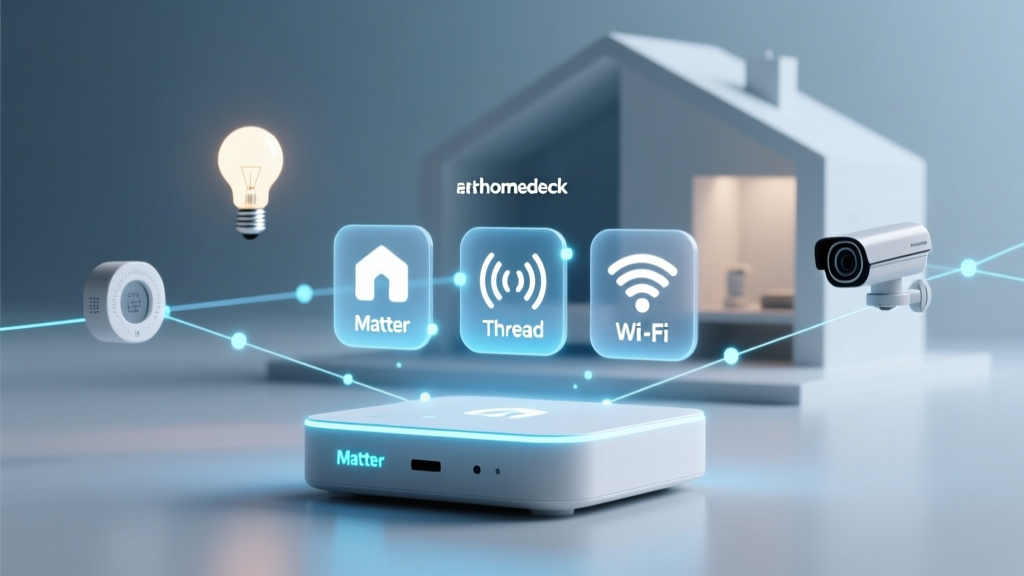
Announced in December 2019 and launched in October 2022, Matter is the first open, IP-based application layer standard developed jointly by Apple, Google, Amazon, the Connectivity Standards Alliance (CSA), and hundreds of industry partners. Built atop IPv6, Thread, and Wi-Fi (with optional Ethernet), Matter operates at the application layer—meaning it sits above transport protocols, enabling devices to communicate regardless of underlying radio.
Critical innovations include:
- Device Attestation Certificates (DACs): Hardware-rooted cryptographic identity verified by the CSA’s Device Attestation Service.
- Commissioning over Thread or Wi-Fi: Seamless, secure onboarding via QR code or NFC tap—no manual IP entry.
- Unified data model: Standardized clusters (e.g.,
OnOff,LevelControl,TemperatureMeasurement) ensure consistent behavior across brands.
Unlike predecessors, Matter doesn’t replace Zigbee or Z-Wave—it coexists. Many Matter devices (e.g., Aqara M3 Hub, Nanoleaf Matter Bridge) act as bridges, translating Matter commands to legacy protocols. Others are native Matter, running the Matter stack directly (e.g., Philips Hue Play Bar, Eve Energy Matter).
Protocol Timeline & Key Milestones
| Year | Protocol | Key Innovation | First Commercial Product | Price (Launch) | Limitations |
|---|---|---|---|---|---|
| 1975 | X10 | Powerline signaling | Pico Electronics Lamp Module | $19.95 (~$120 today) | No ACK, noise-sensitive, no encryption |
| 2003 | Z-Wave | Sub-GHz mesh + certification | Leviton D2000Z Switch | $69.95 | Proprietary, limited bandwidth (100 kbps) |
| 2004 | Zigbee HA 1.2 | IEEE 802.15.4 + mesh | Ember-based light switches | $45–$80 | 2.4 GHz interference, profile fragmentation |
| 2012 | Wi-Fi Direct | Hubless smartphone control | Belkin WeMo Switch | $49.99 | High power, network bloat, weak security |
| 2022 | Matter 1.0 | IP-based, vendor-agnostic app layer | Thread Border Router + Matter endpoint (e.g., Nanoleaf Essentials Bulb) | $29.99–$149.99 (bulbs to hubs) | Requires Thread/Wi-Fi infrastructure; no audio/video streaming in v1.0 |
What This History Means for You Today
You don’t need to scrap your smart home—but you do need a strategy. Here’s how to apply this historical insight:
1. Prioritize Matter-Ready Hubs If Starting Fresh
If building a new system, invest in a Matter-certified hub with Thread border router capability. Top options:
- Apple HomePod mini (2nd gen, 2026): $99 — supports Matter over Thread and acts as a Thread border router. Requires iOS/macOS ecosystem.
- Amazon Echo (4th gen, 2022): $99.99 — Matter controller with Thread support; integrates natively with Ring, Eero, and select security systems.
- Google Nest Hub (2nd gen, Matter-enabled firmware): $99.99 — supports Matter and works with Thread and Wi-Fi endpoints.
All three offer local processing for Matter devices (no cloud dependency for basic commands), reducing latency and improving privacy.
2. Bridge, Don’t Replace—Where It Makes Sense
Existing Z-Wave or Zigbee devices remain valuable. Instead of discarding them, use bridges:
- Aqara M3 Hub ($79.99): Supports Matter, Thread, Zigbee 3.0, and Bluetooth LE. Can expose up to 128 Zigbee devices as Matter endpoints.
- Samsung SmartThings Hub (2026) ($69.99): Certified for Matter 1.3, adds Thread border routing, and maintains full Zigbee/Z-Wave compatibility.
Crucially: bridged devices retain their native protocol’s range and reliability—but inherit Matter’s unified control and automations.
3. Choose Native Matter Devices for New Purchases
For new purchases—especially battery-powered sensors or lighting—prioritize native Matter devices. They benefit from:
- Lower latency (direct IP communication)
- Better security (DACs, secure commissioning)
- Future-proofing (Matter 1.2+ adds energy monitoring, diagnostics, and enhanced diagnostics)
Top native Matter picks (as of Q2 2026):
- Eve Energy Matter ($39.95): Plug-in smart outlet with real-time energy monitoring, Thread-native, works locally with HomeKit and Matter controllers.
- Nanoleaf Essentials A19 Bulb ($29.99): Full-color RGBWW bulb, Matter-over-Thread, dimmable, no hub required if paired with a Thread border router.
- Yale Assure Lock 2 (Matter Edition) ($229.99): Touchscreen deadbolt with Matter, Thread, and Z-Wave support—enables lock/unlock via any Matter controller without cloud dependency.
Adoption Trends: How Fast Is Matter Taking Hold?
Matter adoption is accelerating—but unevenly. According to the Connectivity Standards Alliance’s Q1 2026 Market Adoption Report, over 2,800 Matter-certified products shipped in 2026—a 210% increase from 2022. Yet only ~32% of U.S. smart home owners report using a Matter device, per a March 2026 Statista survey.
Matter-Certified Product Count (2021–2026)
Looking Ahead: Beyond Matter 1.x
Matter 1.3 (released May 2026) adds support for:\p>
- Energy management: Real-time grid-responsive load shedding (e.g., pausing EV charging during peak demand)
- Diagnostics cluster: Self-reporting device health (battery level, signal strength, firmware status)
- Enhanced access control: Multi-admin role permissions for property managers and tenants
Future versions aim to unify audio/video (Matter 2.0, expected late 2026) and integrate with Project CHIP’s successor initiatives—including efforts to standardize low-power wide-area (LPWA) sensing for outdoor and industrial use cases.
Final Recommendation: Build with Layers
The lesson of 50 years of protocol history isn’t that one standard wins and the rest vanish. It’s that layered architecture wins: Matter for control and interoperability, Thread for low-power mesh reliability, Wi-Fi for bandwidth-heavy tasks (cameras, speakers), and Z-Wave/Zigbee for legacy investment protection. Your smart home should be a stack—not a monolith.
Start with a Thread-border-router hub. Add native Matter devices for new purchases. Bridge what you already own. And remember: the goal isn’t the newest tech—it’s the most resilient, secure, and human-centered system possible. That’s what X10 pioneers dreamed of in 1975—and what Matter finally delivers.