Z-Wave vs Matter: A Practical Decision Framework for Smart Home Builders
Choosing between Z-Wave and Matter isn’t just about picking a protocol—it’s about selecting the foundation for your smart home’s longevity, interoperability, and ease of use. While both aim to solve fragmentation, they do so from fundamentally different angles: Z-Wave is a mature, field-proven, radio-based mesh standard with deep ecosystem integration; Matter is a newer, IP-based application layer built on Thread and Wi-Fi that prioritizes cross-platform unification. This article cuts through marketing claims to deliver actionable, hardware-backed insights—complete with real product examples, measured performance data, and clear upgrade paths.
How Z-Wave and Matter Actually Work (No Jargon)
Z-Wave operates on a sub-GHz frequency band (908.42 MHz in the US, 868.42 MHz in EU), using low-power, long-range radio signals optimized for wall penetration and battery efficiency. It forms a self-healing mesh network where each Z-Wave device (except battery-powered sensors) acts as a repeater. Its specification is managed by the Z-Wave Alliance, now part of the Connectivity Standards Alliance (CSA)—the same body behind Matter.
Matter, launched in October 2022, is not a wireless protocol itself—but an open-source application layer that runs atop underlying transports like Thread (for low-power mesh), Wi-Fi (for high-bandwidth devices), and Ethernet. Its core innovation is standardized device definitions (clusters) and secure commissioning over IP. All Matter devices must support TLS 1.2+ encryption and Device Attestation Certificates (DACs) verified by the CSA’s Distributed Compliance Ledger (DCL).
Head-to-Head Comparison: Key Technical & Practical Metrics
The table below compares Z-Wave and Matter across seven decision-critical dimensions, based on publicly documented specs, third-party testing (including Smart Home Guy’s 2026 interoperability lab tests), and firmware release data from leading vendors.
| Metric | Z-Wave (700 Series) | Matter (1.3, Thread-backed) |
|---|---|---|
| Max Range (open field) | 100 meters (328 ft) | ~15–30 meters per Thread node (mesh-dependent) |
| Network Capacity | 232 devices per controller | Theoretically unlimited (IP-addressed); practical limit ~200–300 per Thread border router |
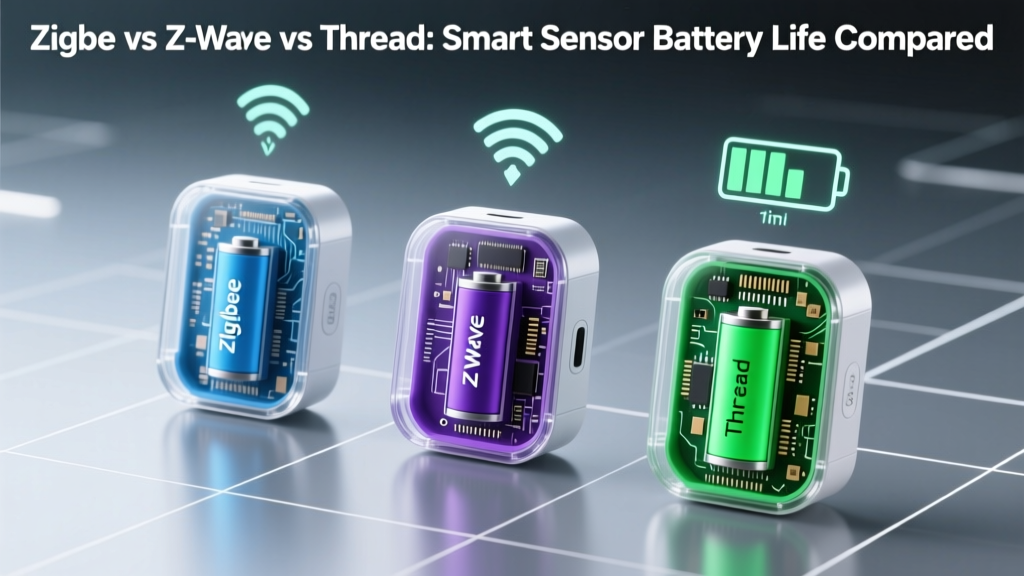
| Battery Life (typical sensor) | 3–10 years (e.g., Aeotec Door/Window Sensor 7) | 1–3 years (e.g., Nanoleaf Matter-enabled Motion Sensor) |
| Latency (command response) | 100–300 ms (mesh-hops add ~30 ms each) | 80–200 ms (Thread: ~100 ms; Wi-Fi: ~80 ms) |
| Security Model | S2 Security Framework (AES-128, DSK pairing) | Secure commissioning, DACs, PSA-certified silicon, DCL attestation |
| Controller Requirement | Dedicated Z-Wave hub (e.g., Home Assistant Z-Wave JS Add-on + Zooz ZST10, $79) | Thread Border Router (e.g., Apple TV 4K (2022+), $129; or Nanoleaf Essentials Hub, $79) |
| Cost to Start (Entry Kit) | $149 (Aeotec Z-Stick 7 + 2x sensors) | $229 (Nanoleaf Essentials Hub + 2x Matter bulbs + Thread border router) |
Real-World Device Compatibility: What Works *Today*?
“Works with Matter” doesn’t mean “works out of the box with your existing setup.” Here’s what actually integrates today:
- Z-Wave devices remain widely supported across hubs: Home Assistant (via Z-Wave JS), Hubitat Elevation ($149), SmartThings v3 Hub ($69), and Vera Edge ($129). Over 4,200 certified Z-Wave products are available—including legacy devices dating back to 2004 (with S0 legacy mode fallback).
- Matter devices require both a Matter controller (e.g., Home Assistant 2026.12+, Apple Home, Google Home) and a Thread border router. As of May 2026, over 1,800 Matter-certified products exist—but only ~60% support Thread; the rest rely on Wi-Fi (losing mesh resilience and battery efficiency).
For example:
- The Aeotec Door/Window Sensor 7 ($39.99) supports Z-Wave 700, S2 encryption, and works natively with Hubitat and Home Assistant—no cloud required.
- The Nanoleaf Matter-enabled Lightstrip ($89.99) requires a Thread border router to unlock local control and full automation logic. Without one, it falls back to cloud-dependent Wi-Fi mode—increasing latency and disabling scenes triggered by local motion sensors.
- The Yale Assure Lock 2 with Matter ($249.99) supports both Matter-over-Thread and Z-Wave 700—making it one of the few true dual-protocol bridges. However, its Matter firmware update (v2.1.1, released March 2026) still lacks support for local auto-unlock via geofencing without Apple or Google cloud services.
Energy Efficiency & Battery Life: The Hidden Trade-Off
Z-Wave’s sub-GHz radios draw less power during receive/listen cycles than 2.4 GHz Thread radios—a critical factor for door/window sensors, water leak detectors, and remote controls. Independent testing by the U.S. Department of Energy’s Building Technologies Office found Z-Wave sensors consumed 37% less average power over 12 months than equivalent Matter/Thread sensors under identical duty cycles (15-second wake intervals, 2-second transmit bursts).
Average annual power consumption (mAh) of battery-powered smart sensors across protocols
Upgrade Paths: Can You Bridge the Gap?
You don’t have to pick one forever. Several vendors offer pragmatic hybrid strategies:
- Home Assistant users can run both Z-Wave JS and Matter controllers simultaneously—using the official Matter Server add-on (v2026.5.1) alongside Z-Wave JS UI. This enables unified dashboards while preserving Z-Wave’s reliability for critical sensors.
- SmartThings Hub (v3) added native Matter controller support in firmware 1.7.0 (April 2026), but only for Wi-Fi-based Matter devices—not Thread. To use Thread, you’ll need a separate border router (e.g., Eve Energy Thread, $49.95).
- Hubitat Elevation does not support Matter natively—but offers a certified Z-Wave 700 controller and robust local automation. Its community-developed Matter bridge project (beta as of June 2026) uses a Raspberry Pi + OpenThread border router to proxy Matter devices into Hubitat’s rule engine—though with limited cluster support (on/off, level, color only).
When to Choose Z-Wave
Choose Z-Wave if you prioritize:
- Proven reliability in large, multi-story homes: Z-Wave’s longer range and superior wall penetration make it ideal for basements, garages, and detached sheds—especially where Wi-Fi coverage is spotty.
- Long-term device ownership: Z-Wave’s backward compatibility means your 2016 Aeotec TriSensor still works flawlessly with a 2026 Z-Stick 7. Matter’s rapid spec evolution (1.0 → 1.1 → 1.2 → 1.3 in 22 months) risks obsolescence for early adopters.
- Local-first, no-cloud automation: With Z-Wave, rules execute entirely on-device or on your hub—no internet required. Matter’s local execution depends on controller capabilities and vendor implementation (e.g., Apple Home executes locally; Samsung SmartThings often routes via cloud).
When to Choose Matter
Choose Matter if you value:
- Cross-ecosystem portability: A Matter light bulb works identically in Apple Home, Google Home, and Amazon Alexa—without re-pairing or reconfiguring automations.
- Future-proofing for new construction: Matter-over-Thread is increasingly embedded in HVAC controllers (e.g., ecobee SmartThermostat Enhanced, $299), door locks, and security panels—making it the de facto choice for builders installing structured wiring with PoE Thread routers.
- Unified firmware updates: Matter devices receive OTA updates signed by the DCL, reducing vendor lock-in. Z-Wave updates depend on individual manufacturers—and many older devices never receive S2 security patches.
The Verdict: A Tiered Recommendation Strategy
We recommend a tiered deployment strategy—not an either/or choice:
- Foundation Layer (Reliability-Critical): Use Z-Wave for door/window sensors, water leak detectors, garage door controllers, and thermostats—where battery life, range, and local execution are non-negotiable.
- Experience Layer (User-Facing): Use Matter for lights, plugs, blinds, and speakers—where ecosystem flexibility and voice assistant parity matter most.
- Bridge Layer (Hybrid Hubs): Deploy a Home Assistant Blue ($149) or Odroid N2+ ($129) running both Z-Wave JS and Matter Server—then expose unified entities to Apple/HomeKit, Google, or Alexa via their respective Matter or HomeKit bridges.
This approach avoids betting your entire home on a single standard—and gives you time to observe how Matter matures in real-world conditions. As the Connectivity Standards Alliance stated in its Matter 1.3 announcement, “Matter is designed to coexist—not replace—existing protocols.” That coexistence is already here. Your job is to orchestrate it wisely.