The Battle for Smart Home Supremacy
For over a decade, the smart home industry has been defined by fragmentation. Homeowners were forced to choose between competing ecosystems, juggling multiple apps, and relying on proprietary hubs that often became obsolete. Two protocols, however, have consistently risen above the noise to offer reliable, mesh-networked automation: the veteran Z-Wave and the revolutionary newcomer, Matter. As the smart home landscape undergoes its most significant architectural shift in history, consumers and installers alike are asking a critical question: Z-Wave vs Matter—which protocol should form the backbone of your connected home?
At SmartHomeDeck, we believe that choosing the right wireless standard is just as important as selecting the right smart lock or thermostat. The protocol you choose dictates your network's reliability, battery life, latency, and long-term compatibility. In this comprehensive guide, we will dissect the technical foundations, real-world performance, and ecosystem maturity of both Z-Wave and Matter, providing you with actionable advice to build a future-proof smart home.
Understanding Z-Wave: The Reliable Veteran
Z-Wave is a proprietary, low-power wireless mesh protocol designed specifically for home automation. Unlike Wi-Fi or Bluetooth, Z-Wave operates in the sub-GHz frequency band—specifically 908.42 MHz in North America and 868.42 MHz in Europe. This lower frequency is the secret to Z-Wave's legendary reliability. Because it avoids the crowded 2.4 GHz spectrum, Z-Wave signals easily penetrate thick walls, floors, and ceilings without competing with your home's Wi-Fi router, baby monitors, or microwave ovens.
According to the Z-Wave Alliance, the protocol supports up to 232 devices on a single network, utilizing a mesh topology where every mains-powered device acts as a repeater, extending the network's range. The latest iteration, the Z-Wave 800 series, introduces Z-Wave Long Range (LR), which dramatically increases signal reach and allows for direct connections from simple sensors to the hub without needing intermediate repeaters. Popular devices like the Aeotec Smart Switch 7, Ring Alarm Security System, and Zooz ZEN76 switches rely on Z-Wave for instant, rock-solid local control.
Understanding Matter: The Universal Newcomer
Matter is not a radio protocol in the traditional sense; rather, it is an open-source, IP-based application layer that runs on top of existing transport protocols, primarily Thread, Wi-Fi, and Ethernet. Backed by the Connectivity Standards Alliance (CSA), which includes tech giants like Apple, Google, Amazon, and Samsung, Matter aims to solve the interoperability crisis. As detailed by the Connectivity Standards Alliance, Matter ensures that a smart plug bought from one brand will seamlessly integrate into another brand's ecosystem without the need for cloud-based workarounds.
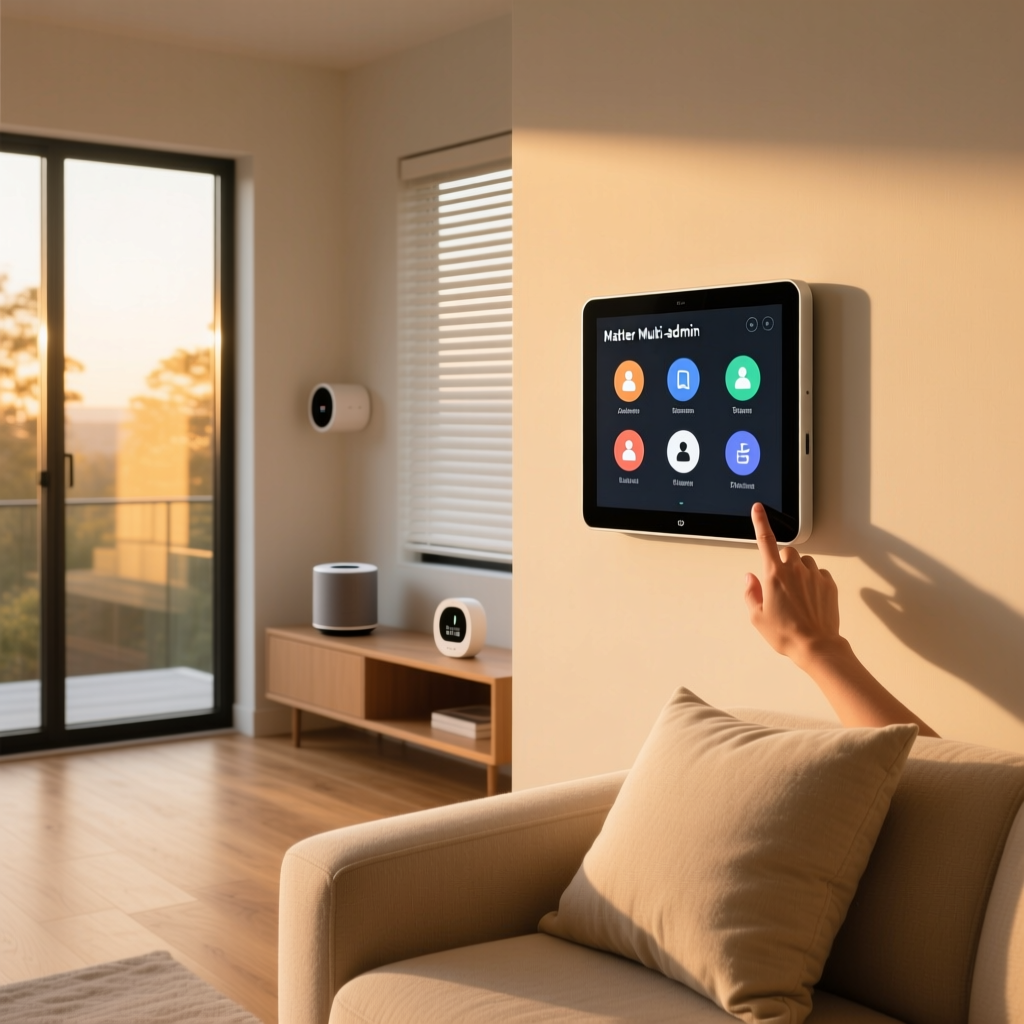
When comparing Z-Wave to Matter, we are usually comparing Z-Wave to Matter over Thread. Thread is a low-power, mesh-networking protocol built on the IEEE 802.15.4 standard. It operates on the 2.4 GHz spectrum, offering higher bandwidth and faster data transmission rates than Z-Wave. Matter's killer feature is 'Multi-Admin,' which allows a single device to be controlled simultaneously by multiple ecosystems—for example, controlling an Eve Energy smart plug via both Apple HomeKit and Google Home at the same time, without complex bridging.
Head-to-Head Comparison Table
To understand the fundamental differences between these two smart home giants, it is helpful to look at their core technical specifications side-by-side.
| Feature | Z-Wave (800 Series) | Matter (via Thread) |
|---|---|---|
| Radio Frequency | Sub-GHz (908.42 MHz US) | 2.4 GHz (IEEE 802.15.4) |
| Network Topology | Mesh (Source-Routed) | Mesh (IPv6 based) |
| Max Devices per Network | 232 (Up to 4000 with LR) | Theoretically thousands (practical limits apply) |
| Interference Risk | Extremely Low | Moderate to High (shares 2.4 GHz band) |
| Hub Requirement | Dedicated Z-Wave Controller | Thread Border Router or Wi-Fi Hub |
| Multi-Admin Support | No (Single Controller) | Yes (Native Ecosystem Bridging) |
Visualizing the Technical Differences
While both protocols offer excellent mesh capabilities, their physical layer differences result in distinct performance profiles in real-world home environments. The chart below illustrates the general network capabilities of Z-Wave 800 series versus Matter operating over a Thread network.
Comparison of Z-Wave and Matter over Thread network capabilities
Network Topology, Range, and the Interference Factor
The most significant differentiator between Z-Wave and Matter over Thread is how they handle physical obstacles and wireless interference. Z-Wave's sub-GHz waves are longer, allowing them to diffract around obstacles and penetrate dense materials like brick, concrete, and metal framing. In a large, multi-story home, a Z-Wave signal can often reach a basement sensor with just one or two hops. Furthermore, because it operates in a relatively empty frequency band, Z-Wave networks rarely experience dropped packets due to environmental noise.
Matter over Thread, operating on the 2.4 GHz band, offers higher data throughput, which is beneficial for devices that need to transmit larger payloads quickly, such as smart locks downloading new access codes. However, the 2.4 GHz spectrum is notoriously crowded. Your Thread network must coexist with your Wi-Fi network, Bluetooth devices, and even microwave ovens. While Thread utilizes advanced mesh routing and channel-hopping to mitigate interference, homes with dense Wi-Fi deployments (such as those using multiple Ubiquiti or Eero access points) may experience occasional latency spikes on their Thread network that Z-Wave simply does not encounter.
The Hub Dilemma: Gateways and Border Routers
Neither Z-Wave nor Thread can connect directly to your smartphone or cloud; both require a central gateway. For Z-Wave, this means purchasing a dedicated Z-Wave controller. Hubs like the Hubitat Elevation, Samsung SmartThings Station, or a Raspberry Pi running Home Assistant with a Zooz ZST10 800 Long Range USB stick are mandatory. This centralized approach gives advanced users immense local control and privacy, but it requires dedicated hardware.
Matter over Thread requires a 'Thread Border Router.' Fortunately, many modern smart home hubs already contain the necessary 802.15.4 radios to act as border routers. The Apple TV 4K (Wi-Fi + Ethernet model), Apple HomePod mini, Amazon Echo (4th Gen), and Google Nest Hub (2nd Gen) all function as Thread Border Routers. If you are already invested in one of these major ecosystems, you likely already own the hardware required to run a Matter network. However, if you rely on a mix of older hubs, you may need to purchase a dedicated border router to ensure your Thread mesh remains stable.
Security and Privacy Architecture
Both protocols take security incredibly seriously, but they approach it from different philosophies. Z-Wave utilizes the S2 security framework, which mandates AES-128 symmetric encryption for all communications. The S2 framework also introduces Elliptic Curve Diffie-Hellman (ECDH) key exchange, making it virtually impossible for hackers to intercept and decrypt Z-Wave traffic, even if they capture the pairing process.
Matter, being an IP-based protocol, leverages standard internet security paradigms adapted for low-power devices. It uses end-to-end encryption and a unique, blockchain-style Device Attestation Certificate (DAC) system. Every certified Matter device contains a cryptographic certificate that proves its authenticity to the controller. Furthermore, because Matter is designed for local control, commands do not need to travel to a distant cloud server and back, significantly reducing the attack surface and ensuring your home remains operational even if your internet connection goes down.
Cost, Availability, and Ecosystem Maturity
Z-Wave has a massive, two-decade head start. There are over 4,000 certified Z-Wave products on the market, covering every conceivable category: in-wall relays, gas detectors, motorized blinds, and advanced multi-sensors. Pricing is highly competitive and stable. A premium Z-Wave smart switch from Inovelli or Zooz typically costs between $45 and $60, while basic contact sensors can be found for under $20.
Matter is still in its growth phase. While the number of certified devices is expanding rapidly, the current market is heavily skewed toward lighting (Nanoleaf, Philips Hue), smart plugs (Eve, Meross), and basic sensors. High-end Matter devices sometimes carry an 'early adopter' tax, though prices are normalizing. It is also worth noting that many existing Zigbee and Z-Wave devices can be integrated into Matter ecosystems via 'Matter Bridges,' allowing you to leverage your existing hardware investments while transitioning to the new standard.
Which Protocol Should You Choose? Practical Scenarios
The choice between Z-Wave and Matter is not necessarily an 'either/or' proposition; many advanced hubs like Home Assistant and SmartThings support both simultaneously. However, if you are starting fresh or expanding a specific network, here is our actionable advice based on real-world use cases:
- Scenario A: The Large Home with Thick Walls (Choose Z-Wave)
If you live in a sprawling home with masonry, brick, or metal framing, Z-Wave's sub-GHz penetration is unmatched. Devices like the Ring Alarm and Zooz sensors will provide reliable coverage in basements and detached garages where 2.4 GHz Thread signals might struggle to maintain a stable mesh. - Scenario B: The Mixed-Ecosystem Household (Choose Matter)
If one partner uses an iPhone and Apple HomeKit, while the other uses an Android phone and Google Home, Matter is the undisputed winner. The Multi-Admin feature ensures both users have native, low-latency control over devices like the Yale Assure Lock 2 or Eve MotionBlinds without fighting over hub ownership. - Scenario C: The Advanced Tinkerer (Choose Both via Home Assistant)
If you run Home Assistant, you should utilize Z-Wave for your critical infrastructure (door locks, leak sensors, in-wall relays) due to its zero-interference reliability, and use Matter/Thread for high-bandwidth or ecosystem-specific devices like smart lighting and color bulbs. - Scenario D: The Renter or Apartment Dweller (Choose Matter over Wi-Fi)
If you cannot install in-wall Z-Wave switches and only have a few smart plugs and bulbs, Matter over Wi-Fi is the most cost-effective route. It requires no dedicated hub or border router, connecting directly to your existing Wi-Fi network while still offering Matter's unified app experience.
Conclusion
The debate of Z-Wave vs Matter ultimately comes down to your home's physical layout and your ecosystem preferences. Z-Wave remains the undisputed king of reliable, interference-free, low-power mesh networking, making it ideal for whole-home sensor deployments and critical security devices. Matter, on the other hand, represents the future of smart home interoperability, breaking down walled gardens and offering seamless multi-admin control across Apple, Google, and Amazon platforms.
As industry analysts at The Verge have noted, Matter's success hinges on the continued rollout of Thread border routers and the expansion of the device catalog. For now, the smartest approach for most homeowners is a hybrid one: leverage Z-Wave for the heavy lifting of home security and environmental monitoring, and embrace Matter for lighting, climate control, and cross-platform convenience. By understanding the strengths of each protocol, you can build a smart home that is not only intelligent but fundamentally resilient.