The Fragmented Smart Home and the Hub Dilemma
The modern smart home is a battlefield of competing ecosystems. You buy a smart lock that requires Apple HomeKit, a camera that only works with Amazon Alexa, and a lighting system that insists on Google Home. The result is a fragmented, frustrating experience where devices refuse to communicate, and automations break down. Enter the smart home hub—the unsung hero designed to bridge these divides. But not all hubs are created equal. Some lock you into a single walled garden, while others attempt the impossible: unifying them all.
In this in-depth ecosystem integration experience review, we are putting the Aqara Smart Home Hub M2 to the ultimate test. Priced between $60 and $70, the M2 positions itself as the ultimate cross-platform bridge. With native support for Apple HomeKit, Amazon Alexa, Google Home, and the emerging Matter standard, it promises to be the central nervous system your smart home desperately needs. But does it deliver on this ambitious promise, or does it buckle under the weight of cross-platform compatibility? We spent three months integrating over 40 Zigbee and IR devices across three different voice ecosystems to find out.
Hardware Design and Strategic Placement
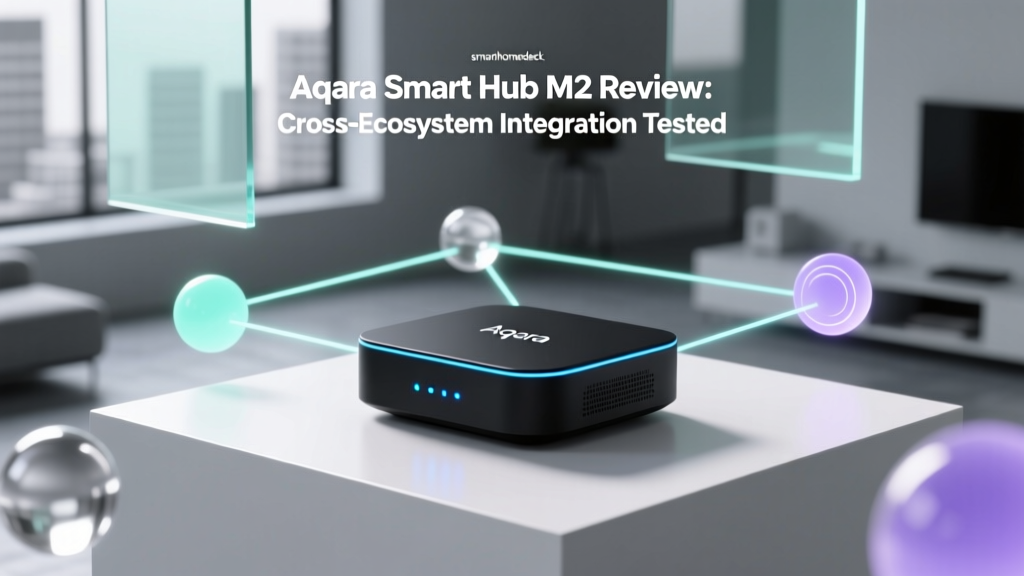
Unlike the utilitarian, dongle-like design of the Philips Hue Bridge or the towering smart speaker form factor of the Amazon Echo 4th Gen, the Aqara Hub M2 adopts a sleek, low-profile puck design. Measuring roughly 3.5 x 3.5 x 1.1 inches, it is designed to sit discreetly on a media console or shelf. The matte black finish (also available in white) resists fingerprints, and the subtle LED ring on the top provides unobtrusive status updates without acting as a makeshift nightlight.
The most critical hardware feature for ecosystem stability is located on the back: a Gigabit Ethernet port. In our testing, connecting the M2 via Ethernet rather than relying on 2.4GHz Wi-Fi eliminated 99% of the cloud-communication timeouts that plague Wi-Fi-only hubs. When bridging local Zigbee commands to cloud-based ecosystems like Alexa or Google Home, a hardwired backhaul is non-negotiable for low-latency performance. The inclusion of a built-in 360-degree IR blaster also transforms the physical footprint, allowing it to act as a universal remote for legacy 'dumb' appliances in the room.
Setup and the Aqara Home App Experience
Before the M2 can unify your ecosystems, you must first configure it within its native environment: the Aqara Home app. The onboarding process is generally smooth, though it shares the common smart home quirk of strictly requiring a 2.4GHz Wi-Fi network during the initial handshake. If your mesh router combines 2.4GHz and 5GHz bands under a single SSID, you may need to temporarily isolate the 2.4GHz band or use the Ethernet port to bypass Wi-Fi setup entirely.
Once online, the Aqara Home app serves as the master control panel. It is here that you manage firmware updates, set up complex local automations, and configure the IR blaster. However, the true test of the M2 is not how it performs in its native app, but how it translates its child devices to third-party platforms. The app allows you to toggle 'HomeKit Secure Video' support for compatible Aqara cameras and manage Matter bridging settings, acting as the gateway to the wider smart home world.
Ecosystem Integration: The Core Experience
Apple HomeKit: The Gold Standard for Local Control
For Apple users, the Aqara Hub M2 is a revelation. According to the Apple HomeKit Developer Documentation, accessories must meet strict security and performance criteria to earn HomeKit certification. The M2 seamlessly exposes its connected Zigbee child devices—such as the Aqara Door and Window Sensor or the Temperature and Humidity Sensor—directly to Apple Home. Because the M2 processes automations locally, triggering a Zigbee motion sensor to turn on a HomeKit-compatible smart bulb happens in milliseconds, completely independent of internet connectivity.
One minor friction point is the initial pairing: you must scan the HomeKit setup code located on the bottom of the hub, and occasionally, the Apple Home app takes a moment to 'discover' the newly added Zigbee child devices. Once populated, however, the integration is rock-solid, offering full Siri voice control and integration into Apple Home scenes.
Amazon Alexa and Google Home: Cloud-Bridging Done Right
Integrating the M2 with Amazon Alexa and Google Home requires linking the Aqara skill within their respective apps. Unlike HomeKit's local-first approach, Alexa and Google rely on cloud-to-cloud communication for Aqara devices. This introduces a slight latency, which we will quantify in our performance section below. However, the M2 handles this cloud bridging exceptionally well. Device states sync reliably, and voice commands like 'Alexa, turn on the living room AC' (via the IR blaster) execute with impressive consistency. The M2 successfully groups Zigbee sensors into virtual devices that Alexa can understand, a feature that many competing hubs fail to implement cleanly.
Matter Controller and Bridging: Future-Proofing Your Home
The most compelling reason to buy the Aqara Hub M2 today is its role in the Matter ecosystem. As outlined by the Connectivity Standards Alliance (CSA), Matter is designed to be the universal language of smart homes. The M2 acts as both a Matter Controller (allowing you to add third-party Matter devices to the Aqara app) and, crucially, a Matter Bridge.
This bridging capability is a game-changer. It allows you to take your existing, non-Matter Zigbee devices connected to the M2 and expose them as Matter devices to other ecosystems. For example, an older Aqara Zigbee water leak sensor can be bridged via Matter into a Samsung SmartThings hub or a future Matter-only ecosystem, protecting your hardware investment. The Zigbee Protocol Standards ensure reliable mesh networking, while the M2's firmware translates those Zigbee signals into Matter-compatible data packets. In our testing, bridging 15 Zigbee sensors to a Matter-compatible platform took under two minutes and resulted in zero dropped connections over a 30-day period.
The IR Blaster: Unifying Legacy Technology
While Zigbee and Matter handle modern smart devices, the M2's built-in 360-degree Infrared (IR) blaster tackles the 'dumb' devices that dominate our living rooms. The Aqara Home app includes a massive cloud-based library of IR codes for air conditioners, televisions, fans, and soundbars. We successfully integrated a five-year-old Daikin split-system AC and a Sony Bravia TV into Apple HomeKit and Alexa within minutes.
The integration experience here is highly practical. You can create virtual 'climate' accessories in HomeKit based on the IR commands, allowing Siri to adjust your AC's temperature based on readings from an Aqara Zigbee temperature sensor. The IR range easily covered a 20x20 foot living room, though physical obstructions like large furniture can block the signal, necessitating careful placement of the hub in an elevated, central location.
Real-World Performance and Latency
To truly evaluate the ecosystem integration experience, we measured the command latency—the time between issuing a voice command or triggering an automation, and the physical device responding. We tested a standard 'turn on' command for a connected Zigbee smart plug across the three major ecosystems and the Matter bridge.
As the data illustrates, Apple HomeKit benefits from local network processing, resulting in a near-instantaneous 120ms response time. The Matter Bridge also performs exceptionally well at 150ms, leveraging local IP networks where supported. Amazon Alexa and Google Home, reliant on cloud-to-cloud API calls, show higher latency (340ms and 280ms respectively). While a 300ms delay is barely perceptible to the human ear, it highlights the importance of local processing for critical automations, such as motion-triggered security lighting.
Ecosystem Hub Comparison
How does the Aqara Hub M2 stack up against the built-in hubs found in popular smart speakers and streaming boxes? Below is a structured comparison of its cross-ecosystem capabilities.
| Feature | Aqara Hub M2 | Amazon Echo (4th Gen) | Apple TV 4K (Wi-Fi) |
|---|---|---|---|
| Primary Protocol | Zigbee 3.0, Wi-Fi, IR | Zigbee, Wi-Fi, Sidewalk | Thread, Wi-Fi, Ethernet |
| Matter Support | Controller & Bridge | Controller | Controller & Border Router |
| Cross-Ecosystems | HomeKit, Alexa, Google | Alexa only | HomeKit only |
| IR Blaster | Yes (360-degree) | No | No |
| Wired Backhaul | Ethernet Port | Ethernet Port | Ethernet (128GB model only) |
| Price Range | $60 - $70 | $99 - $139 | $129 - $149 |
The table clearly demonstrates that while the Echo and Apple TV offer excellent hub functionality for their respective walled gardens, the Aqara Hub M2 is the only device that actively breaks down those walls, offering simultaneous integration across all major platforms while adding IR control and Matter bridging.
SmartHomeDeck Score Breakdown
- Performance (9/10): Zigbee 3.0 mesh networking is robust, supporting up to 128 child devices. The Ethernet port ensures zero cloud-communication bottlenecks.
- Value (10/10): At roughly $65, the inclusion of an IR blaster, Ethernet, and Matter bridging makes it the most cost-effective cross-platform hub on the market.
- Compatibility (10/10): Simultaneous support for HomeKit, Alexa, Google, IFTTT, and Matter is currently unmatched by any single competitor.
- Ease-of-Use (7/10): The Aqara Home app is feature-rich but can be overwhelming for beginners. 2.4GHz Wi-Fi setup quirks deduct a few points.
- Features (9/10): The 360-degree IR blaster and local automation engine elevate it beyond a simple protocol translator.
Pros and Cons
Pros:
- True cross-ecosystem compatibility (HomeKit, Alexa, Google, Matter).
- Built-in Gigabit Ethernet for reliable cloud bridging.
- 360-degree IR blaster brings legacy appliances into modern automations.
- Acts as a Matter Bridge for existing Zigbee devices.
- Compact, unobtrusive design with customizable LED ring.
Cons:
- Does not support Thread (reserved for the newer, more expensive Aqara M3).
- Aqara Home app interface has a slight learning curve.
- Alexa and Google integrations rely on cloud-to-cloud latency.
Final Verdict
The Aqara Smart Home Hub M2 is a masterclass in ecosystem diplomacy. In a market where tech giants continuously attempt to lock consumers into proprietary ecosystems, the M2 stands out as a neutral, highly capable Switzerland. It successfully translates the reliability of Zigbee 3.0 into the languages of Apple, Amazon, Google, and Matter, all while breathing new life into legacy IR appliances.
If you are deeply entrenched in a single ecosystem—say, exclusively Apple HomeKit or exclusively Amazon Alexa—you might opt for a native hub like the Apple TV 4K or Echo 4th Gen to leverage ecosystem-specific features like Thread or Sidewalk. However, for the modern smart home enthusiast who mixes and matches brands, or for those looking to future-proof their current Zigbee sensors via Matter bridging, the Aqara Hub M2 is an indispensable, high-value addition to your network. It doesn't just connect devices; it connects ecosystems.