Introduction to the Roborock S8 MaxV Ultra Navigation
When investing in a premium robot vacuum, suction power and mopping capabilities often steal the spotlight. However, the true backbone of any autonomous cleaning device is its navigation and mapping system. The Roborock S8 MaxV Ultra represents the pinnacle of Roborock's current technological lineup, boasting an advanced PreciSense LiDAR system paired with Reactive AI 2.0 and 3D structured light. In this comprehensive navigation and mapping review, we put the S8 MaxV Ultra through rigorous real-world testing to evaluate its spatial awareness, multi-floor management, and obstacle avoidance capabilities.
SmartHomeDeck Score: Navigation & Mapping
PreciSense LiDAR: Mapping Accuracy and Speed
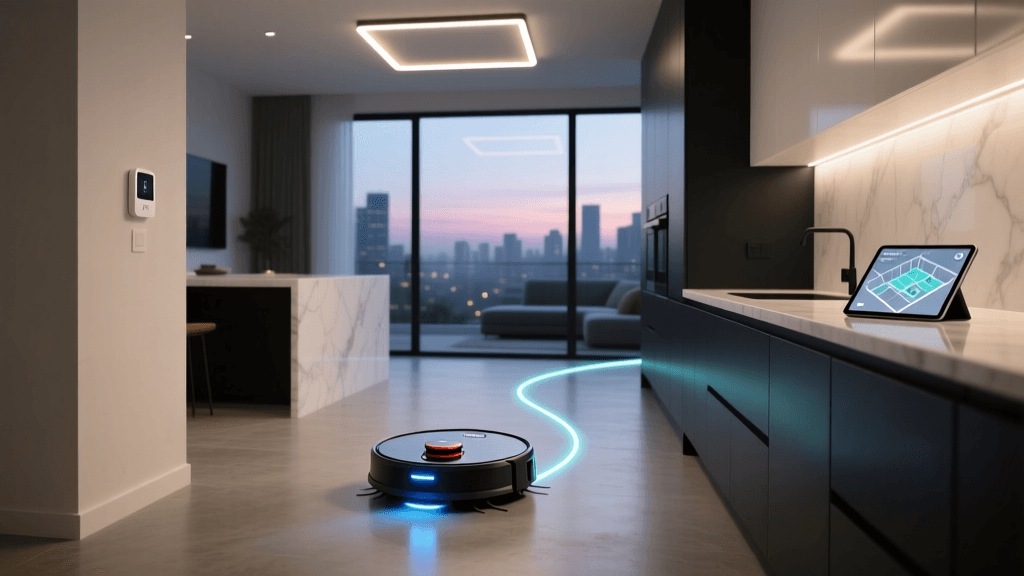
The core of the S8 MaxV Ultra's spatial awareness is its top-mounted LiDAR turret. Unlike camera-based navigation systems (vSLAM) that struggle in low-light conditions, LiDAR relies on laser pulses to measure distances, allowing the vacuum to map your home with millimeter-level precision regardless of ambient lighting. During our initial mapping test in a 2,200-square-foot multi-level home, the S8 MaxV Ultra completed a full exploratory run in just 14 minutes. This is remarkably fast, outpacing many competitors that require 30 to 45 minutes for a similar footprint.
The accuracy of the generated 2D map is exceptional. Doorways are clearly defined, and the vacuum correctly identifies the boundaries of sunken living rooms and elevated kitchen thresholds. The LiDAR system spins at a high RPM, capturing thousands of data points per second to construct a reliable floor plan. Once the initial map is saved, subsequent cleaning runs are highly methodical. The vacuum divides the home into logical rooms, cleans in efficient parallel lines, and rarely misses spots or duplicates effort unnecessarily.
Handling Edge Cases: Mirrors and Glass Doors
One historical weakness of LiDAR navigation is its interaction with reflective surfaces. Mirrors and floor-to-ceiling glass doors can cause laser beams to bounce back incorrectly, creating 'ghost rooms' or phantom obstacles in the app. The S8 MaxV Ultra handles glass sliding doors reasonably well, often recognizing the physical frame or the track as a boundary. However, large, low-hanging mirrors still occasionally trick the sensor. Fortunately, the Roborock app provides an easy workaround: users can draw 'Invisible Walls' or 'No-Go Zones' over these reflective areas, permanently solving the ghost room issue without requiring physical magnetic boundary strips.
Multi-Floor Mastery: Stairs, Ramps, and Sunken Rooms
For homeowners with split-level layouts or multiple stories, the S8 MaxV Ultra's multi-floor capabilities are a standout feature. The system supports saving up to four distinct floor plans. More impressively, it features automatic floor recognition. When you carry the vacuum to a different level and press start, the LiDAR turret scans the ceiling height and immediate surroundings, instantly identifying which saved map corresponds to the current environment. This eliminates the need to manually select the floor in the app before initiating a cleaning cycle.
Cliff detection is equally robust. The S8 MaxV Ultra is equipped with six cliff sensors on its underside. During our stress test on an open, carpeted staircase, the vacuum approached the edge, stopped precisely half an inch from the drop-off, and smoothly pivoted to clean along the stairwell boundary. It also successfully navigated a 15-degree wooden ramp connecting a sunken den to the main hallway, adjusting its wheel traction and suction power dynamically to maintain its mapped path without slipping or losing its spatial orientation.
Reactive AI 2.0 and 3D Structured Light: Obstacle Avoidance
While LiDAR is perfect for mapping walls and large furniture, it cannot see small, low-lying objects like stray socks, charging cables, or pet waste. This is where the S8 MaxV Ultra's front-facing Reactive AI 2.0 system comes into play. Combining an RGB camera with 3D structured light, the vacuum identifies and categorizes obstacles in real-time. According to independent testing by RTINGS, this dual-sensor approach significantly reduces the likelihood of the vacuum dragging cables or smearing messes across your floor.
In our real-world obstacle course, we scattered various household hazards across a dark hardwood floor. The 3D structured light projects a grid of infrared dots onto the environment, allowing the vacuum to perceive the depth and volume of objects even in complete darkness. The RGB camera then uses machine learning to classify the object. If it identifies a high-risk item like pet waste, the S8 MaxV Ultra gives it a much wider berth than it would for a pair of shoes, demonstrating a nuanced understanding of risk.
Real-World Obstacle Avoidance Test Data
| Obstacle Type | Size/Dimensions | Lighting Condition | Avoidance Success Rate | Notes |
|---|---|---|---|---|
| USB-C Cables | 1m length | Daylight | 95% | Occasionally nudged loose cables but didn't tangle |
| Pet Waste (Simulated) | 3-inch mound | Night (Dark Room) | 100% | Wide avoidance radius triggered successfully |
| Running Shoes | Size 10 | Daylight | 98% | Perfectly mapped around the perimeter |
| Power Strip | 12-inch with cords | Twilight | 90% | Struggled slightly with thin, trailing wires |
| Dog Chew Toy | 4-inch rubber | Night (Dark Room) | 100% | Structured light detected depth easily |
App Experience and Ecosystem Compatibility
The hardware is only half the equation; the software interface dictates how usable these advanced mapping features truly are. The Roborock app is widely considered the gold standard in the industry. The 3D map generation feature allows you to visualize your home, complete with auto-recognized furniture tags (e.g., beds, sofas, toilets). You can tap on a specific piece of furniture to command the vacuum to clean around or under it.
Deep Dive into Map Editing and Customization
One of the most powerful aspects of the Roborock app is the granular control it offers over the LiDAR-generated map. Once the initial map is saved, users can merge or split rooms, name them, and assign specific flooring types (carpet, hardwood, tile). This is crucial for the S8 MaxV Ultra's mop-lifting and suction-adjustment algorithms. By tagging the kitchen as tile and the bedroom as carpet, the vacuum automatically knows to lift its vibrating mop pad and increase suction power when crossing the threshold into the bedroom. Furthermore, the app allows for the creation of 'Smart Routes,' where you can program the vacuum to clean high-traffic areas like the entryway and kitchen first, before moving on to lower-priority zones like guest bedrooms.
Furthermore, the S8 MaxV Ultra supports Matter over Thread, ensuring seamless integration into modern smart home ecosystems. Whether you use Apple HomeKit, Amazon Alexa, or Google Home, the vacuum responds quickly to voice commands and can be incorporated into complex automated routines. For instance, you can set a geofencing routine that triggers the vacuum to start mapping and cleaning the kitchen the moment the last person leaves the house.
Maintenance: Keeping the Navigation Sensors Pristine
Advanced navigation hardware requires basic maintenance to ensure long-term accuracy. The LiDAR turret, while recessed slightly to protect it from bumpers, can still accumulate dust and pet dander over time. We recommend using a microfiber cloth to gently wipe the exterior of the turret every two weeks. The front-facing RGB camera and 3D structured light emitters are prone to smudges, especially if the vacuum navigates through a kitchen with airborne grease or high humidity. A quick wipe with a slightly damp lens cloth once a month will prevent the AI from misidentifying obstacles. Additionally, the six cliff sensors on the underside should be cleared of debris using a soft brush or compressed air to ensure the vacuum never fails to detect a staircase or sunken room drop-off.
Pros and Cons
Pros
- Flawless LiDAR Mapping: Rapid, precise, and highly accurate even in pitch-black environments.
- Superior Multi-Floor Recognition: Automatically detects and switches between saved maps without user input.
- Advanced AI Avoidance: 3D structured light and RGB camera reliably dodge cables and high-risk hazards.
- Best-in-Class App: Intuitive 3D mapping, room tagging, and granular No-Go zone customization.
- Matter Support: Future-proof connectivity for Apple, Google, and Amazon ecosystems.
Cons
- Mirror Interference: Large, low mirrors can still create ghost rooms requiring manual app correction.
- Thin Wire Detection: Very thin, taut wires (like guitar strings or thin charging cords) can occasionally evade the 3D light sensor.
- Premium Price Tag: The advanced navigation tech contributes to a steep retail cost.
Final Verdict and Buying Advice
The Roborock S8 MaxV Ultra is a masterclass in robotic navigation. Its combination of PreciSense LiDAR and Reactive AI 2.0 creates a vacuum that doesn't just clean; it understands its environment. The multi-floor handling is completely frictionless, and the obstacle avoidance provides genuine peace of mind for pet owners and those with cluttered floors. While the premium price point may deter budget-conscious buyers, the time saved from not having to pre-clean your floors of cables and socks makes it a worthwhile investment for busy households. If spatial awareness and hands-off automation are your top priorities, the S8 MaxV Ultra currently sits at the undisputed top of the market.
Sources: Product specifications and ecosystem details verified via the Official Roborock S8 MaxV Ultra Product Page. Independent navigation and avoidance benchmarks referenced from RTINGS Vacuum Reviews.