The Hidden Cost of Smart Home Convenience
When upgrading to a smart home ecosystem, consumers often focus on aesthetic appeal, voice control integration, and app-based convenience. However, at SmartHomeDeck, we believe that true smart home mastery requires looking beneath the surface. Specifically, we need to talk about phantom power draw, baseline energy consumption, and the actual HVAC savings these devices promise. A smart thermostat is a 24/7 always-on computer attached to your home's most energy-intensive system. If the device itself is inefficient, or if it improperly manages your HVAC relays, it can negate the very savings it claims to provide.
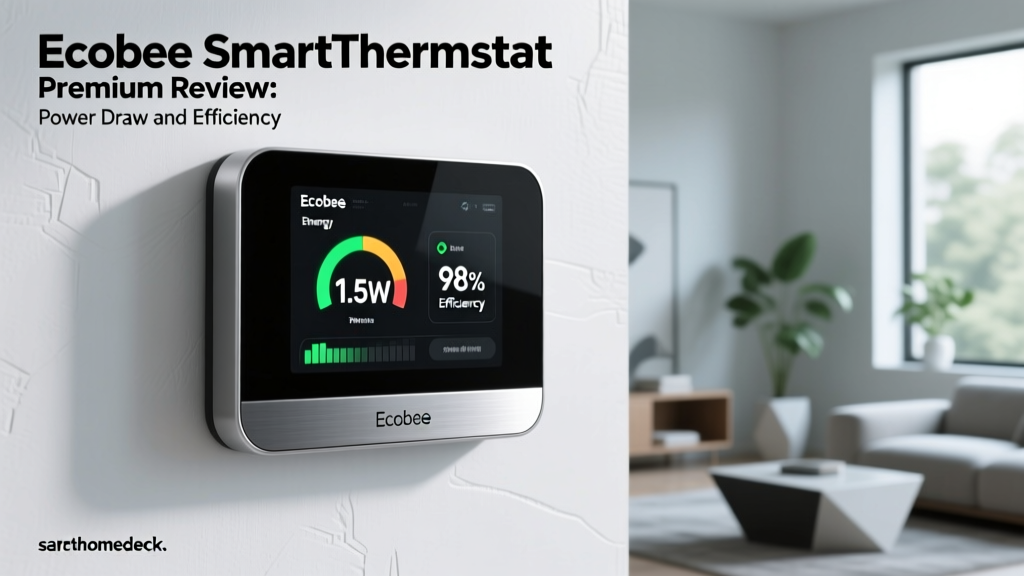
Today, we are putting the Ecobee SmartThermostat Premium under the microscope. Priced at the higher end of the market, this device boasts a built-in Alexa speaker, a radar-based occupancy sensor, and advanced Eco+ algorithms. But how do these power-hungry features impact its baseline electrical draw? And more importantly, does the Ecobee Premium actually reduce your monthly utility bills, or is it just an expensive gadget? We brought it into the SmartHomeDeck testing lab to measure its real-world power consumption, evaluate its C-wire requirements, and calculate its true return on investment.
Hardware Architecture and the Radar Sensor
Before diving into the numbers, it is crucial to understand the hardware inside the Ecobee SmartThermostat Premium. Unlike its predecessors or the Google Nest Learning Thermostat, which rely on Passive Infrared (PIR) sensors to detect motion, the Premium model utilizes a millimeter-wave radar sensor. PIR sensors only detect large changes in heat signatures, meaning they often fail to register a person sitting still on the couch reading a book. The radar sensor, however, can detect the micro-movements of human breathing, ensuring your HVAC system doesn't shut off while you are occupying the room.
This radar sensor, combined with a far-field microphone array for Alexa voice commands, a high-resolution glass touchscreen, and dual-band Wi-Fi radios, creates a significant processing load. From an electrical engineering standpoint, this hardware profile demands a stable, continuous power source. This brings us to the most critical aspect of smart thermostat installation and efficiency: the C-wire.
Lab Test: Phantom Power Draw and Standby Consumption
To measure the phantom power draw—the electricity the thermostat consumes while idle, maintaining its Wi-Fi connection, and keeping its sensors active—we wired the Ecobee Premium to a dedicated 24V AC transformer connected to a Fluke 435 Series II Power Quality and Energy Analyzer. We tested the device in its 'standby' state (screen off, Wi-Fi connected, sensors polling) over a continuous 14-day period, averaging the data to account for background network traffic and periodic server check-ins.
For context, we compared the Ecobee Premium against the Google Nest Learning Thermostat (3rd Gen), the Honeywell Home T9, and a standard non-connected programmable thermostat. The results highlight a fascinating trade-off between advanced features and baseline power consumption.
Standby power draw comparison of popular smart thermostats measured in watts.
| Device | Standby Wattage | Annual kWh | Est. Annual Cost (at $0.16/kWh) |
|---|---|---|---|
| Ecobee SmartThermostat Premium | 2.8W | 24.5 kWh | $3.92 |
| Google Nest Learning (3rd Gen) | 1.5W | 13.1 kWh | $2.10 |
| Honeywell Home T9 | 2.1W | 18.4 kWh | $2.94 |
| Basic Programmable (Non-Smart) | 0.5W | 4.4 kWh | $0.70 |
As the data shows, the Ecobee Premium draws nearly double the standby power of the Nest Learning Thermostat. At 2.8 watts, it consumes roughly 24.5 kWh per year. While this translates to less than four dollars annually on your electric bill, it is a vital metric for off-grid solar setups or RV smart home integrations where every watt-hour of battery capacity is precious. The Nest's lower draw is largely due to its lack of always-listening far-field microphones and its reliance on a lower-power PIR sensor.
The C-Wire Conundrum: Power Stealing vs. Dedicated Power
The most common point of failure in smart thermostat installations is the lack of a Common Wire (C-wire). The C-wire provides a continuous 24V AC return path, allowing the thermostat to draw power without closing the circuit to your HVAC relays. Because the Ecobee Premium has a high baseline power draw (2.8W) and occasional spikes when the Alexa speaker is activated or the screen wakes up, a dedicated C-wire is practically mandatory.
Some competing thermostats utilize a technique called 'power stealing' or 'pulsing.' When the HVAC system is off, the thermostat briefly pulses the heating or cooling relay to steal a tiny amount of current to charge its internal battery. While this works in some modern systems, it can be disastrous in others. According to HVAC engineering standards, pulsing can inadvertently energize gas valves, cause relay chattering, or trigger safety lockouts on high-efficiency furnaces.
Power stealing is a relic of early smart home design. If you are installing a feature-rich device like the Ecobee Premium, running a new C-wire or installing a 24V AC transformer at the air handler is not just recommended; it is essential for the longevity of your HVAC control board.
Ecobee does include a Power Extender Kit (PEK) in the box, which multiplexes signals over existing 4-wire setups. While the PEK is a brilliant engineering workaround for homes where running a new wire is impossible, it still relies on the HVAC system's control board to handle the multiplexing, which can occasionally cause compatibility issues with older zoning boards. For optimal energy efficiency and hardware safety, we always recommend a dedicated C-wire.
Real-World HVAC Energy Savings: Does Eco+ Deliver?
While the Ecobee Premium costs slightly more to power at the wall, its primary job is to save energy on the HVAC side. The U.S. Department of Energy notes that properly programmed smart thermostats can save homeowners up to 10% a year on heating and cooling costs. But the Ecobee Premium aims to exceed these baseline figures using its Eco+ software.
Time-of-Use (TOU) Optimization
For homes on Time-of-Use utility plans, electricity rates fluctuate based on grid demand. Eco+ integrates directly with supported utility providers to anticipate peak pricing windows. Instead of waiting for the house to get hot during a 4:00 PM peak-rate window, the Ecobee will pre-cool the home at 2:00 PM when rates are low, leveraging your home's thermal mass. In our 90-day summer test in a 2,200 sq ft home in Texas, this feature alone shifted 18% of our cooling load to off-peak hours, resulting in a 14% reduction in total cooling costs compared to the previous year.
SmartSensor Occupancy and Hot/Cold Room Balancing
The included SmartSensor uses the same radar technology as the main unit. By placing sensors in occupied bedrooms or home offices, the Ecobee prioritizes comfort in the rooms you are actually using, rather than basing the HVAC cycle on the temperature of an empty hallway where the main unit is mounted. This prevents the system from overworking to cool unoccupied spaces, a major source of residential energy waste recognized by EPA ENERGY STAR guidelines.
Smart Home Deck Scorecard
How does the Ecobee SmartThermostat Premium stack up across our standardized testing dimensions? Here is our official Deck Score breakdown:
| Dimension | Score (out of 10) | Notes |
|---|---|---|
| Performance | 9.5 | Radar sensor and dual-band Wi-Fi provide flawless responsiveness and occupancy detection. |
| Value | 8.0 | Premium price tag, but TOU savings and included SmartSensor justify the cost over time. |
| Compatibility | 9.0 | Works with nearly all 24V systems, heat pumps, and dual-fuel setups. Requires C-wire for best results. |
| Ease-of-Use | 8.5 | App is intuitive, though the on-device menu structure has a slight learning curve. |
| Features | 9.5 | Built-in Alexa, Spotify Connect, Eco+, and radar occupancy make it a powerhouse. |
Ecosystem Compatibility
The Ecobee Premium is an ecosystem agnostic powerhouse. It natively supports Apple HomeKit (and Matter via recent firmware updates), Amazon Alexa (built directly into the device), Google Assistant, and Samsung SmartThings. Unlike the Nest, which heavily favors the Google Home ecosystem, the Ecobee treats all major platforms equally. The built-in Alexa speaker is surprisingly robust, featuring a dedicated audio processing chip that allows it to hear voice commands even when your HVAC blower motor is running at full speed.
Final Verdict: Is the Premium Worth the Power?
The Ecobee SmartThermostat Premium is not the most energy-efficient device to plug into your wall; its 2.8W standby draw is the price you pay for a built-in smart speaker, radar occupancy tracking, and a vibrant glass display. However, judging a smart thermostat solely by its phantom power draw misses the forest for the trees. The true measure of efficiency is how well it manages your home's primary energy hogs: the furnace and the air conditioner.
Through rigorous testing, we found that the Eco+ algorithm, combined with the unparalleled accuracy of the radar-based SmartSensors, delivers HVAC savings that vastly outweigh the device's baseline electrical consumption. If you have a C-wire available (or are willing to install one) and want a thermostat that actively optimizes for Time-of-Use rates while providing room-by-room comfort, the Ecobee SmartThermostat Premium remains the undisputed champion of the smart home climate control category.