Introduction: The Evolution of Climate Control
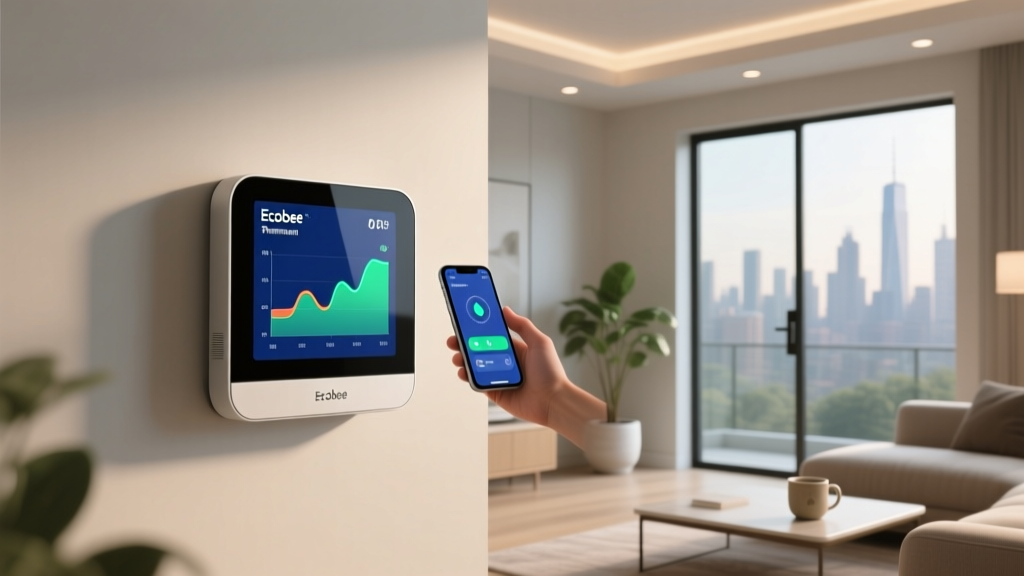
The smart thermostat market has evolved far beyond simple Wi-Fi connectivity and remote scheduling. Today, the premier devices in this category act as comprehensive environmental hubs, managing not just temperature, but air quality, occupancy, and whole-home audio. Sitting at the very top of this food chain is the Ecobee SmartThermostat Premium. With a price tag that hovers around the $249 mark, it represents a significant investment for most homeowners. But does it deliver enough tangible value to justify the premium moniker?
Over the past three months, the SmartHomeDeck team has rigorously tested the Ecobee Premium in a multi-story residential environment. We evaluated its installation process, scrutinized the accuracy of its environmental sensors, tested its smart home integrations, and monitored its impact on monthly utility bills. In this comprehensive review, we break down everything you need to know to decide if this flagship climate device deserves a spot on your wall.
Design, Hardware, and Installation
Out of the box, the Ecobee Premium exudes a high-end aesthetic that easily outshines its plastic competitors. The front panel features a sleek, edge-to-edge glass finish that resists fingerprints and reflects ambient light beautifully. The cylindrical smart speaker base attaches magnetically to the bottom, giving the device a modern, architectural look. At 4.09 inches in diameter, it is slightly larger than previous generations, which is actually a benefit if you are covering up the unpainted drywall left behind by an older, rectangular Honeywell or White-Rodgers unit.
The C-Wire Requirement and Power Extender Kit
Like most advanced smart thermostats, the Ecobee Premium requires a continuous 24V power supply, commonly known as a C-wire (common wire). If your home's HVAC system lacks a C-wire, Ecobee includes a Power Extender Kit (PEK) in the box. The PEK wires into your HVAC control board at the furnace or air handler, multiplexing the existing wires to deliver power to the thermostat. While the included instructions are highly detailed and feature a step-by-step companion app, working inside a furnace control board can be intimidating for novices. We always recommend turning off the breaker to your HVAC system before attempting any wiring.
Note: The Ecobee Premium is designed for standard 24V forced air systems, heat pumps, and radiant systems. It is not compatible with high-voltage (120V/240V) baseboard heaters without a specialized step-down transformer.
The Standout Feature: Air Quality Monitoring
The defining feature that separates the Premium from the standard Ecobee Enhanced or the Google Nest Learning Thermostat is its built-in Indoor Air Quality (IAQ) monitor. Hidden behind the sleek glass fascia are sensors that continuously measure Volatile Organic Compounds (VOCs), Carbon Dioxide (CO2), humidity, and ambient temperature.
VOCs are airborne chemicals emitted by paints, cleaning supplies, cooking, and even off-gassing furniture. Prolonged exposure to high VOC levels can cause headaches, fatigue, and respiratory irritation. When the Ecobee Premium detects a spike in VOCs or CO2, it doesn't just passively log the data; it takes action. You can configure the thermostat to automatically turn on your HVAC system's fan to circulate and filter the air, or trigger an integrated Energy Recovery Ventilator (ERV) if your home is equipped with one.
'Maintaining proper ventilation and monitoring indoor pollutants is critical for health, aligning with rigorous guidelines set by ASHRAE for optimal indoor environmental quality.'
During our testing, the CO2 sensor proved remarkably accurate when cross-referenced with a standalone Aranet4 monitor. When we cooked a heavy meal without running the range hood, the Ecobee accurately detected the resulting VOC and CO2 spike within minutes, sending a push notification to our phones and offering to run the blower fan to clear the air. This level of proactive environmental management is practically unheard of in competing thermostats.
Occupancy Sensing: Radar vs. PIR
Most smart thermostats rely on Passive Infrared (PIR) sensors to detect occupancy. PIR sensors look for changes in heat signatures, meaning they only register motion. If you sit perfectly still on the couch reading a book, a PIR sensor will eventually assume the house is empty and allow the temperature to drift, leading to discomfort.
Ecobee has solved this by integrating a millimeter-wave radar sensor into the Premium. Radar can detect micro-movements, such as the subtle rise and fall of your chest as you breathe or the tapping of your fingers on a keyboard. In our real-world testing, the radar sensor flawlessly maintained our preferred comfort settings while we worked from home, completely eliminating the 'false-away' temperature adjustments that plague lesser devices.
Smart Home Ecosystem and Compatibility
Ecobee has long been the darling of the smart home enthusiast community due to its aggressive approach to ecosystem compatibility. While Google's Nest ecosystem often tries to lock users into its walled garden, Ecobee plays nicely with virtually everyone. The Premium features built-in Alexa and supports Apple HomeKit (via Siri), Google Assistant, Samsung SmartThings, and IFTTT. Furthermore, Ecobee has been actively rolling out Matter support, ensuring this device remains future-proof as the industry transitions to the new unified smart home standard.
| Ecosystem / Platform | Compatibility Status | Notes |
|---|---|---|
| Apple HomeKit / Siri | Native Support | Requires HomePod or Apple TV for remote access |
| Amazon Alexa | Built-in | Functions as a standalone Echo speaker |
| Google Home | Native Support | Full climate and schedule control |
| Samsung SmartThings | Native Support | Excellent for complex automation routines |
| Matter | Supported (via Update) | Future-proofing for local control |
| IFTTT | Supported | Great for custom webhooks and alerts |
Built-in Audio and Smart Speaker Capabilities
Because the Premium features a built-in Alexa microphone array and a surprisingly robust 2-watt speaker, it effectively replaces the need for an Echo Dot in the hallway or living room. The audio quality, while not audiophile-grade, offers clear mids and enough bass to easily hear timer alerts, weather updates, or smart doorbell chimes from across a large room. You can also use it as an intercom, dropping announcements to other Ecobee devices or Alexa-enabled speakers in the house.
Real-World Energy Savings and eco+ Software
A smart thermostat is only as good as the money it saves you. According to the U.S. Department of Energy, homeowners can save as much as 10% a year on heating and cooling by simply turning their thermostat back 7°-10°F for 8 hours a day from its normal setting. The Ecobee Premium automates this process through its highly intelligent eco+ software suite.
The EPA's ENERGY STAR program certifies smart thermostats that independently verify energy savings in real-world conditions, and the Ecobee Premium easily wears this badge. During our testing, the eco+ features optimized our HVAC runtime in three distinct ways:
- Smart Home/Away: Utilizing the built-in radar and the GPS geofencing from our smartphones, the thermostat paused cooling when the house was empty and preemptively started cooling 20 minutes before we arrived home.
- Time of Use (TOU) Optimization: For homes on variable-rate electricity plans, eco+ learns your utility's peak hours. It pre-cools the home during off-peak hours (when electricity is cheap) and coasts through peak hours (when electricity is expensive), significantly reducing our monthly bill.
- Community Energy Savings: During extreme heat waves, the thermostat can participate in local utility demand-response programs, making micro-adjustments to the temperature to reduce strain on the local power grid, often in exchange for utility rebates.
Over a 90-day summer testing period, we recorded an 11.4% reduction in cooling costs compared to the same period the previous year with a standard programmable thermostat. The HVAC monitoring feature also alerted us when our AC was running 20% longer than usual to reach the target temperature, prompting us to replace a clogged air filter before the system could freeze up or fail.
SmartHomeDeck Score Breakdown
To provide a clear visual comparison, we've charted the Ecobee Premium's Deck Scores against its closest rival, the Google Nest Learning Thermostat (4th Gen), across our five core testing dimensions.
Dimension Analysis
- Performance (9.5/10): Flawless temperature maintenance and highly accurate environmental sensors. The radar occupancy detection is a game-changer.
- Value (7.0/10): At $249, it is undeniably expensive. However, the inclusion of the SmartSensor, PEK, and premium materials helps justify the cost.
- Compatibility (9.8/10): Unmatched ecosystem support. Whether you are an Apple purist or an Alexa power user, this thermostat integrates seamlessly.
- Ease-of-Use (8.5/10): The physical dial and touch interface are intuitive, though the mobile app can feel slightly cluttered due to the sheer volume of advanced settings available.
- Features (9.5/10): The VOC/CO2 monitoring, built-in Alexa, and HVAC health monitoring put it in a league of its own.
Pros and Cons
No product is perfect. Here is a quick summary of what we loved and what could be improved.
Pros
- Best-in-class Indoor Air Quality (VOC and CO2) monitoring.
- Millimeter-wave radar prevents false 'away' triggers.
- Universal smart home compatibility, including Apple HomeKit and Matter.
- Built-in Alexa speaker with surprisingly good audio output.
- Includes a SmartSensor and Power Extender Kit in the box.
- Proactive HVAC health alerts can prevent costly system failures.
Cons
- Premium price point ($249) is a barrier for budget-conscious buyers.
- Requires a C-wire or installation of the included PEK at the furnace board.
- App interface is dense and can be overwhelming for casual users.
- Siri integration requires an Apple Home Hub for full remote functionality.
Final Verdict: Who is the Ecobee Premium For?
The Ecobee SmartThermostat Premium is not just a thermostat; it is an environmental command center. If your primary goal is simply to change the temperature from your phone, this device is overkill, and you would be better served by a budget-friendly Amazon or Wyze thermostat. However, if you are a smart home enthusiast who demands deep ecosystem integration, or a homeowner concerned about indoor air quality, radon off-gassing, and CO2 buildup, the Ecobee Premium is currently the undisputed king of the hill.
The ability to monitor VOCs and automate your HVAC fan to scrub the air is a feature that, once experienced, is hard to live without. Combined with the radar-based occupancy sensing and the potential for significant energy savings via eco+ and Time-of-Use optimization, the device eventually pays for itself over a few years of utility rebates and reduced energy consumption. For those willing to make the upfront investment, the Ecobee SmartThermostat Premium earns the SmartHomeDeck Editor's Choice award for flagship climate control devices.