Introduction: The Premium Price Tag
When navigating the smart home market, few devices sit at the intersection of home comfort, energy efficiency, and advanced technology quite like the smart thermostat. At the very top of this market sits the Ecobee SmartThermostat Premium. With a retail price hovering around $249, it demands a significant upfront investment compared to budget alternatives that can be found for under $80. But does the sticker price tell the whole story?
At SmartHomeDeck, we believe that evaluating a smart home device requires looking far beyond the initial checkout total. A true value-for-money assessment must factor in installation requirements, accessory inclusions, energy savings over time, utility rebates, and the cost of replacing standalone devices that the Ecobee Premium effectively absorbs into its sleek glass-and-metal chassis. In this comprehensive review, we break down the total cost of ownership (TCO) and long-term return on investment (ROI) of the Ecobee SmartThermostat Premium to determine if it is genuinely worth your hard-earned money.
Unboxing the Value: What is Actually in the Box?
To understand the value proposition of the Ecobee Premium, we first have to look at what you are actually getting for your $249. Unlike many competitors that strip down the box to keep the base unit price low, Ecobee bundles several high-value accessories that directly impact your total cost assessment.
The SmartSensor Advantage
The Ecobee Premium includes one SmartSensor in the box. This battery-powered, puck-sized device monitors temperature and occupancy in the rooms that matter most, solving the common problem of a thermostat in a hallway misreading the comfort level of the living room. If you were to purchase a comparable temperature and occupancy sensor for a competing ecosystem, such as the Nest Temperature Sensor, you would pay an additional $39 to $49. Ecobee includes this critical comfort tool right out of the gate.
Built-In Air Quality Monitoring
This is where the Ecobee Premium truly separates itself from the pack. The device features a built-in air quality monitor that tracks Volatile Organic Compounds (VOCs), carbon dioxide (CO2), and estimated particulate matter. Standalone smart air quality monitors from reputable brands like Airthings or Awair typically retail between $100 and $150. By integrating this sensor directly into the thermostat, Ecobee allows the system to automatically trigger your HVAC fan or an ERV/HRV system to circulate fresh air when VOC levels spike, effectively replacing a $100+ standalone device.
The SmartSpeaker Integration
The Premium model features a built-in smart speaker with far-field microphones and Alexa integration. While audiophiles won’t confuse it for a high-end Sonos system, it easily matches the audio quality and utility of an Amazon Echo Dot (retail value ~$50). This allows for voice-controlled temperature adjustments, smart home routines, and intercom features without needing an extra device on your countertop.
Installation and the Dreaded C-Wire
No smart thermostat review is complete without addressing the common wire. The Ecobee Premium requires a 24V C-wire (common wire) to provide continuous power to its vibrant glass touchscreen, Wi-Fi radio, and air quality sensors. According to Consumer Reports, the absence of a C-wire is the number one hurdle consumers face when upgrading to a smart thermostat.
If your home lacks a C-wire, Ecobee includes a Power Extender Kit (PEK) in the box. The PEK connects to your HVAC control board and multiplexes the existing wires to deliver power to the thermostat. While the hardware is free, the installation requires opening your air handler or furnace panel. If you are not comfortable working with low-voltage HVAC wiring, hiring a professional HVAC technician or electrician will add anywhere from $100 to $200 to your total upfront cost. This is a vital consideration for your initial budget.
Energy Savings: Calculating the Real ROI
The primary financial justification for any smart thermostat is the reduction in monthly utility bills. The Ecobee Premium utilizes advanced algorithms, geofencing, and its included SmartSensor to ensure you are only heating or cooling the rooms you are actively using.
The Math Behind the Savings
According to the U.S. Department of Energy, homeowners can save as much as 10% a year on heating and cooling by simply turning their thermostat back 7°F to 10°F for eight hours a day from its normal setting. Smart thermostats automate this process entirely. Furthermore, the Environmental Protection Agency (EPA) notes that Energy Star certified smart thermostats deliver verified, measurable energy savings by learning your schedule and adjusting to real-world weather conditions.
Let’s break down the math for an average household:
- Average Annual HVAC Spend: $1,200
- Conservative Smart Savings (10%): $120 per year
- Aggressive Smart Savings (15% with eco+ and Sensors): $180 per year
Over a standard 5-year lifespan before a potential hardware upgrade, the energy savings alone range from $600 to $900. When you subtract the $249 upfront cost, the Ecobee Premium doesn’t just pay for itself; it generates a net positive return of $351 to $651.
Utility Rebates and Tax Incentives
Many local utility companies and regional governments offer instant rebates for installing Energy Star certified smart thermostats. It is incredibly common to find rebates ranging from $50 to $100 simply for registering your new Ecobee device on your local utility’s portal. In some cases, these rebates can cut the upfront cost of the Ecobee Premium in half, drastically accelerating your ROI timeline.
5-Year Total Cost of Ownership Comparison
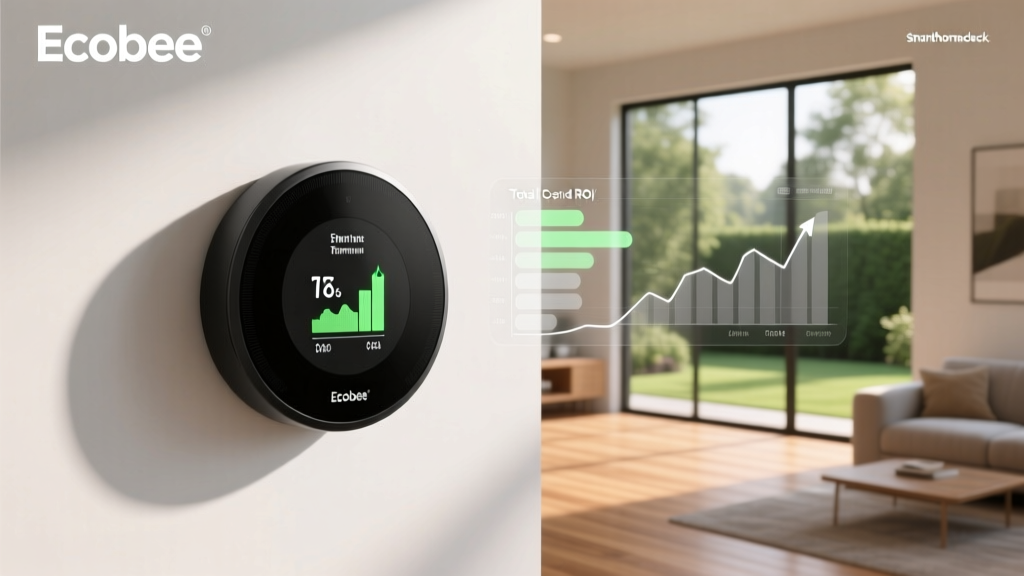
To provide a clear market perspective, we have modeled the 5-year Total Cost of Ownership (TCO) for the Ecobee Premium against its two most prominent rivals: the Google Nest Learning Thermostat and the budget-friendly Amazon Smart Thermostat. This model factors in the upfront hardware cost, the cost of necessary add-on sensors to achieve multi-room comfort, and estimated 5-year energy costs based on a baseline $1,200 annual HVAC spend.
As the data illustrates, while the Amazon Smart Thermostat is significantly cheaper on day one, its lack of an included occupancy sensor and less aggressive multi-room optimization algorithms result in lower overall energy savings over five years. The Ecobee Premium and Nest Learning are closely matched in price, but Ecobee’s inclusion of the SmartSensor and air quality monitor gives it a distinct edge in pure hardware value.
Feature Valuation: The Hidden Savings
When conducting a total cost assessment, we must assign a monetary value to the features that prevent you from buying redundant smart home devices. Here is how the Ecobee Premium consolidates your smart home spending:
| Feature / Device Equivalent | Standalone Market Cost | Included with Ecobee Premium? |
|---|---|---|
| Smart Thermostat Base Unit | $130 - $180 | Yes |
| Room Temp & Occupancy Sensor | $39 - $49 | Yes (1 Included) |
| Smart Air Quality Monitor (VOC/CO2) | $100 - $150 | Yes (Built-in) |
| Smart Speaker (Alexa Integration) | $40 - $50 | Yes (Built-in) |
| Total Standalone Value | $309 - $429 | $249 Retail Price |
From a purely mathematical standpoint, purchasing the Ecobee Premium is actually a discount compared to assembling the equivalent functionality from separate, dedicated devices on your network.
Ecosystem Compatibility and Smart Home Integration
A major factor in the long-term value of a smart device is its compatibility. If you are forced to abandon your preferred smart home ecosystem, the device loses its value. The Ecobee Premium is a masterclass in universal compatibility:
- Apple HomeKit: Full support, including Siri voice control and HomeKit Secure Video (if integrated with other Ecobee cameras).
- Amazon Alexa: Built-in natively, acting as a full-fledged Echo device.
- Google Assistant: Fully supported via cloud integration.
- Samsung SmartThings & IFTTT: Deep integration for complex, cross-brand automation routines.
This broad compatibility ensures that if you switch from an iPhone to an Android, or from an Echo to a Nest Hub, your thermostat investment remains protected and fully functional.
SmartHomeDeck Score Dimensions
We evaluate every product across our proprietary Deck Score dimensions to provide a holistic view of its market standing.
- Performance (9.5/10): The HVAC control is flawless, and the Wi-Fi connectivity is remarkably stable. The air quality sensor responds rapidly to changes in the environment.
- Value (9.0/10): Despite the high initial price, the inclusion of the SmartSensor, air quality monitor, and speaker makes the total hardware value exceptional.
- Compatibility (10/10): Unmatched support across HomeKit, Alexa, Google, and SmartThings.
- Ease-of-Use (8.5/10): The physical dial and touchscreen are intuitive, though the companion app can feel slightly cluttered due to the sheer volume of advanced settings and eco+ features.
- Features (10/10): It is difficult to imagine what else could be packed into this device without turning it into a tablet.
Pros and Cons Summary
Pros:
- Includes a SmartSensor in the box for multi-room comfort.
- Built-in VOC and CO2 air quality monitoring.
- Universal smart home ecosystem compatibility, including Apple HomeKit.
- eco+ software provides aggressive, automated energy savings.
- Premium glass and metal aesthetic.
Cons:
- High upfront retail price ($249).
- Strict C-wire requirement (PEK included but requires HVAC panel access).
- Built-in speaker audio quality is merely adequate, not audiophile-grade.
Final Verdict: Who is the Ecobee Premium For?
If your sole objective is to set a schedule and forget it, the Ecobee SmartThermostat Premium is overkill, and a budget model like the Amazon Smart Thermostat will suffice. However, if you approach your smart home from a holistic, long-term value perspective, the Ecobee Premium is arguably the most cost-effective high-end thermostat on the market.
By consolidating an air quality monitor, a smart speaker, and a remote room sensor into a single, beautifully designed hub, Ecobee saves you from buying redundant hardware. When combined with the aggressive energy savings generated by its eco+ algorithms and the included SmartSensor, the device pays for itself well within the first two years of use. For homeowners who want total control over their climate, air quality, and energy spend, the Ecobee SmartThermostat Premium earns our highest recommendation for long-term value and ROI.