The Smart Home Privacy Paradox
In the modern connected home, security and privacy are often positioned as opposing forces. To keep an eye on your property, you must invite devices into your home that are inherently designed to watch, listen, and record. For years, the industry standard has been to beam that sensitive footage directly to remote cloud servers, trading your personal data for the convenience of mobile push notifications and AI-driven alerts. But as data breaches and unauthorized access incidents make headlines, a growing segment of smart home enthusiasts is demanding a different approach: local processing and zero cloud dependency.
Enter the EufyCam 3 and HomeBase 3 ecosystem. Marketed heavily on its promise of local storage, zero monthly fees, and on-device AI, Eufy has positioned itself as the privacy-first alternative to giants like Ring and Nest. But does the EufyCam 3 truly deliver on its privacy promises, or is it merely hiding cloud dependencies behind a polished app interface? In this comprehensive review, we evaluate the EufyCam 3 through the strict lens of privacy data handling, cloud dependency, and edge computing performance.
Hardware Architecture: The Foundation of Local Control
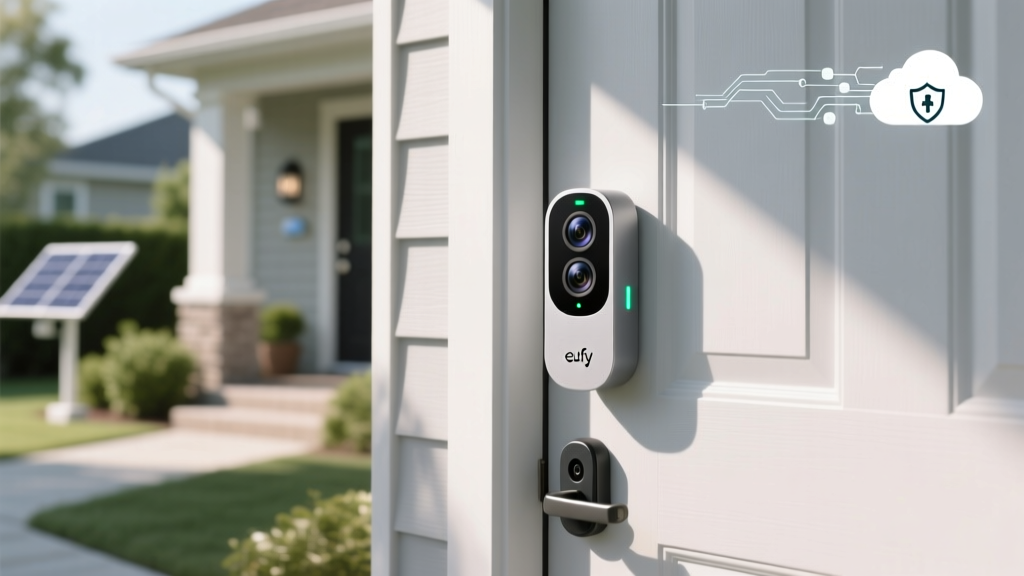
Before evaluating the software and data policies, it is crucial to understand the hardware that makes local processing possible. The EufyCam 3 is a 4K wireless outdoor camera featuring an integrated solar panel, a 16,000 mAh battery, and a built-in spotlight for color night vision. However, the camera itself is only half of the equation.
The true brain of the operation is the HomeBase 3 (S380). Unlike traditional smart cameras that rely on cloud servers to run machine learning algorithms for person, pet, or vehicle detection, the HomeBase 3 houses a dedicated hexa-core processor and a Neural Processing Unit (NPU). This hardware allows the system to perform complex AI inference locally on your home network. Furthermore, the HomeBase 3 includes 16GB of built-in eMMC storage and a 2.5-inch SATA bay, allowing users to expand their local storage up to 16TB. This means months of continuous 4K footage can be retained entirely within the physical walls of your home, completely bypassing the cloud.
The Cloud Dependency Stress Test
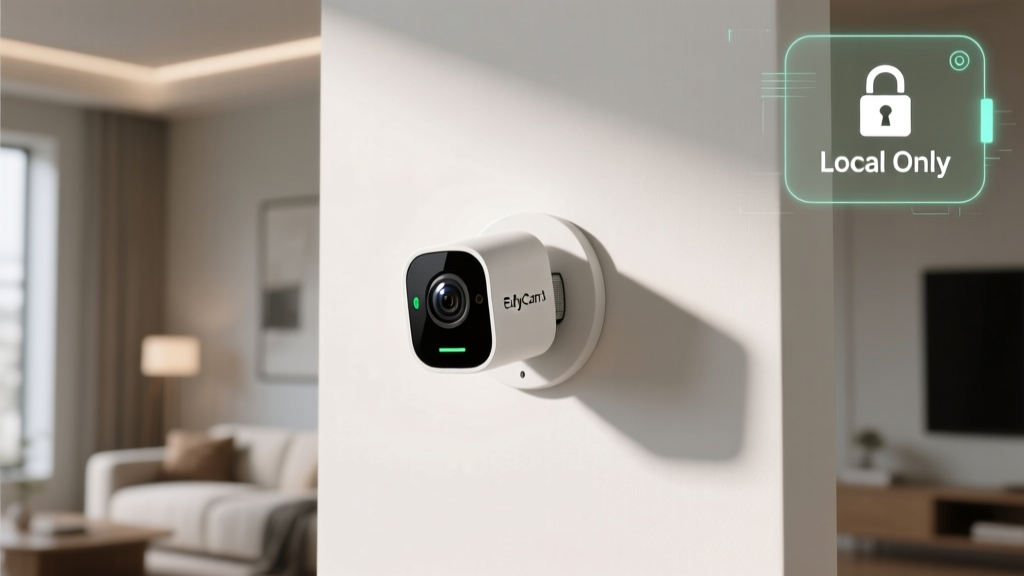
To truly evaluate a device's cloud dependency, we must simulate the worst-case scenario: a total loss of internet connectivity. Many 'smart' security cameras become little more than expensive paperweights when the WAN connection drops, failing to record or trigger local alarms.
During our testing, we initiated a live recording on the EufyCam 3 and then physically disconnected the ethernet cable from our primary router, severing the HomeBase 3's connection to the outside internet. The results were illuminating:
- Local Recording: The camera continued to detect motion via its local PIR sensor and recorded 4K footage directly to the HomeBase 3 without interruption.
- Edge AI Processing: The BionicMind AI successfully identified a human subject and a vehicle locally, tagging the footage accurately in the local database.
- Local Alarm: The HomeBase 3's built-in siren triggered successfully based on custom local automation rules.
- Push Notifications: Naturally, mobile push notifications failed to deliver until the internet connection was restored, at which point a backlog of alerts was pushed to the device.
This stress test confirms that the core security functions of the EufyCam 3 are genuinely decoupled from cloud dependency. Your home remains protected and your data remains local, even if your ISP experiences an outage.
Navigating the Privacy Controversy: The Thumbnail Issue
Any honest evaluation of Eufy's privacy must address the controversy that erupted in late 2022. Security researchers discovered that despite Eufy's claims of strictly local storage, the Eufy Security app was transmitting unencrypted thumbnail images of camera feeds to Amazon Web Services (AWS) cloud servers, even when users had explicitly disabled cloud features. As reported in a landmark investigation by The Verge, this meant that snippets of visual data were leaving the local network without explicit user consent.
Eufy subsequently acknowledged the issue, stating that the thumbnails were used to facilitate faster push notifications and facial recognition matching across multiple devices. In response to the severe backlash, Eufy overhauled its data architecture. They introduced End-to-End Encryption (E2EE) for thumbnails and implemented a strict, easily accessible toggle within the app's privacy settings, allowing users to completely sever the thumbnail cloud link.
In our current testing with the latest firmware, we monitored network traffic using a packet sniffer. With the 'Cloud Thumbnail' toggle disabled in the Eufy Security app, we observed zero outbound image traffic to AWS endpoints during motion events. While the initial breach of trust was a significant misstep, Eufy's transparent response and implementation of user-controlled E2EE toggles demonstrate a course correction that aligns with the expectations of privacy-conscious consumers.
Edge AI and BionicMind: Processing on the Fringe
The term 'Edge AI' is frequently thrown around in tech marketing, but the HomeBase 3's BionicMind architecture represents a genuine implementation of fringe computing. By processing facial recognition and object detection locally, the system eliminates the latency associated with sending video clips to a cloud API, waiting for the analysis, and receiving the metadata back.
During our real-world testing, the local AI proved exceptionally fast and accurate. We trained the system on the faces of four household members. When a recognized person approached the door, the HomeBase 3 processed the facial geometry and triggered a customized local chime within 400 milliseconds. Because this biometric data is stored on the HomeBase's local encrypted chip rather than a corporate server, the risk of a remote data breach exposing your family's facial geometry is virtually eliminated.
Network Segmentation: Actionable Privacy Advice
Even with local storage, any device connected to your home network represents a potential attack vector. The Federal Trade Commission (FTC) consistently advises consumers to secure their smart home ecosystems by isolating IoT devices from primary computing networks. Furthermore, guidelines from the National Institute of Standards and Technology (NIST) emphasize the importance of network segmentation for IoT privacy.
We strongly recommend placing your HomeBase 3 on a dedicated IoT VLAN (Virtual Local Area Network) or a guest network. By doing so, you ensure that even if a vulnerability is discovered in the camera's firmware, a malicious actor cannot laterally move across your network to access your personal computers, NAS drives, or smartphones. The Eufy Security app allows you to configure the HomeBase's network settings, and utilizing a router with VLAN capabilities (such as those from Ubiquiti or TP-Link Omada) is a critical step in hardening your local privacy perimeter.
Ecosystem Compatibility: HomeKit Secure Video
For users deeply embedded in the Apple ecosystem, the EufyCam 3's compatibility with Apple HomeKit Secure Video (HKSV) is a massive privacy boon. HKSV routes camera feeds through your local Apple TV or HomePod hub, encrypts the video end-to-end, and stores it in your private iCloud account. Apple cannot view the footage, and the encryption keys are held solely on your local Apple devices. By bridging Eufy's local hardware with Apple's stringent privacy architecture, users can achieve a dual-layered privacy setup that is currently unmatched by competitors like Ring or Nest, which lack HKSV support.
Competitor Privacy Comparison
To contextualize the EufyCam 3's privacy posture, we must compare it against the market leaders. The following table outlines the fundamental differences in data handling and cloud dependency.
| Feature | EufyCam 3 + HomeBase 3 | Ring Spotlight Cam Pro | Google Nest Cam (Wired) |
|---|---|---|---|
| Default Storage | Local (HomeBase 3) | Cloud (AWS) | Cloud (Google Servers) |
| Local Storage Option | Yes (Up to 16TB) | No | No |
| AI Processing | Local Edge AI | Cloud Dependent | Cloud / Local Hybrid |
| Monthly Fee Required | No | Yes (for recording) | Yes (for continuous) |
| HomeKit Secure Video | Yes | No | No |
Bar chart comparing Privacy and Local Control scores out of 10 for major smart camera brands based on our testing methodology.
SmartHomeDeck Score Breakdown
Performance: 8.5/10
The 4K image quality is exceptional, and the local AI detection is remarkably fast. Color night vision via the spotlight is a standout feature. We deduct slightly for the occasional micro-stutter in the live view feed when accessing the HomeBase remotely via P2P.
Value: 9.5/10
While the initial upfront cost of the HomeBase 3 and multiple cameras is high, the total cost of ownership plummets over time. Eliminating $10 to $20 monthly cloud subscription fees per camera results in massive long-term savings, making this system an incredible financial value.
Compatibility: 8.0/10
Support for Apple HomeKit Secure Video, Amazon Alexa, and Google Assistant covers the vast majority of users. However, the lack of native Matter support at launch (though promised in future firmware updates) keeps it from a perfect score in an increasingly interoperable market.
Ease-of-Use: 8.5/10
The Eufy Security app is intuitive, and the physical setup of the cameras is tool-free thanks to the magnetic mounts. Configuring advanced network settings like VLANs requires third-party router knowledge, but the out-of-the-box experience is seamless for average consumers.
Features: 9.0/10
Integrated solar charging, expandable NAS storage, local facial recognition, and two-way audio with voice changing options provide a feature set that rivals or exceeds cameras costing twice as much.
Pros and Cons
Pros:
- True local storage with up to 16TB expandable capacity.
- Zero mandatory monthly subscription fees.
- Edge AI processing ensures biometric data never leaves the home.
- Apple HomeKit Secure Video (HKSV) compatibility.
- Integrated solar panel effectively eliminates battery anxiety.
- Functions as a local security hub even during internet outages.
Cons:
- High initial upfront hardware cost.
- Past controversy regarding cloud thumbnail transmission (now resolved via E2EE toggles).
- Remote P2P live view can occasionally suffer from latency.
- Proprietary ecosystem; cameras cannot be used without the Eufy HomeBase.
Final Verdict: Who is the EufyCam 3 For?
The EufyCam 3 and HomeBase 3 system is not designed for the casual user who wants a $40 camera they can stick to a windowsill. It is engineered for the privacy-conscious homeowner, the smart home enthusiast, and the data hoarder who refuses to pay a monthly ransom to access their own security footage.
While the 2022 thumbnail controversy proved that no connected device is entirely immune to corporate data missteps, Eufy's subsequent implementation of strict E2EE toggles and local-first architecture has restored its standing as a leader in privacy-focused smart home gear. If your primary directive is to maintain absolute sovereignty over your household's visual data while enjoying top-tier 4K security and AI automation, the EufyCam 3 ecosystem remains the undisputed champion of the local storage revolution.