Home Assistant Green Smart Hub Review: The Ultimate Plug-and-Play Local Controller
For years, the smart home community has faced a persistent dilemma: choose between the convenience of cloud-based hubs that compromise privacy, or the steep learning curve of DIY local controllers. Home Assistant has long been the undisputed king of local, privacy-focused home automation, but getting it running used to require technical know-how, a Raspberry Pi, and a lot of patience. Enter the Home Assistant Green, a dedicated smart home hub created by Nabu Casa, the company behind the Home Assistant project itself.
In this comprehensive review, we will explore whether the Home Assistant Green lives up to its promise of delivering a true plug-and-play local smart home experience. We will break down its hardware specifications, setup process, performance capabilities, ecosystem compatibility, and overall value to help you decide if it belongs at the heart of your smart home.
Product Overview: The Shift to Dedicated Hardware
The Home Assistant Green represents a major milestone in the evolution of local smart home control. Historically, enthusiasts relied on single-board computers like the Raspberry Pi to run Home Assistant OS. While cost-effective, this DIY approach was plagued by supply chain shortages, corrupted microSD cards, and complex initial configurations. Nabu Casa designed the Green to eliminate these friction points entirely.
Marketeted as the easiest way to start with Home Assistant, the Green is a purpose-built appliance. It comes pre-flashed with Home Assistant OS, housed in a custom-designed, passively cooled enclosure, and optimized specifically for the database operations and automation routines that smart homes demand. It bridges the gap between consumer-friendly hubs like SmartThings or Hubitat and the limitless, open-source power of the Home Assistant ecosystem.
Design and Hardware Specifications
Under the hood, the Home Assistant Green is built around the Rockchip RK3566 System-on-Chip (SoC). While this might not sound as powerful as a modern desktop processor, it is meticulously chosen for its balance of low power consumption and high efficiency for edge-computing tasks. The hub features 4GB of RAM and 32GB of eMMC flash storage.
The inclusion of eMMC storage is a critical upgrade over traditional microSD cards. Home Assistant relies heavily on database write cycles to log sensor states, energy usage, and automation histories. MicroSD cards are notorious for failing under these continuous write conditions, leading to corrupted systems. The soldered eMMC chip ensures long-term reliability and significantly faster boot and dashboard loading times.
Key Hardware Specifications:
- Processor: Rockchip RK3566 (Quad-core ARM Cortex-A55)
- Memory: 4GB LPDDR4 RAM
- Storage: 32GB eMMC Flash
- Networking: Gigabit Ethernet port
- Ports: 2x USB 2.0 (for RF dongles or external storage), 1x HDMI (for local diagnostics)
- Cooling: Passive aluminum heatsink core (completely silent)
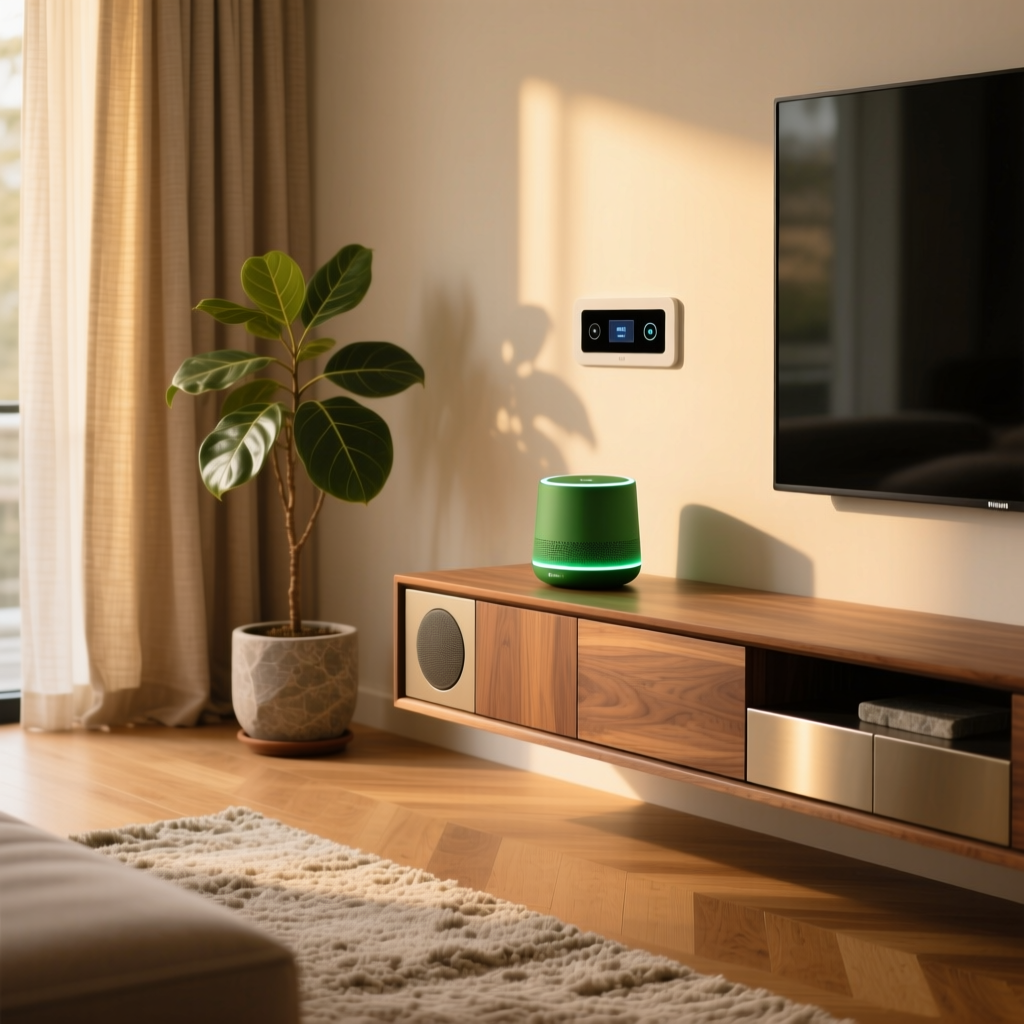
The physical design is sleek, minimalist, and intended to blend into modern home decor or sit unobtrusively in a network rack. The passive cooling design means there are no moving parts, no fans, and absolutely zero noise, making it perfect for living spaces.
Setup Experience: True Plug-and-Play
The most significant selling point of the Home Assistant Green is its onboarding experience. If you have ever tried to flash an operating system image, configure a headless server via SSH, or troubleshoot network bridging on a DIY mini PC, you will appreciate the simplicity Nabu Casa has engineered here.
The Setup Process:
- Connect the included Ethernet cable to your router or network switch.
- Plug in the power adapter.
- Wait for the LED indicator to turn solid green (usually under two minutes).
- Open a web browser on any device connected to the same network and navigate to homeassistant.local.
From there, the web-based onboarding wizard guides you through creating your first admin account, setting your home location on a map (crucial for sun-based automations and presence detection), and selecting your preferred time zone and currency. Within ten minutes, you are staring at the Home Assistant dashboard, ready to add devices. For users who prefer mobile management, the companion iOS and Android apps can also discover the hub on the local network and handle the initial configuration seamlessly.
Performance and Software Features
The Home Assistant Green runs on Home Assistant OS (HAOS), a specialized, lightweight Linux distribution built specifically to run the Home Assistant Supervisor. This software architecture is what gives the Green its immense power.
Local Processing and Privacy
Unlike cloud-dependent hubs, all logic, automations, and dashboard rendering happen locally on the Green. This means your smart home continues to function perfectly even if your internet connection goes down. Furthermore, your data never leaves your local network, offering unparalleled privacy. Independent latency tests consistently show that local automations execute in milliseconds, completely eliminating the 500ms to 2-second delays common with cloud-based API calls.
The Add-on Ecosystem
The 4GB of RAM and capable SoC allow users to install one-click Add-ons directly from the built-in store. You can easily run an MQTT broker (Mosquitto), a visual automation editor (Node-RED), or a device firmware management tool (ESPHome). While the RK3566 chip is a powerhouse for standard automations and dashboards, users looking to run heavy, AI-based local NVR software like Frigate with multiple 4K cameras may still want to look into x86-based mini PCs. However, for 95% of smart home enthusiasts, the Green provides more than enough computational headroom.
For more ideas on what you can build once your hub is running, check out our guide on advanced home automation ideas.
Ecosystem Compatibility and Integrations
Hardware is only half the story; software compatibility is where Home Assistant truly destroys the competition. The Home Assistant Green supports over 2,500 native integrations out of the box. Whether you are using Philips Hue, Lutron Caseta, Shelly, Tuya, Ecobee, or Sonos, the Green can pull them all into a single, unified dashboard.
Zigbee, Z-Wave, and Matter
It is important to note that the Home Assistant Green does not have built-in Zigbee, Z-Wave, or Thread radios. This is a deliberate design choice by Nabu Casa to keep the base cost down and allow users to choose the specific RF protocols they need. To connect Zigbee or Thread/Matter devices directly to the hub, you will need to plug a USB coordinator, such as the Home Assistant Connect ZBT-1, into one of the USB ports.
Alternatively, if you already own a hub like the Philips Hue Bridge or an Aeotec Z-Wave stick, the Green can integrate with those existing hubs over your local network, aggregating all their connected devices into the main Home Assistant interface without needing additional USB dongles.
This hub is an essential component for anyone looking to build a local vs cloud smart home setup, acting as the ultimate bridge between fragmented brand ecosystems.
Pros, Cons, and Value Proposition
When evaluating the best smart home hubs on the market, the Home Assistant Green occupies a unique space. Here is a breakdown of its strengths and weaknesses.
Pros
- True Plug-and-Play: Eliminates the need for Linux knowledge, SD card flashing, or DIY hardware assembly.
- Reliable Storage: 32GB eMMC prevents the database corruption issues associated with microSD cards.
- Massive Compatibility: Access to over 2,500 integrations, unifying virtually every smart home brand.
- Silent Operation: Passively cooled with no moving parts.
- Privacy First: 100% local execution with no mandatory cloud connection.
- Supports the Project: Purchasing official Nabu Casa hardware directly funds the research & development of the open-source Home Assistant project.
Cons
- Requires USB Dongles for RF: You must purchase separate USB coordinators for native Zigbee, Z-Wave, or Thread/Matter support.
- Software Learning Curve: While the hardware setup is easy, mastering the Home Assistant software, YAML configurations, and complex automations still requires time and dedication.
- Not for Heavy AI/NVR: Users wanting to run local, AI-driven security camera processing (like Frigate) will need more powerful x86 hardware.
The Verdict: The Home Assistant Green is an outstanding investment for anyone who wants the power of local control without the headache of maintaining server hardware. It is the definitive starting point for modern, privacy-conscious smart homes.
Frequently Asked Questions
Do I need a USB dongle for the Home Assistant Green?
Yes, if you want to connect Zigbee, Z-Wave, or Thread/Matter devices directly to the hub. The Green relies on your local network (WiFi or Ethernet) for integrations like Hue, Shelly, or Lutron. For direct RF communication with sensors and smart bulbs, you will need to purchase a compatible USB coordinator and plug it into one of the Green's USB ports.
Can I run Home Assistant Green without an internet connection?
Absolutely. The Home Assistant Green is designed for local processing. Once the initial setup and account creation are complete, the hub does not require an active internet connection to run automations, control devices, or serve the dashboard. An internet connection is only needed for downloading Add-ons, receiving software updates, or utilizing cloud-based integrations like weather APIs or remote access.
How does the Home Assistant Green compare to a Raspberry Pi?
The Green offers a vastly superior user experience compared to a Raspberry Pi. It features a custom, passively cooled case, dedicated eMMC storage that won't corrupt from database write cycles, and a pre-installed operating system. While a Raspberry Pi might be slightly cheaper upfront, the hidden costs of buying a case, power supply, and high-endurance SD card—combined with the time spent troubleshooting hardware issues—make the Green a much better value for a production smart home.
Is there a monthly subscription fee?
No. The Home Assistant Green and the Home Assistant software are completely free to use locally with no mandatory subscriptions. Nabu Casa does offer an optional, paid cloud subscription service called Home Assistant Cloud, which provides secure remote access to your hub from outside your home and enables voice assistant integrations (like Alexa & Google Home) without complex network port forwarding. However, this is entirely optional, and the hub functions perfectly without it.
Final Thoughts
The Home Assistant Green successfully democratizes local smart home control. By removing the technical barriers to entry associated with server management and hardware assembly, Nabu Casa has created a product that appeals to both seasoned home automation veterans and curious beginners alike. If you are ready to take your smart home to the next level, prioritize your privacy, and unify your devices under one powerful roof, the Home Assistant Green is undoubtedly one of the best smart home hubs available today.