Introduction: The Case for Local Smart Home Control
The smart home industry has long been plagued by a single, frustrating point of failure: the cloud. When your internet connection drops, or a manufacturer's server experiences an unexpected outage, your "smart" home suddenly becomes remarkably dumb. Lights fail to turn on, security automations stall, and climate control goes haywire. Enter the Hubitat Elevation Model C-8, a dedicated smart home hub designed from the ground up to prioritize local processing. In this comprehensive SmartHomeDeck review, we put the C-8 through its paces, testing its Z-Wave 800 series range, Zigbee 3.0 mesh stability, and its highly anticipated Matter and Thread capabilities. If you are tired of cloud lag, subscription fatigue, and privacy concerns, this hub might just be the central nervous system your home needs.
Hardware Design and Initial Setup
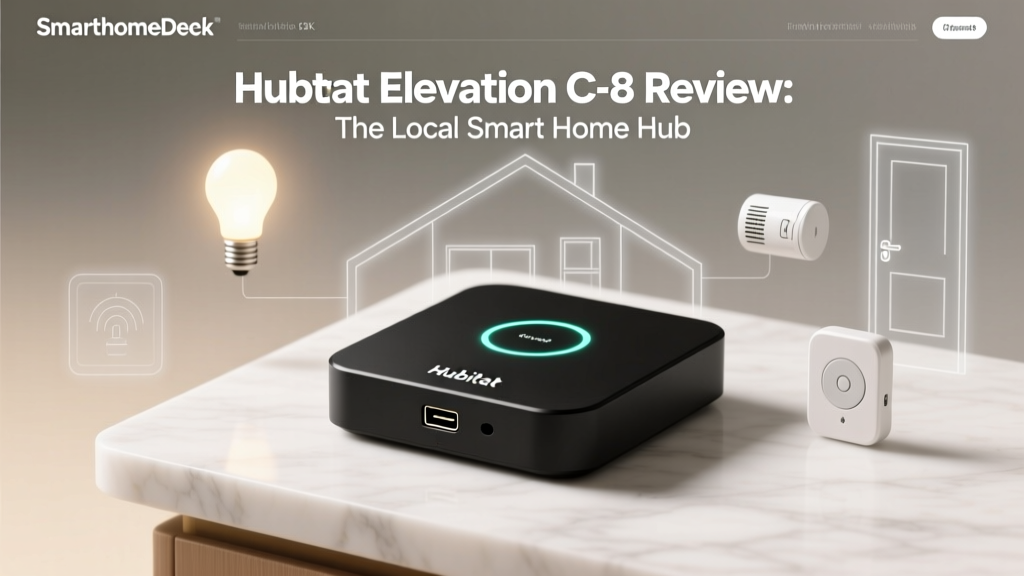
Unlike the sleek, minimalist orbs pushed by mainstream tech giants, the Hubitat C-8 adopts a utilitarian, almost industrial aesthetic. It is a matte black rectangular box flanked by two prominent external antennas. While this design might not win any interior design awards, those antennas serve a critical purpose: maximizing the range and penetration of both Zigbee and Z-Wave signals through dense building materials like drywall and concrete.
Inside the chassis, Hubitat has equipped the C-8 with a robust 1GHz quad-core processor and ample RAM to handle complex automation logic without breaking a sweat. The rear I/O panel is refreshingly simple, featuring a Gigabit Ethernet port, a USB-C power delivery port, and a USB-A port for future expansion or local storage. The inclusion of a hardwired Ethernet port is a massive win for local hubs. Wi-Fi introduces unnecessary latency and potential interference in a crowded 2.4GHz spectrum, so hardwiring your hub to your router is always the recommended best practice for mission-critical smart home infrastructure.
One notable hardware omission, however, is a built-in battery backup. In a home where local control is paramount, a power outage will still take your automations offline unless you plug the C-8 into an external Uninterruptible Power Supply (UPS). Given the target demographic of power users, we would have loved to see an internal supercapacitor or battery to ensure automations survive brief power flickers.
Setting up the Hubitat C-8 is a deliberate departure from the app-centric onboarding of competitors. Instead of forcing you to download an app and create a cloud account, Hubitat relies on a web-based administrative interface. You plug the hub into your router, locate its IP address via your router's DHCP table, and log in via any web browser. This immediately signals who the target audience is: tinkerers, privacy advocates, and users who demand absolute control over their network.
Performance Testing: Latency and Reliability
To test the C-8's performance, we focused on automation latency and mesh network stability. We deployed a network of 45 Zigbee and Z-Wave devices, including Aeotec MultiSensor 7s, Philips Hue bulbs, and Inovelli smart switches. The difference between local execution and cloud execution is not just measurable; it is visceral.
When walking into a dark room, a cloud-dependent hub might take 800ms to 1.5 seconds to process the motion event, send it to a remote server, and route the command back to the bulb. The Hubitat C-8 executes the same routine in under 50 milliseconds. It feels instantaneous, perfectly mimicking the reliability and speed of a traditional dumb switch. This sub-50ms latency is a game-changer for high-traffic areas where even a half-second delay feels like a system failure.
Smart Home Hub Latency Comparison
Zigbee vs. Z-Wave Mesh Dynamics
One of the most impressive aspects of the C-8 is how it handles mesh networking. The external antennas provide a noticeable boost to the Z-Wave Plus V2 (800 series) signal. In our testing, the 800 series chip demonstrated superior range and faster inclusion times compared to the older 700 series. Meanwhile, the Zigbee 3.0 radio handled a dense mesh of 30+ repeater devices without experiencing the "dropped node" issues that plague some internal-antenna hubs. The web interface provides a visual mesh map, allowing you to see exactly how devices are routing traffic and identify weak links in your network topology.
Ecosystem Compatibility: Zigbee, Z-Wave, and Matter
The C-8 is a protocol powerhouse, designed to bridge the gap between legacy smart home devices and the emerging unified standards. As highlighted by the Connectivity Standards Alliance (CSA), Matter aims to create a unified, interoperable ecosystem across brands, breaking down the walled gardens that have historically frustrated consumers. Hubitat has embraced this by ensuring the C-8 can act as a Thread Border Router and support Matter-over-Thread devices.
This future-proofs your investment, allowing you to seamlessly integrate newer Matter devices while maintaining your legacy Zigbee and Z-Wave mesh networks. You are not forced to rip and replace your existing gear; instead, the C-8 acts as the ultimate translator.
| Protocol | Version Supported | Theoretical Max Devices | Real-World Range |
|---|---|---|---|
| Z-Wave | Plus V2 (800 Series) | 232 Nodes | Up to 300m (Line of Sight) |
| Zigbee | 3.0 | 65,000+ | Up to 100m (Mesh Dependent) |
| Thread / Matter | Thread 1.2 / Matter 1.0+ | 250+ per Border Router | Mesh Dependent |
The Hubitat Dashboard and Rule Machine
The software experience on the C-8 is defined by two major pillars: the Dashboard and the Rule Machine. The Hubitat Dashboard is highly customizable, allowing you to create different views tailored for mobile phones, tablets, or wall-mounted displays. Advanced users can inject custom CSS to tweak layouts, add background images, and create bespoke tiles that perfectly match their home's aesthetic.
The crown jewel, however, is the Rule Machine. This built-in logic engine allows you to create incredibly complex, multi-conditional automations without needing to write a single line of code or rely on third-party webhooks. Want your living room lights to fade to 20% brightness only if the TV is on, the sun has set, the house is in "Movie Mode," and motion is detected in the hallway? Rule Machine handles this effortlessly. It supports variables, loops, and conditional IF/THEN/ELSE logic that rivals basic programming environments.
Privacy and Security: Keeping Your Data Home
By keeping processing local, the Hubitat C-8 inherently reduces your smart home's attack surface. According to guidelines and research published by the National Institute of Standards and Technology (NIST), IoT devices that rely heavily on cloud communication introduce vulnerabilities related to data transit, DNS hijacking, and third-party server breaches.
Because Hubitat processes your automations locally and does not require a cloud account for core functionality, your telemetry data—such as when you unlock your front door, arm your security system, or turn off your bedroom lights—never leaves your local network. Remote access is available via Hubitat's paid cloud subscription (which acts as a secure tunnel) or by setting up your own secure VPN (like WireGuard or Tailscale). This architecture puts the control of your data firmly in your hands, a rarity in today's data-hungry tech landscape.
SmartHomeDeck Score Breakdown
- Performance (9.5/10): Sub-50ms local latency and rock-solid mesh stability make this a top-tier performer.
- Value (8.5/10): At its price point, the inclusion of Z-Wave 800, Zigbee 3.0, and Thread makes it an incredible hardware value, though the optional remote access subscription adds a recurring cost.
- Compatibility (9.5/10): Unmatched support for legacy and modern protocols, including Matter and Thread.
- Ease-of-Use (6.0/10): The steep learning curve of the web interface and Rule Machine will intimidate casual users. This is a hub for enthusiasts.
- Features (9.5/10): Granular mesh mapping, local dashboards, and deep variable logic in automations.
Pros and Cons
Pros:
- True local processing with sub-50ms automation latency.
- External antennas provide excellent Z-Wave and Zigbee range.
- Supports Z-Wave 800 series, Zigbee 3.0, Matter, and Thread.
- Rule Machine offers unparalleled automation logic without coding.
- No mandatory cloud account required for core functionality.
- Gigabit Ethernet port for stable, interference-free network connection.
Cons:
- Steep learning curve; the UI is not beginner-friendly.
- Utilitarian hardware design with external antennas may not suit all decor.
- No built-in battery backup for power outages.
- Remote access requires a paid subscription or manual VPN setup.
- Mobile app is primarily a dashboard viewer, lacking setup capabilities.
Final Verdict: Who Should Buy the Hubitat C-8?
The Hubitat Elevation Model C-8 is not designed for the casual user who simply wants to ask a voice assistant to turn on the lights. It is a precision tool built for smart home enthusiasts, tinkerers, and privacy advocates who demand absolute reliability and local control. If you are frustrated by cloud lag, want to integrate a massive mixed-protocol network, and value the security of keeping your home's data off external servers, the C-8 is arguably the best dedicated hub on the market.
While the learning curve is undeniably steep, the payoff is a smart home that operates with the speed and reliability of hardwired electrical systems. The addition of Z-Wave 800 series and Thread Border Router capabilities ensures that the C-8 will remain the beating heart of your smart home for years to come, seamlessly bridging the gap between your legacy devices and the Matter-enabled future.