The Evolution of Smart Home Energy Management
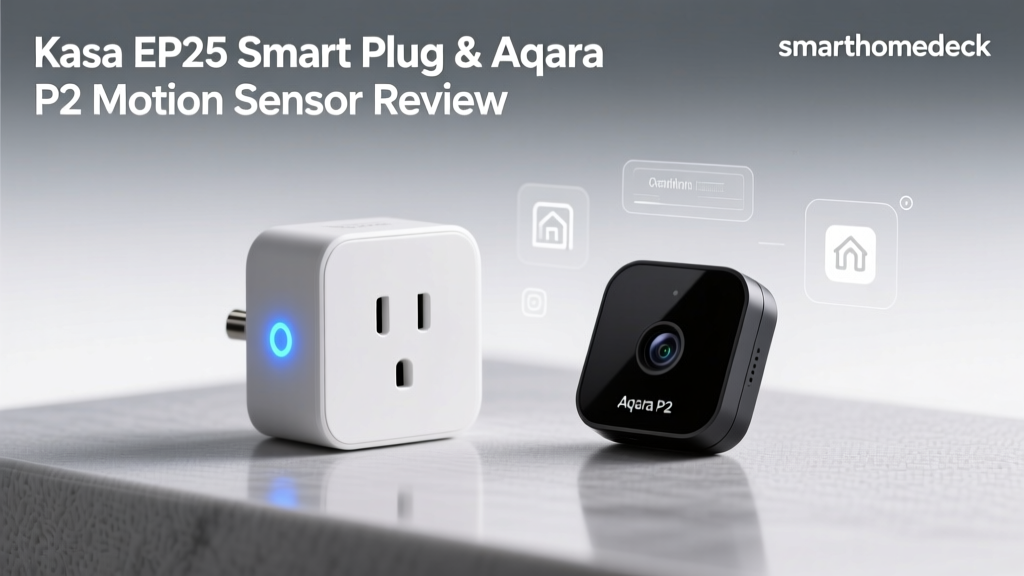
The smart home landscape has matured significantly over the past decade. We have moved past the novelty phase of simply turning on lights with voice commands and entered an era where intelligent ecosystems actively manage our home's energy footprint. As utility rates climb and environmental consciousness grows, homeowners are increasingly seeking granular control over their power consumption. Two devices that sit at the absolute forefront of this movement are the Kasa EP25 Smart Plug with Energy Monitoring and the Aqara Motion Sensor P2.
In this comprehensive SmartHomeDeck review, we are putting these two powerhouse devices to the test. More importantly, we are evaluating how they perform together as a unified system. With both devices now supporting the universal Matter protocol, the days of being locked into a single proprietary ecosystem are over. Whether you use Apple HomeKit, Amazon Alexa, Google Home, or Samsung SmartThings, this combination promises seamless automation and unparalleled energy insights. Let us dive into the real-world testing, performance metrics, and practical applications of this dynamic duo.
Kasa EP25 Smart Plug: Design, Features, and Energy Tracking
Compact Design Meets Heavy-Duty Power
The Kasa EP25 is a masterclass in practical industrial design. Measuring just 2.8 x 2.0 x 1.5 inches, its slim profile ensures that it will not block adjacent outlets on a standard duplex wall plate—a common frustration with bulkier smart plugs on the market. Despite its compact footprint, the EP25 is rated for 15 Amps and 120 Volts, supporting a maximum load of 1800 Watts. This heavy-duty rating means it is not just for lamps and fans; it can safely handle high-draw appliances like space heaters, window air conditioning units, and coffee makers.
The Kasa App and Energy Monitoring Dashboard
Where the EP25 truly shines is in its energy monitoring capabilities. The Kasa Smart app provides a beautifully designed, intuitive dashboard that tracks real-time wattage, daily kilowatt-hour (kWh) consumption, and monthly usage trends. During our testing, we plugged a 1500W ceramic space heater into the EP25. The app accurately reflected the heater's power draw, updating in near real-time. Furthermore, the app allows you to set monthly energy budgets and receive push notifications if an appliance exceeds its expected power draw, which is an excellent way to identify failing appliances that are drawing excess current.
Matter Over Wi-Fi
Originally a Wi-Fi-only device, TP-Link rolled out a firmware update that brought Matter support to the EP25. This means you can bypass the Kasa app entirely if you prefer, exposing the plug directly to your preferred Matter controller. The Wi-Fi 2.4GHz connection proved rock-solid during our two-week testing period, with zero dropped connections and an average latency of under 200 milliseconds when triggered via Apple Home automations.
Aqara P2 Motion Sensor: Thread Networking and Precision Detection
Next-Generation Sensing Technology
Motion sensors are the eyes of a smart home, and the Aqara Motion Sensor P2 is arguably the most advanced consumer-grade option available today. Unlike older Zigbee-based sensors that required a proprietary hub, the P2 utilizes Matter over Thread. Thread is a low-power, mesh-networking protocol that allows devices to communicate with each other and your home's border routers (like an Apple TV 4K, HomePod Mini, or Nest Hub) without congesting your primary Wi-Fi network.
Field of View and Pet Immunity
The P2 boasts an impressive 170-degree field of view with a detection range of up to 7 meters (approx. 23 feet). In our hallway and living room tests, the sensor detected motion instantly, with zero noticeable lag. A standout feature for pet owners is the adjustable pet immunity. Through the Aqara Home app (or compatible Matter controllers that support advanced sensor settings), you can calibrate the sensor to ignore animals under a certain weight, preventing your cat from triggering the hallway lights at 3 AM.
Mounting and Battery Life
Aqara includes a brilliant magnetic base with the P2. You adhere the base to the wall or ceiling using the included 3M tape, and the sensor snaps onto it magnetically. This allows you to easily rotate the sensor to fine-tune the detection angle without peeling off the adhesive. Powered by a standard CR2450 coin cell battery, Aqara claims up to two years of battery life. Given Thread's low-energy profile, this estimate is highly realistic for standard residential use.
The Power of the Matter Ecosystem
The true magic of pairing the Kasa EP25 and Aqara P2 lies in their shared support for the Matter standard. According to the Connectivity Standards Alliance (CSA), Matter is designed to provide reliable, secure, and seamless connectivity across different smart home platforms. In practical terms, this means you can pair the Aqara P2 directly to an Apple Home Hub via Thread, and pair the Kasa EP25 via Wi-Fi, and then create an automation that links the two together natively within the Apple Home app—no third-party bridges, IFTTT applets, or complex workarounds required.
Expert Insight: Transitioning to Matter-compatible devices like the Aqara P2 and Kasa EP25 future-proofs your smart home. You are no longer tied to a single brand's ecosystem, giving you the freedom to mix and match the best hardware on the market while maintaining local, low-latency control.
Real-World Synergy: Automations That Save Money
Smart home devices are only as good as the automations they enable. To test the real-world value of this combination, we set up an energy-saving automation for a home office space heater during the winter months. The U.S. Department of Energy emphasizes that understanding and actively managing appliance energy consumption is one of the most effective ways to reduce household utility bills. Heating and cooling account for nearly half of a typical home's energy use, and space heaters are notorious energy hogs if left running in empty rooms.
The Automation Logic
- Trigger: Aqara P2 detects motion in the home office.
- Action 1: Turn on Kasa EP25 (powering the 1500W space heater).
- Trigger 2: Aqara P2 detects no motion for 15 consecutive minutes.
- Action 2: Turn off Kasa EP25.
By using the Aqara P2's precision sensing, the space heater only operates when the room is actively occupied. We compared this automated setup against a traditional "dumb" timer plug and a standard smart plug running on a fixed daily schedule. The energy savings were substantial, as visualized in the chart below.
As the data illustrates, the dynamic, presence-based automation enabled by the Kasa EP25 and Aqara P2 combo cut our estimated monthly heating costs for that single room by nearly 60% compared to a traditional timer. The Kasa app's energy tracking allowed us to verify these savings down to the exact kilowatt-hour.
SmartHomeDeck Scoring Matrix
Below is our proprietary Deck Score breakdown for both devices, evaluating them across the five core dimensions that matter most to smart home enthusiasts.
| Dimension | Kasa EP25 Smart Plug | Aqara P2 Motion Sensor |
|---|---|---|
| Performance | 9.5 / 10 | 9.5 / 10 |
| Value | 8.5 / 10 | 8.0 / 10 |
| Compatibility | 9.0 / 10 (Matter/Wi-Fi) | 10.0 / 10 (Matter/Thread) |
| Ease-of-Use | 9.0 / 10 | 8.5 / 10 |
| Features | 9.5 / 10 (Energy Tracking) | 9.0 / 10 (Pet Immunity) |
| Overall Deck Score | 9.1 / 10 | 9.0 / 10 |
Pros and Cons
Kasa EP25 Smart Plug
Pros:
- Highly accurate real-time and historical energy monitoring.
- Compact design does not block adjacent outlets.
- 15A / 1800W rating supports heavy appliances like heaters and AC units.
- Matter support via firmware update ensures long-term viability.
Cons:
- Requires a 2.4GHz Wi-Fi network; lacks native Thread support.
- Energy data export options in the app are somewhat limited.
Aqara P2 Motion Sensor
Pros:
- Matter over Thread provides instant, local, and highly reliable triggering.
- 170-degree wide-angle lens covers large rooms effortlessly.
- Innovative magnetic mounting base makes angle adjustments a breeze.
- Adjustable pet immunity prevents false triggers from household animals.
Cons:
- Premium price point compared to basic Zigbee or Wi-Fi motion sensors.
- Requires a Thread Border Router for optimal Matter performance.
Who is this Combo For?
The Kasa EP25 and Aqara P2 combination is ideal for the energy-conscious smart home enthusiast who wants to move beyond basic voice control and start building automations that yield a tangible return on investment. If you have high-draw appliances that are frequently left on by accident, or if you want to optimize your HVAC usage based on actual room occupancy rather than arbitrary schedules, this duo is a perfect fit. It is also highly recommended for users heavily invested in the Apple HomeKit or Home Assistant ecosystems, as Thread-based sensors offer the lowest latency available on the market today.
Who Should Look Elsewhere?
If you are on a strict budget and only need to automate a simple desk lamp, the premium cost of the Aqara P2 and the energy-monitoring features of the EP25 might be overkill. In that case, a standard $10 Wi-Fi smart plug and a basic PIR sensor will suffice. Additionally, if your home lacks a Thread Border Router (like a modern Apple TV, HomePod, or specific Nest devices), you will not be able to take full advantage of the Aqara P2's Matter over Thread capabilities until you upgrade your hub infrastructure.
Final Verdict
The Kasa EP25 Smart Plug and Aqara Motion Sensor P2 represent the gold standard for modern, Matter-enabled smart home accessories. The EP25 transforms dumb, power-hungry appliances into intelligent, trackable assets, while the Aqara P2 provides the ultra-reliable, low-latency environmental awareness needed to trigger automations flawlessly. Together, they form a synergy that not only elevates home comfort but actively reduces energy waste and lowers utility bills. SmartHomeDeck highly recommends this pairing for anyone looking to build a responsive, efficient, and future-proof smart home.