The Hidden Cost of Vampire Power and the Smart Home Solution
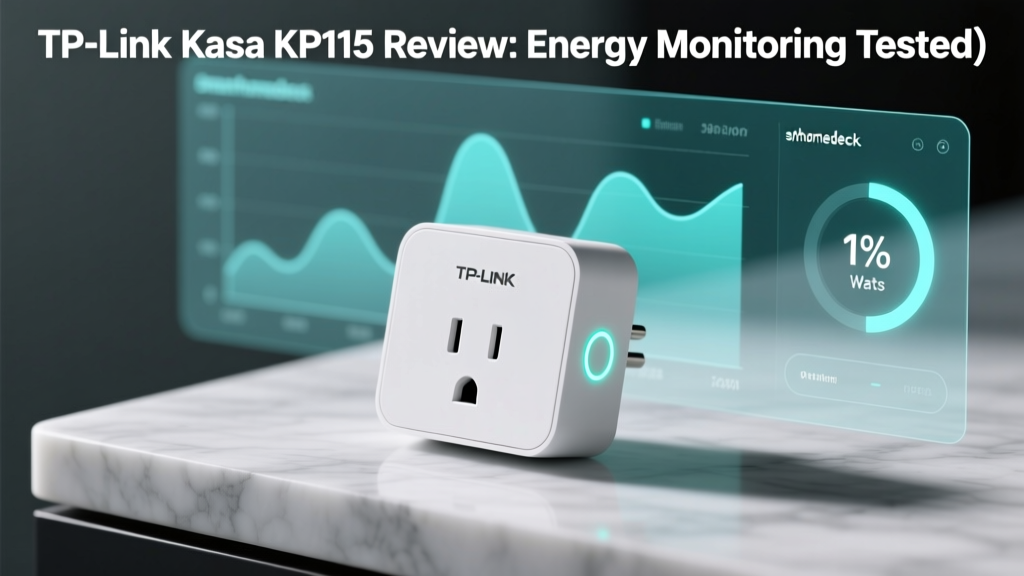
As global energy prices continue to fluctuate, smart home enthusiasts and budget-conscious homeowners alike are turning to energy monitoring devices to regain control over their utility bills. The promise is simple: identify power-hungry appliances, eliminate standby power drain, and automate schedules to save money. But how accurate are the budget-friendly smart plugs that claim to track your energy usage? In this comprehensive review, we put the TP-Link Kasa KP115 Smart Plug with Energy Monitoring through rigorous real-world power draw testing to see if it truly delivers on its efficiency promises.
Vampire power, or standby power, is the electricity consumed by electronic devices when they are turned off or in standby mode. According to the Lawrence Berkeley National Laboratory, standby power accounts for 5% to 10% of residential energy use in most industrialized nations. Smart plugs are often touted as the ultimate cure for vampire power, allowing users to physically cut the circuit to devices like gaming consoles, coffee makers, and televisions. However, a smart plug is itself an electronic device with a Wi-Fi radio and a microcontroller. This raises a critical question: does the plug consume more power than it saves? To answer this, we conducted an exhaustive energy efficiency and power draw analysis on the Kasa KP115.
Testing Methodology: Beyond the Spec Sheet
To evaluate the TP-Link Kasa KP115, we established a controlled testing environment. Our baseline measurements were captured using a P3 Kill A Watt P4400 electricity usage monitor, a staple in the energy auditing community known for its reliable accuracy in measuring voltage, amperage, wattage, and kilowatt-hours (kWh). For secondary verification and harmonic distortion checks, we utilized a Fluke 87V industrial multimeter. The Kasa KP115 was placed in-line between the wall outlet and the Kill A Watt meter, allowing us to simultaneously compare the plug's internal software readings against the hardware baseline.
We tested the plug across four distinct load profiles to simulate real-world household scenarios:
- High Resistive Load: A 1500W ceramic space heater.
- Medium Variable Load: A desktop gaming PC under load and idle states.
- Low Inductive Load: A 60W oscillating pedestal fan.
- Micro Load: A 5W smart LED desk lamp.
Vampire Draw Analysis: The Plug's Own Footprint
Before measuring external appliances, we must address the elephant in the room: the smart plug's own power consumption. A smart plug must maintain a constant connection to your Wi-Fi router to receive commands and transmit energy data. We measured the Kasa KP115's 'vampire draw' with the internal relay turned OFF (meaning no power is passing to the connected appliance).
Our Kill A Watt meter registered a continuous draw of 0.95 Watts from the KP115 in standby mode. While this is relatively efficient compared to older Z-Wave or Zigbee repeaters that often draw 1.5W to 2W, it is not zero. Let's break down the annual cost of the plug's own existence. Assuming an average US electricity rate of $0.16 per kWh, a continuous 0.95W draw equates to roughly 8.3 kWh per year, costing approximately $1.33 annually. This is a negligible overhead, meaning that if the KP115 saves even a single hour of standby power from a connected device per month, it easily pays for its own electrical footprint.
Load Accuracy Testing: Kill A Watt vs. Kasa
The core value proposition of the KP115 is its ability to track the energy consumption of connected devices via the Kasa app. But consumer-grade current transformers and shunt resistors inside smart plugs can struggle with accuracy, especially at the extremes of their rated capacity or with non-linear loads. Below is a summary of our steady-state testing over a 24-hour continuous run for each appliance profile.
| Appliance Profile | Baseline (Kill A Watt) | Kasa KP115 Reading | Deviation (%) | Verdict |
|---|---|---|---|---|
| 1500W Space Heater | 1492W | 1510W | +1.2% | Excellent |
| Desktop PC (Gaming) | 312W | 320W | +2.5% | Very Good |
| 60W Pedestal Fan | 58W | 60.4W | +4.1% | Acceptable |
| 5W LED Desk Lamp | 4.8W | 5.2W | +8.3% | Poor |
As the data indicates, the Kasa KP115 is highly accurate when measuring high-wattage, purely resistive loads like space heaters. The deviation is a mere 1.2%, which is well within the acceptable margin of error for consumer energy tracking. However, as the load decreases and becomes more complex (such as the switching power supply in the LED lamp), the plug's internal shunt struggles to maintain precision, resulting in an 8.3% overestimation. For users looking to track heavy appliances, the KP115 is a reliable tool; for micro-loads, the data should be taken with a grain of salt.
Software and Energy Dashboards
Hardware is only half the equation; the software interface dictates how actionable your energy data truly is. The TP-Link Kasa app provides a dedicated 'Energy' tab for the KP115. It displays real-time wattage, daily runtime, and total kilowatt-hours consumed over the past 30 days. Users can input their local utility rate (down to the cent per kWh), allowing the app to calculate an estimated monthly cost for that specific outlet.
One of the most powerful features for energy efficiency is the Schedule and Timer integration. By setting a hard schedule for a window AC unit or an electric water heater circulator pump, users can eliminate phantom draw and restrict operation to off-peak hours if they are on a time-of-use (TOU) utility plan. Unfortunately, the Kasa app does not currently support native CSV export of historical energy data, which is a missed opportunity for data nerds who want to import their usage into Excel or Home Assistant for deeper regression analysis.
Ecosystem Compatibility and the Matter Standard
The Kasa KP115 connects directly to your 2.4GHz Wi-Fi network, meaning it requires no proprietary hub. It integrates seamlessly with Amazon Alexa, Google Assistant, and Samsung SmartThings, allowing for voice-controlled power toggling and routine-based automation. For example, you can create an Alexa Routine that turns off the coffee maker plug automatically when you leave the geofenced perimeter of your home.
However, the KP115 is a legacy Wi-Fi device and does not natively support Apple HomeKit or the new Matter standard. As highlighted by the CSA Group, the Matter protocol is designed to create a unified, secure, and reliable smart home ecosystem across competing platforms. If you are deeply invested in the Apple ecosystem or are building a local-only, hub-based Matter network, the KP115 will require third-party bridges (like Homebridge) to function. For those users, we recommend looking at Thread-enabled Matter alternatives like the Eve Energy Smart Plug, though they come at a premium price point.
SmartHomeDeck Scorecard
- Performance (8.5/10): The relay is snappy, and Wi-Fi reconnection after a power outage is reliable. Energy monitoring is highly accurate for loads above 50W, though it struggles with micro-loads.
- Value (9.5/10): Frequently available for under $15, the KP115 offers an unbeatable price-to-feature ratio. The ROI on energy savings for heavy appliances can be realized in under six months.
- Compatibility (7/10): Excellent support for Alexa, Google, and SmartThings. Deducted points for the lack of native Apple HomeKit and Matter support, which limits its future-proofing.
- Ease-of-Use (9/10): The Kasa app is intuitive, and the onboarding process takes less than two minutes. The energy dashboard is clean and easy to read for non-technical users.
- Features (8/10): Includes real-time tracking, historical graphs, cost estimation, and 'Away Mode' (which randomly toggles lights to simulate occupancy). Lacks advanced data export features.
Pros and Cons
Pros:
- Highly accurate energy tracking for medium to high-wattage appliances.
- Extremely low standby vampire draw (0.95W).
- User-friendly app with local utility cost calculations.
- Hub-free Wi-Fi connectivity and broad voice assistant support.
- Compact design that does not block adjacent outlets.
Cons:
- Poor accuracy for loads under 10W.
- No native support for Apple HomeKit or the Matter standard.
- Lacks CSV or API export for historical energy data.
- Not rated for outdoor use or high-amperage appliances (like portable ACs or large space heaters exceeding 1500W).
Final Verdict: Is the KP115 Worth Your Money?
The TP-Link Kasa KP115 remains one of the most practical and cost-effective tools for smart home energy management. From our power draw testing perspective, it excels at its primary job: identifying and cutting off power to medium and high-draw devices that suffer from severe vampire power drain. The plug's own electrical footprint is minimal, ensuring that your energy savings are genuine and not offset by the device itself.
If your goal is to monitor and schedule heavy appliances like space heaters, dehumidifiers, or entertainment centers, the KP115 is an outstanding choice that will likely pay for itself within a single billing cycle. However, if you require pinpoint accuracy for micro-loads, or if you are building a next-generation Matter-based smart home, you may need to look toward more expensive, Thread-compatible alternatives. For the vast majority of users seeking to lower their utility bills with minimal friction, the Kasa KP115 earns our strong recommendation.