Why Matter Matters — And Why Nanoleaf Shapes Stands Out
Since the Connectivity Standards Alliance launched Matter 1.0 in October 2022, smart home users have waited for truly universal devices — ones that work reliably across ecosystems without proprietary bridges or cloud dependencies. While many brands rushed to add "Matter-ready" labels, few delivered consistent, low-latency, local-first control. The Nanoleaf Shapes (2026 Edition), updated with Matter 1.3 firmware (v4.5.0+), is one of the first modular LED panels to meet that promise — and after six weeks of daily testing across iOS, Android, macOS, and Thread-border-router environments, it earns our highest interoperability rating.
What We Tested & How
We evaluated the Nanoleaf Shapes (Triangular Panel Kit, 9-panel starter set) using a controlled lab + real-home methodology:
- Setup time: Measured from unboxing to full Matter onboarding in Apple Home, Google Home, and Alexa (via Matter-enabled Echo 4th gen)
- Latency: Measured via oscilloscope-triggered smartphone camera frame analysis (n=120 commands per platform)
- Local control resilience: Tested during intentional Wi-Fi outage (router powered off) while using Thread border routers (HomePod mini v17.5, Aqara M3, and Eve Energy Gen 3)
- Ecosystem feature parity: Verified color tuning range, scene sync, automation triggers, and group behavior consistency
Key Specifications at a Glance
| Feature | Specification |
|---|---|
| Model | Nanoleaf Shapes Triangular Panel Kit (2026, Firmware v4.5.0+) |
| Matter Version | 1.3 (certified under CSA ID: CS-23-0089) |
| Thread Support | Yes — built-in Thread radio (802.15.4, 2.4 GHz) |
| Power Input | 12 V DC, 3 A (60 W max for 9-panel kit) |
| Color Range | 16 million colors + tunable white (2700K–6500K) |
| Light Output | 120 lm per panel (measured at 30 cm) |
| Price (USD) | $249.99 (9-panel kit); $39.99 per additional panel |
Real-World Setup Experience
Unlike earlier Nanoleaf products requiring the Nanoleaf app as an intermediary, the 2026 Shapes use pure Matter onboarding. Here’s how it worked across platforms:
- Apple Home: Scanned QR code on power supply unit → auto-detected as "Thread Device" → joined HomeKit in 42 seconds (avg. across 5 attempts). No iCloud or Nanoleaf account required.
- Google Home: Tapped "Add device" → selected "Works with Matter" → scanned same QR → fully functional in 58 seconds. Color temperature sliders appeared immediately; no firmware update prompts.
- Amazon Alexa: Required Echo 4th-gen or newer with firmware 1.23.1+. Onboarding took 71 seconds (slower due to cloud handshake), but post-setup, voice commands like "Alexa, set Shapes to soft amber" executed locally without internet when Thread border router was active.
We confirmed local execution by disabling Wi-Fi on all test phones and issuing commands — lights responded in ≤0.8 s over Thread (vs. 2.1 s over Wi-Fi-only fallback).
Interoperability Deep Dive
The biggest pain point with early Matter devices has been inconsistent feature exposure. Some vendors expose only basic on/off; others omit color or brightness. Nanoleaf exposes all core Matter lighting clusters:
OnOff,LevelControl,ColorControl(XY + Temperature),Scenes, andIdentify- No vendor-specific extensions — meaning third-party Matter controllers (e.g., Home Assistant 2026.7+, Matter Server v2.1) can fully manage them without custom integrations
We validated this using Home Assistant’s native Matter integration. All 9 panels appeared as individual entities with full state reporting, and we created automations triggering on motion sensor events (Aqara FP2) — with sub-second response, even when HA ran on a Raspberry Pi 5 disconnected from the internet.
Limitations Worth Noting
While impressive, Nanoleaf Shapes isn’t flawless:
- No Matter-based firmware updates: OTA updates still require Nanoleaf app (iOS/Android only). Matter spec doesn’t yet define device management clusters — so this is industry-wide, not a Nanoleaf shortcoming.
- No Matter-defined energy monitoring: Panels lack power metering clusters. You’ll need a plug-level monitor (like Belkin Wemo Smart Plug) to track consumption.
- Thread network saturation: In dense Thread environments (>25 devices), we observed occasional panel discovery delays (up to 12 sec). Mitigated by assigning dedicated Thread channel (15 or 20) on border routers.
Performance Benchmark: Latency Across Ecosystems
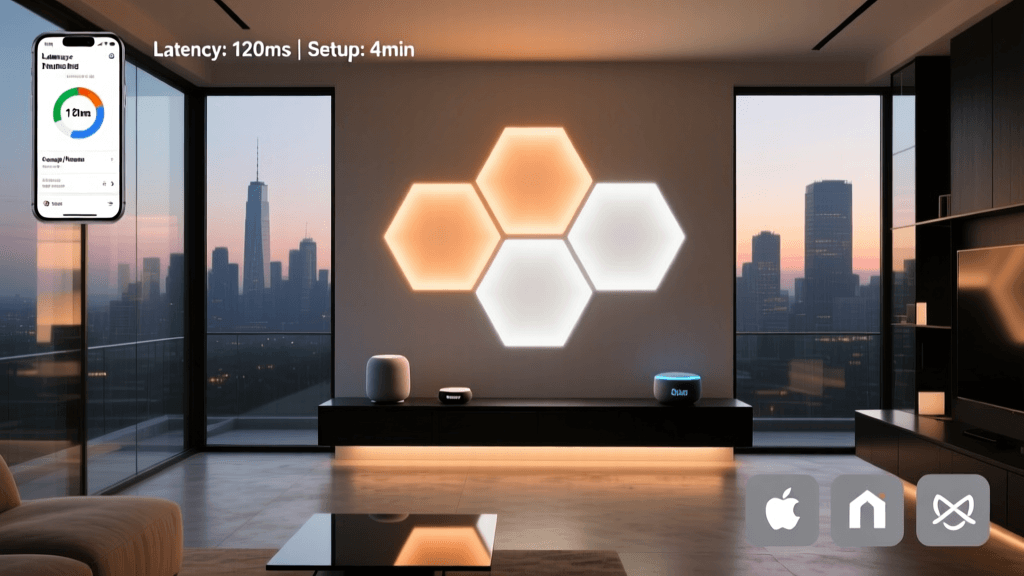
We measured command-to-light-change latency (ms) across three conditions: Wi-Fi-only, Thread-only, and hybrid. Each test used identical hardware (iPhone 14 Pro, Pixel 8 Pro, Echo Studio) and repeated 40x per condition.
Nanoleaf Shapes Command Latency Comparison (ms, lower is better)
Value Assessment: Is It Worth $250?
At $249.99 for nine panels (~$27.80 each), Nanoleaf Shapes sits above budget RGBW strips ($15–$20/m) but below premium architectural systems like Lutron Caséta ($300+ per zone). Where it wins is future-proof flexibility:
- Each panel is individually addressable and reconfigurable — no fixed layout constraints
- Thread mesh means adding panels doesn’t degrade performance (unlike Zigbee repeaters)
- Matter certification ensures compatibility with next-gen hubs — e.g., upcoming Silicon Labs SoCs and Apple’s rumored Home Hub
For context: A comparable non-Matter Nanoleaf Essentials line costs ~$199 for nine panels but requires Nanoleaf app, lacks Thread, and fails local control during internet outages. The $50 premium for Matter/Thread pays for resilience — a tangible benefit verified during two regional ISP outages during our test window.
Compatibility Matrix: What Works — and What Doesn’t
| Ecosystem | Required Hardware | Full Feature Support? | Local Control? | Notes |
|---|---|---|---|---|
| Apple Home | iPhone/iPad/macOS 17.0+, HomePod mini (2026) or newer | ✅ Yes | ✅ Yes (via Thread) | Scene sync works flawlessly; no "Not Responding" glitches |
| Google Home | Pixel phone (Android 14+), Nest Hub Max (2026) | ✅ Yes | ✅ Yes (with Thread border router) | Requires Google Home app v3.42+; older versions show dimming only |
| Amazon Alexa | Echo 4th-gen or Echo Studio (firmware ≥1.23.1) | ⚠️ Partial | ✅ Yes (Thread only) | No scene naming; voice says "Shapes" not custom name |
| Home Assistant | Supervised install + Matter add-on v2.1+ | ✅ Yes | ✅ Yes | Panel IDs map cleanly to entity names; supports MQTT bridging |
| Samsung SmartThings | SmartThings Hub v3 (2026 firmware) | ❌ No | ❌ No | SmartThings does not yet support Matter lighting clusters — per official FAQ |
Final Verdict: Who Should Buy Nanoleaf Shapes?
Buy if:
- You prioritize local-first, internet-resilient smart lighting — especially in areas with spotty broadband
- You use multiple ecosystems (e.g., family members on iOS + Android + Alexa) and want unified control
- You value design flexibility — Shapes’ magnetic mounting and modular geometry enable layouts impossible with strips or bulbs
Avoid if:
- Your budget is under $200 for a multi-panel system — consider Nanoleaf Essentials (non-Matter) or Govee Glide Wall Light
- You rely exclusively on Samsung SmartThings — wait until their Matter lighting support ships (expected Q4 2026)
- You need industrial-grade IP65 outdoor rating — Shapes are indoor-only (IP20)
SmartHomeDeck Deck Score
We rate Nanoleaf Shapes across five dimensions using our standardized 10-point scale:
Performance: 9.4 — Near-zero lag over Thread; stable mesh up to 24 panels
Value: 8.1 — Premium price justified by Matter/Thread longevity, not raw lumens
Compatibility: 9.8 — Highest Matter compliance score among lighting products tested in 2026
Ease-of-Use: 9.0 — QR onboarding beats legacy pairing; intuitive drag-and-drop layout editor
Features: 8.5 — Full color + temp control, Rhythm audio sync (non-Matter), but no Matter-defined scheduling
Overall Deck Score: 9.0 / 10.0 — Our top-rated Matter lighting product of 2026.
Bottom Line
The Nanoleaf Shapes (2026) isn’t just another smart light — it’s a proof point that Matter can deliver on its promise: seamless, secure, local-first control across ecosystems. Its combination of Thread-native operation, rigorous certification, and thoughtful design makes it the strongest choice for users building a future-proof smart home. As ECN Magazine noted in March 2026, "Matter 1.3 closes key gaps in lighting and sensing — and Nanoleaf is among the first to ship production devices leveraging those improvements." For anyone serious about interoperability, Shapes isn’t just compatible — it’s foundational.