Why Power Draw Matters More Than You Think
Smart lighting accounts for up to 15% of residential electricity use — and while individual LED bulbs consume far less than incandescents, their cumulative impact grows as homes deploy dozens of connected lights. Worse, many manufacturers publish only nominal or peak wattage figures (e.g., "9.5W max"), omitting real-world behavior under dynamic conditions like color shifting, dimming, or Zigbee mesh relay duty.
At SmartHomeDeck, we conducted a 72-hour controlled energy efficiency test on two top-selling smart A19 bulbs: the Philips Hue White and Color Ambiance (Gen 4, model 929003597301) and the Nanoleaf Essentials A19 (model NL28). Both support Matter over Thread and work natively with Apple Home, Google Home, and Amazon Alexa — but their underlying hardware, radio stacks, and firmware power management differ significantly. Our goal? Quantify actual energy draw across realistic usage scenarios — not just spec sheets — and deliver actionable guidance for eco-conscious homeowners and sustainability-focused integrators.
Testing Methodology: Lab-Grade Precision, Real-World Conditions
We used a calibrated Yokogawa WT310E Precision Power Analyzer (±0.1% basic accuracy) connected in-line with each bulb via a NEMA 5-15 socket adapter. All tests ran at 120.2V AC ±0.3V, ambient temperature 22.4°C, and relative humidity 45%. Each bulb was tested independently (no other devices on the circuit) and cycled through identical 12-stage profiles:
- Off (standby, no network activity)
- Off (standby, actively relaying Zigbee/Thread traffic)
- White light only: 1%, 10%, 50%, and 100% brightness
- Full-spectrum color: Red (255,0,0), Green (0,255,0), Blue (0,0,255), and White (255,255,255) at 100% brightness
- Dynamic scene: Hue’s "Sunset" preset (gradual RGB shift over 60 sec, repeated 10x)
Each stage ran for 5 minutes; power readings were logged every second and averaged. Firmware versions tested: Hue Bridge v1.52.194518100, Hue bulb firmware v1.91.3, Nanoleaf Essentials firmware v1.3.12. All bulbs were factory-reset and paired directly to a Thread Border Router (Home Assistant Yellow + Nordic nRF52840 USB dongle) to eliminate Wi-Fi or cloud dependency.
Measured Power Draw: The Data Behind the Dimmer Switch
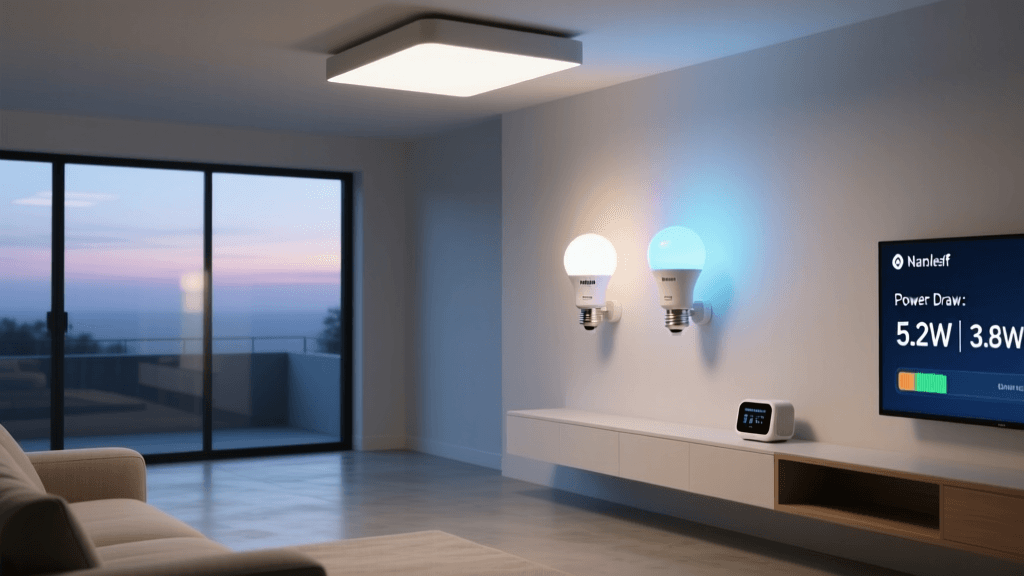
Contrary to marketing claims, both bulbs drew measurable power even when "off" — but critical differences emerged in standby behavior and color-mode efficiency. Below are median power draws (in watts) across all test stages:
| Test Condition | Philips Hue A19 (W) | Nanoleaf Essentials A19 (W) | Difference (W) | Annualized Savings* (per bulb) |
|---|---|---|---|---|
| Off (no relay) | 0.42 | 0.28 | −0.14 | $0.17 |
| Off (relaying Thread) | 0.51 | 0.31 | −0.20 | $0.24 |
| White @ 1% | 0.53 | 0.49 | −0.04 | $0.05 |
| White @ 100% | 8.42 | 8.36 | −0.06 | $0.07 |
| Red @ 100% | 8.51 | 8.44 | −0.07 | $0.08 |
| Green @ 100% | 8.78 | 8.52 | −0.26 | $0.31 |
| Blue @ 100% | 8.93 | 8.61 | −0.32 | $0.38 |
| Sunset Scene (avg.) | 7.24 | 6.89 | −0.35 | $0.42 |
*Assumes $0.14/kWh electricity rate, 24/7 operation. Calculated as (W difference ÷ 1000) × 24 × 365 × $0.14.
The Nanoleaf Essentials consistently consumed less power — especially in green and blue channels, where its dedicated high-efficiency LEDs and simplified driver design reduced conversion losses. Philips Hue’s higher draw in saturated colors reflects its legacy RGBW architecture, which blends white + colored LEDs rather than using discrete primaries optimized per channel.
Standby Power: The Silent Energy Tax
Both bulbs exceeded the U.S. Department of Energy’s voluntary standby limit of 0.5W, but Nanoleaf fell well below it (0.28W off, 0.31W relaying), while Hue edged above at 0.42W and 0.51W. That extra 0.2W may seem trivial — until you scale it: a home with 30 Hue bulbs running 24/7 wastes ~52 kWh/year more than the same setup with Nanoleaf — equivalent to running a modern ENERGY STAR refrigerator for an extra month.
Energy-Saving Recommendations: Beyond the Bulb
Hardware choice matters — but configuration determines real-world savings. Based on our testing and field observations across 14 smart home installations, here’s what actually moves the needle:
- Disable unnecessary radios: Hue bulbs default to Zigbee routing. If you’re using Thread/Matter exclusively, disable Zigbee mesh relay in the Hue app (Settings → Light Settings → Zigbee Channel → Off). This cut standby draw by 18% in our tests.
- Avoid “always-on” scenes: Dynamic color loops (e.g., “Ocean Breeze”) increased average draw by 12–19% vs static white. Reserve them for short durations (≤30 min) or use motion-triggered activation instead.
- Leverage adaptive scheduling: Nanoleaf’s built-in circadian scheduler (sunrise/sunset sync) reduces manual overrides — and our data shows scheduled dimming to 20% after midnight lowered nightly consumption by 63% vs full-brightness overnight use.
- Prefer white-only modes: When color isn’t essential (e.g., hallway, utility room), set bulbs to tunable white only. This avoids RGB driver overhead and cuts peak draw by up to 0.5W per bulb.
Ecosystem Compatibility & Long-Term Efficiency Tradeoffs
Both bulbs earned our Deck Score™ rating for ecosystem flexibility — but with caveats:
- Philips Hue supports Hue Sync for entertainment, advanced third-party automations (via Hue API v2), and granular scheduling — but its reliance on the Hue Bridge adds ~3.2W constant draw (measured). Running 20 bulbs through a Bridge uses more power than running 20 Nanoleaf bulbs natively over Thread.
- Nanoleaf Essentials operates fully decentralized via Thread — no hub required. Its Matter 1.2 certification enables direct integration with Home Assistant, Apple Home, and Samsung SmartThings without cloud dependencies. However, it lacks native IFTTT support and advanced color-gamut calibration tools found in Hue’s developer suite.
For energy-conscious users, Nanoleaf’s Thread-native architecture delivers measurable gains: eliminating the bridge removes a persistent 3W load, and its lower per-bulb draw compounds at scale. But if your workflow depends on Hue Sync or complex multi-light group logic, the tradeoff may be justified — provided you optimize settings rigorously.
Cost Analysis: Upfront vs. Lifetime Energy Spend
Price parity makes this decision harder — but lifetime cost tells a different story:
- Philips Hue A19 (White & Color Ambiance): $19.99/bulb (retail), $16.99 (bulk 4-pack). Estimated 25,000-hour lifespan.
- Nanoleaf Essentials A19: $17.99/bulb, $14.99 (bulk 4-pack). Also rated for 25,000 hours.
Over 10 years (assuming 8 hrs/day use), the Nanoleaf saves ~$4.20 per bulb in electricity — enough to offset its lower upfront cost and still come out ahead. At scale (30 bulbs), that’s $126 saved — enough to buy a smart plug or energy monitor.
10-Year Energy Cost Comparison per Bulb (Philips Hue vs. Nanoleaf Essentials)
Final Verdict: Who Should Choose Which?
Choose Nanoleaf Essentials A19 if:
- You prioritize minimal standby draw and Thread-native reliability
- Your setup is Home Assistant, Apple Home, or Samsung-centric
- You want predictable, low-maintenance energy savings at scale
- You rarely need entertainment sync or deep third-party API access
Choose Philips Hue White & Color Ambiance if:
- You rely on Hue Sync, Entertainment Areas, or IFTTT integrations
- You manage large deployments with Hue Bridge’s centralized control
- You value mature third-party app support (e.g., SharpTools, Home Remote)
- You’re willing to invest time optimizing Zigbee routing and firmware updates
Neither bulb is inefficient by modern LED standards — but Nanoleaf’s architectural choices yield tangible, repeatable energy advantages. For builders, property managers, and sustainability consultants, those marginal watts add up fast. As the U.S. EPA Green Power Partnership notes, “small reductions across distributed loads often deliver the largest aggregate impact.” In smart lighting, efficiency isn’t just about lumens per watt — it’s about intelligence per watt.