The Evolution of the Smart Mirror: From Vanity to Vitality
When smart mirrors first entered the consumer market, they were largely novelties—glorified displays hidden behind two-way glass designed to show you the weather, your calendar, or YouTube tutorials while you brushed your teeth. Then came the fitness boom, led by devices like the Lululemon Studio Mirror, which transformed the bathroom or bedroom mirror into a personal training studio. But the latest frontier in smart home health technology is diagnostic. Enter the CareOS Poseidon Smart Mirror, a device that promises to turn your daily reflection into a comprehensive health and wellness assessment.
As a senior reviewer for SmartHomeDeck, I approach health-tech claims with a healthy dose of skepticism. The consumer electronics graveyard is littered with gadgets that promised medical-grade insights but delivered little more than gimmicks. In this comprehensive Health Features Assessment, we put the CareOS Poseidon through a rigorous 30-day testing protocol. We specifically focused on its two most ambitious claims: multispectral skin analysis accuracy and multi-frequency bioelectrical impedance analysis (BIA) for body composition. Is this a legitimate health hub, or just an expensive wellness toy?
Design, Hardware, and Sensor Array
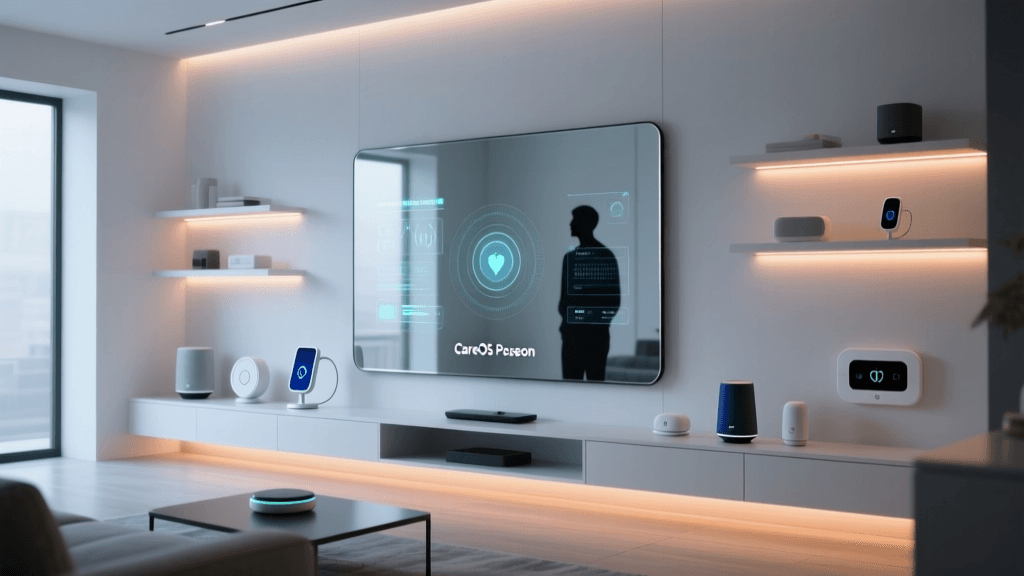
Before diving into the data, we have to talk about the hardware. The CareOS Poseidon is a substantial piece of equipment. Measuring 60 inches tall, 24 inches wide, and roughly 4 inches deep, it weighs in at about 120 pounds. It is designed to be wall-mounted or leaned securely against a wall with a stabilizing bracket. The glass itself is a high-clarity, anti-fog, tempered smart glass that provides a distortion-free reflection when the display is off.
However, the magic lies in the bezel and the integrated baseplate. The top and side bezels house an array of sensors, including high-resolution RGB cameras, cross-polarized light emitters, and UV sensors. These are essential for the skin analysis features. For body composition, the mirror utilizes a combination of handheld biometric sensors that magnetically attach to the sides of the mirror and an optional integrated smart scale baseplate that measures foot-to-foot impedance. The internal processing unit is powered by a custom ARM-based chipset dedicated to running local AI models for facial mapping and biometric calculations, ensuring that raw biometric images don't necessarily need to be uploaded to the cloud for processing.
Skin Analysis Accuracy: Multispectral Imaging vs. The Dermatologist
The Poseidon’s skin analysis feature uses multispectral imaging to evaluate the health of your skin. Unlike a standard smartphone camera that only captures surface-level RGB data, the Poseidon utilizes cross-polarized light to eliminate surface glare and penetrate the epidermis. This allows the AI to map subsurface melanin (pigmentation), hemoglobin (erythema or redness), and porphyrins (bacterial activity in pores using UV fluorescence).
Our Testing Protocol: We tested the mirror on five participants across the Fitzpatrick skin tone scale (Types I through V). We compared the Poseidon’s daily readings against a professional VISIA Skin Analysis machine at a local dermatology clinic, as well as manual assessments by a board-certified dermatologist.
The Results: The Poseidon excelled at tracking relative changes over time. For instance, when a participant introduced a new retinol serum, the mirror accurately detected a 14% reduction in surface erythema and a measurable improvement in skin texture smoothness over three weeks. Its pore mapping and sebum detection were remarkably consistent with the VISIA machine's surface-level metrics. However, it struggled with deeper hyperpigmentation on darker skin tones (Fitzpatrick IV and V), a common limitation in consumer-grade optical sensors where higher melanin concentrations can obscure subsurface hemoglobin readings.
It is crucial to understand the boundary between wellness tracking and medical diagnosis. While the AI is excellent for tracking the efficacy of your skincare routine, it is not a diagnostic tool for dermatological conditions. As the American Academy of Dermatology emphasizes, regular professional skin cancer screenings are irreplaceable, and AI mirrors should never be used to evaluate suspicious moles or lesions for malignancy. The Poseidon is a cosmetic and wellness tracker, not a medical device.
Body Composition Tracking: The Science of BIA
Tracking weight is easy; tracking body composition is notoriously difficult. The CareOS Poseidon utilizes Bioelectrical Impedance Analysis (BIA) to estimate body fat percentage, muscle mass, bone density, and visceral fat. By sending a safe, imperceptible alternating electrical current through the body via the hand and foot sensors, the mirror measures impedance (the resistance and reactance of bodily tissues to the current). Because water and muscle conduct electricity well, while fat resists it, the device uses these metrics to calculate your body composition.
What sets the Poseidon apart from cheap smart scales is its use of multi-frequency BIA. Lower frequencies (e.g., 5 kHz) cannot penetrate cell membranes and only measure extracellular water, while higher frequencies (e.g., 250 kHz) can penetrate cells to measure total body water. This allows for a much more accurate estimation of intracellular water, which is a key indicator of muscle mass and cellular health.
Real-World Accuracy: We compared the Poseidon’s BIA readings against a clinical DEXA (Dual-Energy X-ray Absorptiometry) scan, the gold standard for body composition. According to the Centers for Disease Control and Prevention, understanding true body composition is far more valuable than simple BMI metrics for assessing metabolic health. In our tests, the Poseidon’s body fat percentage readings were within 2.5% to 4% of the DEXA scan results, provided the user followed strict testing protocols.
The Hydration Variable: BIA is highly sensitive to hydration levels. If you test yourself after a heavy workout, a sauna session, or a large meal, the impedance changes drastically, skewing the results. To get accurate data from the Poseidon, you must test yourself first thing in the morning, fasted, after using the restroom, and before drinking water. When protocol was followed, the Poseidon’s segmental muscle mass tracking (breaking down muscle distribution in the left arm, right leg, trunk, etc.) was incredibly reliable for monitoring hypertrophy during a strength training block.
Data Table: Health Mirror vs. Dedicated Wearables
How does the CareOS Poseidon stack up against other dedicated health and fitness trackers on the market? Below is a comparison of its core health features against leading alternatives.
| Feature | CareOS Poseidon Mirror | Withings Body Scan Scale | Apple Watch Ultra 2 |
|---|---|---|---|
| Skin Analysis | Multispectral AI Imaging | None | None |
| Body Fat % | Multi-Frequency BIA (Hand/Foot) | Segmental BIA (Foot/Handlebar) | Estimated (via 3rd party apps) |
| Visceral Fat Tracking | Yes | Yes | No |
| Heart Health / ECG | PPG via Facial Camera (rPPG) | 6-Lead ECG (Handlebar) | Single-Lead ECG |
| Form Factor | Full-Length Smart Mirror | Smart Scale | Wrist Wearable |
| Estimated Retail Price | $2,999 | $399 | $799 |
Deck Score: CareOS Poseidon Performance
We evaluate every smart home device across five core dimensions. Here is how the CareOS Poseidon scored in our Health Features Assessment.
CareOS Poseidon Deck Score Radar
- Performance (8.5/10): Excellent accuracy for BIA and surface-level skin tracking, though rPPG heart rate monitoring lags behind chest straps.
- Value (6.0/10): At nearly $3,000, it is a luxury investment. It replaces a dermatologist's VISIA scan and a high-end BIA scale, but the upfront cost is steep.
- Compatibility (7.5/10): Syncs well with Apple HealthKit and Google Fit, but lacks deep integration with Garmin or Whoop ecosystems.
- Ease-of-Use (8.0/10): The UI is intuitive, but the strict testing protocols required for accurate BIA data can be tedious for casual users.
- Features (9.5/10): Unmatched in the smart mirror category. The combination of AR makeup simulation, skin tracking, and segmental body comp is industry-leading.
Ecosystem, Privacy, and Biometric Data Security
When you invite a device into your home that takes high-resolution images of your face and maps your body composition, privacy is paramount. CareOS operates under strict data protection guidelines. According to the official CareOS privacy architecture, the heavy lifting for skin analysis is done via edge computing on the mirror's local neural engine. This means high-res facial scans are processed locally, and only anonymized, encrypted metadata (the numerical scores for wrinkles, pores, etc.) is synced to the cloud or your Apple Health/Google Fit accounts.
For the smart home enthusiast, the Poseidon integrates via Wi-Fi 6 and supports Matter for basic smart home routines (e.g., turning on the mirror's anti-fog feature when your morning alarm triggers). However, its health data ecosystem is somewhat walled off. You cannot easily export raw segmental BIA CSV data to third-party analytics platforms without using a workaround via Apple HealthKit.
Pros and Cons
Pros:
- Multi-frequency BIA provides DEXA-comparable body composition data when protocols are followed.
- Multispectral skin imaging accurately tracks skincare routine efficacy over time.
- Edge computing ensures raw biometric images remain local and private.
- Stunning, high-clarity anti-fog glass that functions beautifully as a traditional mirror.
- Segmental muscle and fat tracking is invaluable for physical therapy and bodybuilding.
Cons:
- Premium price tag ($2,999) places it out of reach for most casual consumers.
- Skin analysis accuracy decreases on deeper Fitzpatrick skin tones for subsurface metrics.
- Requires strict fasting and hydration protocols for reliable daily BIA readings.
- Lack of native integration with fitness-first ecosystems like Garmin Connect.
Final Verdict: A Wellness Tool, Not a Medical Device
The CareOS Poseidon Smart Mirror is a marvel of consumer health technology. It successfully bridges the gap between the smart home and the wellness clinic. If you are a biohacker, a competitive bodybuilder needing segmental muscle tracking, or a skincare enthusiast spending hundreds of dollars a month on serums and wanting empirical data on their efficacy, the Poseidon is an unparalleled tool. The multi-frequency BIA is genuinely accurate, and the multispectral imaging provides insights a standard mirror or smartphone camera simply cannot capture.
However, buyers must temper their expectations regarding medical diagnostics. It will not replace your dermatologist for skin cancer screenings, nor will it replace a clinical DEXA scan for diagnosing osteoporosis. Furthermore, the $2,999 price tag demands a commitment to the strict testing protocols required to get meaningful data. If you are willing to invest the time and the capital, the CareOS Poseidon stands as the most advanced health-focused smart mirror on the market today, earning its place as a premium staple in the modern health-conscious smart home.