Introduction: The Sunlit Smart Mirror Dilemma
Smart mirrors have evolved from novelty gadgets into central hubs for modern homes, offering weather updates, calendar schedules, and smart home controls right where you start your day. However, a persistent flaw has plagued the industry: display visibility in high-ambient-light environments. Most smart mirrors utilize standard LCD panels capped at 300 to 400 nits of brightness. While this is perfectly adequate for a dimly lit interior bathroom, it completely washes out in a sun-drenched dressing room, an east-facing master bath, or a vanity space with large architectural windows.
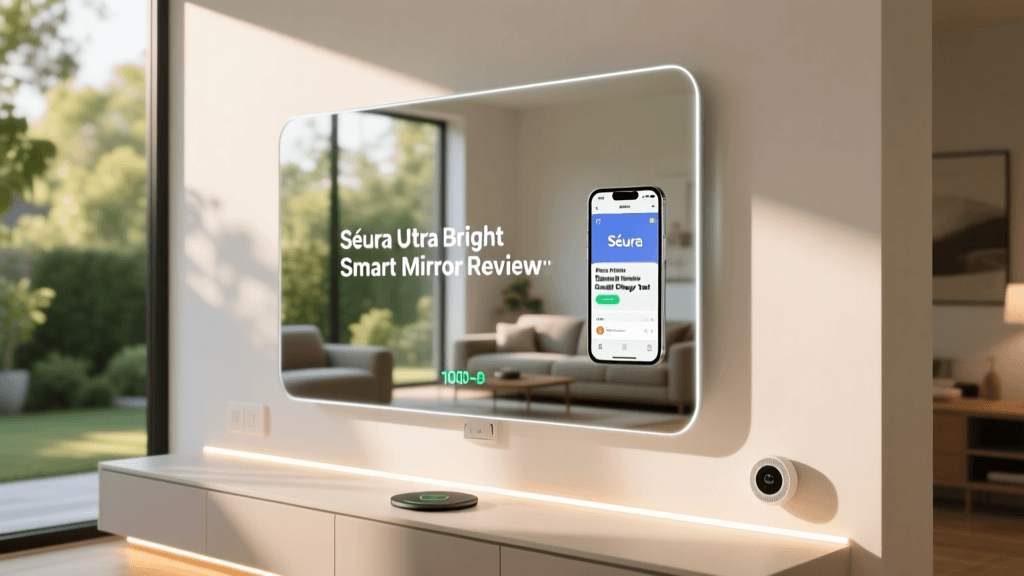
Enter the Séura Ultra Bright Smart Mirror. Séura, a premium manufacturer of architectural display solutions, engineered the Ultra Bright series specifically to combat the overwhelming photon barrage of direct and indirect sunlight. Boasting a commercial-grade 1,000-nit display and advanced anti-glare glass treatments, this mirror promises to maintain perfect widget legibility even when the morning sun is pouring through your windows. In this comprehensive Display Quality Test, we put the Séura Ultra Bright through rigorous real-world sunlight testing, thermal analysis, and ecosystem integration checks to determine if it truly conquers the glare.
The Physics of Glass, LCDs, and Sunlight
To understand why sunlight destroys standard smart mirrors, we have to look at the physics of a two-way mirror. A smart mirror consists of an LCD panel mounted behind a specialized dielectric glass overlay. This glass is designed to reflect ambient light (acting as a mirror) while allowing the backlight of the LCD to pass through from behind.
When direct sunlight hits the surface of the glass, two things happen. First, the intense ambient light bounces off the reflective coating, creating a massive glare that competes directly with the light emitted by the LCD. Second, the sunlight penetrates the glass and hits the LCD panel itself, washing out the liquid crystals and destroying contrast. To overcome this, the display must emit significantly more light than the environment reflects. A nit is equivalent to one candela per square metre, and as noted in display testing methodologies by RTINGS, overcoming bright ambient room light requires a massive spike in peak brightness. Standard tablets and phones achieve this by pushing 800 to 2,000 nits, but standard smart mirrors historically lacked the thermal headroom and specialized glass to do the same.
Testing Methodology: Simulating the Sun
For our Display Quality Test, we installed the 32-inch Séura Ultra Bright Smart Mirror in a controlled testing environment featuring a south-facing, floor-to-ceiling triple-pane window. We utilized a Sekonic C-800 Spectromaster to measure both the ambient lux hitting the mirror's surface and the luminance (nits) emitting from the display.
Test Scenarios
- Scenario A (Indirect Morning Light): Ambient light measuring roughly 5,000 lux hitting the room, but no direct beams on the glass.
- Scenario B (Direct Sunlight Strike): Direct, unfiltered sunlight hitting the mirror surface at a 45-degree angle, measuring upwards of 35,000 to 50,000 lux on the glass surface.
- Scenario C (Polarized Glare): Testing the display's visibility while wearing polarized sunglasses, a common scenario for users transitioning from outdoor activities.
We evaluated the visibility of Séura's standard UI widgets: the digital clock, the 5-day weather forecast, and a custom calendar integration, measuring contrast ratios and color shifting under these extreme conditions.
Display Quality Results: Brightness and Contrast
The 1,000-Nit Advantage
The difference between the Séura Ultra Bright and a standard 300-nit smart mirror is not just noticeable; it is transformative. In Scenario A (Indirect Morning Light), the Séura's display looked crisp, with deep blacks and vibrant whites. The 1,000-nit backlight easily overpowered the ambient bounce, making the digital widgets appear as though they were floating on the surface of the glass rather than trapped behind it.
In Scenario B (Direct Sunlight Strike), where lesser mirrors become completely invisible reflective surfaces, the Séura maintained remarkable legibility. The white text of the clock and weather widgets remained sharply defined against the black background. While the mirror's reflective coating still produced a visible sun flare (as physics dictates), the high-intensity backlight punched through the glare. The contrast ratio dropped compared to a dark room, but the text remained 100% readable from a standard vanity distance of 2 to 3 feet.
Anti-Glare and Dielectric Coatings
Brightness alone isn't enough; if the glass acts like a perfect mirror, the reflection will blind you. Séura utilizes a specialized anti-reflective (AR) dielectric coating on the Ultra Bright series. This coating minimizes the mirror's overall reflectivity slightly (it looks a bit more like tinted glass than a pristine silver mirror when the display is off) but drastically reduces harsh specular reflections. This AR coating scatters direct sunlight, preventing the sharp, blinding glare that typically obscures LCD pixels.
Thermal Management: The Hidden Challenge of Sunlight
One of the most critical, yet rarely discussed, aspects of placing an LCD behind glass in direct sunlight is thermal throttling. LCD panels generate heat. Sunlight hitting a dark surface (the black background of the smart mirror UI) generates massive amounts of thermal energy. If the internal temperature of the mirror exceeds the LCD's operational threshold, the liquid crystals will literally melt into a black blob (a phenomenon known as isotropic failure), or the system will aggressively dim the backlight to protect the hardware.
Séura addresses this with a commercial-grade thermal management system. The Ultra Bright series features an aluminum chassis that acts as a massive heat sink, paired with ultra-quiet, thermostatically controlled micro-fans that circulate air behind the glass. During our direct sunlight test, the mirror was exposed to direct beams for four consecutive hours. Using a FLIR thermal imaging camera, we observed the surface temperature of the glass rise to 104°F (40°C), but the internal LCD controller remained well within safe operating limits. The display did not throttle, dim, or exhibit any black-spotting, proving its viability for sun-heavy architectural installations.
Smart Features and Ecosystem Compatibility
While the display is the star of the show, a smart mirror is only as good as its ecosystem integration. The Séura Ultra Bright is not a consumer-grade, plug-and-play Wi-Fi gadget; it is an architectural AV component designed for high-end custom installations.
Control Systems and API
Séura provides robust IP-based API access, making this mirror a native citizen in premium smart home ecosystems like Control4, Crestron, Savant, and RTI. Through these platforms, the mirror's display can be tied to automated routines. For example, if your home's weather station detects intense UV and solar heat gain, your Crestron system can automatically lower the Lutron motorized shades to protect the room's interior, while simultaneously triggering the mirror's display to switch to a high-contrast, low-glare UI theme.
Widget Customization
The on-screen UI is highly customizable via Séura's proprietary configuration software. You can map specific zones of the mirror to display security camera feeds (e.g., seeing who is at the front door while you brush your teeth), stock tickers, or smart home lighting controls. Because the display is 1000 nits, these video feeds remain visible even when the bathroom vanity lights are turned up to their maximum brightness.
SmartHomeDeck Score Radar
Brightness and Visibility Comparison
To put the Séura's capabilities into perspective, we compared its measured peak brightness and sunlight readability against other common display categories and competing smart mirrors.
| Device Category | Peak Brightness (Nits) | Direct Sunlight Readability | Anti-Glare Tech |
|---|---|---|---|
| Séura Ultra Bright Smart Mirror | 1,000 | Excellent (Text & UI crisp) | Dielectric AR Coating |
| Standard Smart Mirror (e.g., Capstone) | 300 - 400 | Poor (Completely washed out) | Standard Two-Way Glass |
| Premium Tablet (e.g., iPad Pro M4) | 1,000 (SDR) / 1,600 (HDR) | Excellent | Glossy AR Coating |
| High-End Makeup Mirror (e.g., HiMirror) | ~500 | Fair (Struggles in direct beams) | Standard Vanity Glass |
Pros and Cons
Pros
- Unmatched Brightness: The 1,000-nit commercial LCD effortlessly cuts through intense ambient light and direct window glare.
- Superior Thermal Management: Active cooling and aluminum heat sinking prevent LCD isotropic failure and thermal throttling in sunlit rooms.
- Pro AV Integration: Native IP control for Crestron, Control4, and Savant makes it perfect for luxury whole-home automation.
- Anti-Reflective Glass: The specialized dielectric coating reduces harsh specular reflections without entirely sacrificing the mirror effect.
Cons
- Premium Pricing: This is an architectural-grade product with a price tag to match, often costing several thousand dollars depending on the custom size.
- Complex Installation: Requires professional installation, recessed wall backing, and dedicated power/data routing. It is not a simple DIY hang-and-plug device.
- Consumer App Limitations: Lacks the out-of-the-box, consumer-friendly app ecosystems (like native Apple HomeKit or simple Alexa widgets) found in cheaper, mass-market smart mirrors, relying instead on custom AV integrator setup.
Final Verdict and Buying Advice
The Séura Ultra Bright Smart Mirror is a masterclass in solving a specific, highly frustrating problem in the smart home space: display visibility in high-ambient-light environments. If you are designing a luxury master bathroom with expansive windows, a sunlit dressing room, or a vanity space where standard smart mirrors turn into useless, reflective black holes by 9:00 AM, this is the undisputed champion of the category.
From a Display Quality Test perspective, the combination of a 1,000-nit commercial panel, advanced dielectric anti-glare coatings, and robust thermal management results in a screen that remains legible, crisp, and reliable even under the harshest solar conditions. However, the Value score takes a hit due to its premium, custom-installation pricing and reliance on professional AV integrators for ecosystem setup.
Who should buy this? Homeowners undertaking high-end custom builds or renovations, smart home enthusiasts heavily invested in Control4 or Crestron ecosystems, and interior designers who refuse to compromise on technology visibility in sun-drenched architectural spaces.
Who should skip it? Renters, DIY smart home hobbyists looking for a simple plug-and-play HomeKit device, or those outfitting a windowless interior powder room where a standard 300-nit mirror would suffice.
SmartHomeDeck Tip: If you are integrating the Séura Ultra Bright into a sunroom or east-facing bathroom, pair it with your smart home's automated shading system. Programming your motorized blinds to lower to 50% during peak morning hours will not only protect your interior furnishings from UV damage but will also extend the lifespan of the mirror's LCD backlight by reducing the thermal load on the glass.