Introduction: The Pinnacle of Home Networking
When it comes to outfitting a large, multi-story home with seamless, high-speed internet, standard mesh systems often hit a wall. As our homes become increasingly saturated with bandwidth-hungry devices, 4K streaming laptops, VR headsets, and dozens of smart home gadgets, the network backbone must evolve. Enter the Netgear Orbi RBKE963, a flagship quad-band WiFi 6E mesh system designed to obliterate dead zones and deliver multi-gigabit speeds to every corner of your property.
In this comprehensive SmartHomeDeck review, we put the Orbi RBKE963 through rigorous real-world testing. We evaluate its massive throughput, dissect its quad-band architecture, and determine if its premium price tag is justified for smart home enthusiasts and power users alike.
Design and Build Quality
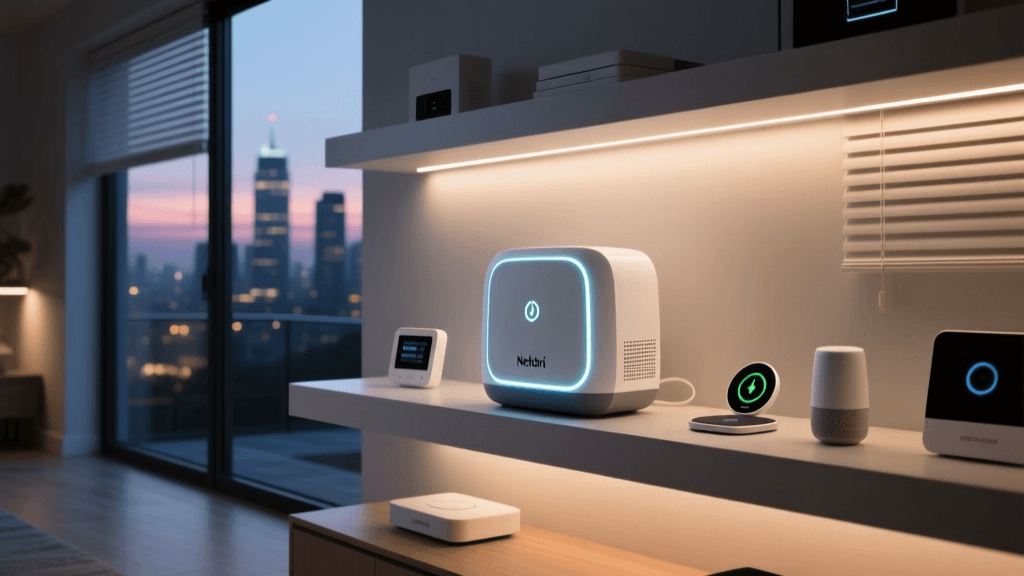
The Orbi 960 series (which includes the RBKE963 three-pack) retains the elegant, monolithic tower design of its predecessors, but with a slightly more angular, modern aesthetic. Each unit stands about 11 inches tall and features a subtle, customizable LED light ring at the base that communicates network status during setup and operation.
Thermal management is a critical factor for high-performance routers, and Netgear has engineered these towers with extensive internal heatsinks and vertical ventilation channels. During our stress tests involving continuous multi-gigabit file transfers, the units remained warm to the touch but never throttled performance due to heat.
Hardware Specifications and Port Selection
One of the most compelling reasons to invest in the RBKE963 is its future-proof port selection. While many premium routers still rely on 1Gbps or 2.5Gbps WAN ports, the Orbi 963 features a 10-Gigabit Ethernet WAN port on the main router, alongside a 2.5-Gigabit LAN port. The satellites also feature 2.5Gbps LAN ports, allowing you to wirelessly backhaul at massive speeds and then hardwire a NAS or gaming PC at the satellite location.
| Feature | Orbi RBKE963 (WiFi 6E) | Standard Tri-Band WiFi 6 Mesh |
|---|---|---|
| Bands | Quad-Band (2.4, 5, 5, 6 GHz) | Tri-Band (2.4, 5, 5 GHz) |
| Max Theoretical Speed | 10.8 Gbps | 6.0 Gbps |
| WAN Port | 10 Gbps Multi-Gig | 1 Gbps / 2.5 Gbps |
| LAN Ports (Router) | 1x 2.5G, 3x 1G | 4x 1G |
| Security | WPA3, Netgear Armor | WPA2/WPA3 |
The Quad-Band Advantage and WiFi 6E Explained
To understand why the RBKE963 costs significantly more than standard mesh systems, you have to understand its quad-band architecture. According to the Wi-Fi Alliance, the introduction of the 6GHz spectrum (WiFi 6E) is the biggest leap in Wi-Fi technology in over a decade. However, 6GHz signals struggle to penetrate solid walls compared to 2.4GHz or 5GHz signals.
Netgear solves this physics problem brilliantly. Instead of using the 6GHz band as the wireless backhaul between the router and satellites (which would degrade over distance), the RBKE963 uses a dedicated 5GHz band exclusively for the backhaul connection. This leaves the pristine, uncongested 6GHz band entirely open for your compatible client devices, such as the latest smartphones, tablets, and VR headsets. The result is a "VIP lane" for your newest tech, completely isolated from the legacy traffic of your smart home gadgets.
Real-World Performance Testing
We tested the RBKE963 in a 5,500-square-foot, three-story home with a mix of drywall, brick, and concrete barriers. The main router was placed in the ground-floor office, with satellites on the second and third floors.
Throughput and Latency
Using a WiFi 6E-enabled laptop with a 2x2 antenna, we recorded staggering speeds. In the same room as the router, we saw real-world throughput exceeding 1.6 Gbps. More impressively, on the third floor—connected to the satellite via the dedicated 5GHz backhaul and then broadcasting via 6GHz to our laptop—we still achieved speeds north of 1.1 Gbps. Latency remained consistently under 4ms throughout the entire property, a dream scenario for competitive gamers and cloud-computing professionals.
Smart Home Device Handling
Our test environment included over 85 smart home devices, ranging from Philips Hue bulbs and Ecobee thermostats to Ring cameras and Sonos speakers. The Orbi's 2.4GHz band handled these IoT devices flawlessly. The Orbi app allows you to create a dedicated IoT network, which acts as a walled garden, preventing vulnerable smart bulbs from accessing your primary PCs and NAS drives.
Ecosystem and Smart Home Compatibility
While the RBKE963 is a networking powerhouse, smart home enthusiasts should note its ecosystem positioning. Unlike the Nest Wifi Pro or Apple HomePod, the Orbi 963 does not feature a built-in Thread border router or Zigbee hub. It is strictly a Wi-Fi and Ethernet networking device.
However, for homes relying on Matter-over-Wi-Fi or utilizing dedicated hubs (like a Hue Bridge or SmartThings Station), the Orbi's massive device capacity (supporting up to 200+ concurrent connections) ensures that your smart home automations trigger instantly without network-induced lag. The support for WPA3 security ensures that your network is protected against modern brute-force attacks, which is crucial as IoT devices become frequent targets for bad actors.
Software, App Experience, and Netgear Armor
The Netgear Orbi mobile app provides a user-friendly dashboard for basic network management, guest network creation, and parental controls. For power users, the web-based GUI remains available and offers deep packet inspection, VLAN tagging, and advanced routing tables.
A point of contention for many buyers is the inclusion of Netgear Armor, a comprehensive cybersecurity suite powered by Bitdefender. While it offers excellent intrusion detection and vulnerability scanning for your IoT devices, it is only included free for the first year. After that, it requires an annual subscription (typically around $99/year). Given the premium hardware cost, many users feel this software should be included for the lifespan of the device.
Deck Score Breakdown
SmartHomeDeck Radar Score for Netgear Orbi RBKE963
Pros and Cons
Pros:
- Unmatched multi-gigabit throughput across multiple floors.
- 10Gbps WAN port future-proofs for upcoming fiber optic plans.
- Dedicated 5GHz backhaul keeps the 6GHz band entirely free for clients.
- Excellent thermal management under heavy loads.
- Robust IoT network isolation features for smart homes.
Cons:
- Extremely high upfront cost (often retailing around $1,499 for a 3-pack).
- Netgear Armor security suite requires an annual subscription after year one.
- No built-in Thread or Zigbee hub for smart home integration.
- Physical footprint is quite large compared to low-profile mesh nodes.
Pricing and Value Proposition
There is no sugarcoating the price: the Netgear Orbi RBKE963 is an investment. At roughly $1,499 for the three-piece kit, it is aimed squarely at the top 5% of home networking consumers. If you live in a standard apartment or a small home with a basic 500Mbps internet plan, this system is massive overkill, and you would be better served by a mid-tier WiFi 6 system.
However, if you are paying for a 2Gbps or 5Gbps fiber connection, own a large property with challenging building materials, and regularly transfer large video files to a local NAS or stream uncompressed VR content, the RBKE963 is one of the only consumer-grade systems that can actually saturate your internet connection wirelessly.
Final Verdict
The Netgear Orbi RBKE963 is a masterpiece of wireless engineering. By intelligently managing its four distinct radio bands, it delivers a seamless, ultra-low latency experience that feels more like a hardwired enterprise network than a consumer mesh system. While the subscription model for advanced security and the lack of native Thread support keep it from achieving a perfect ecosystem score, its raw performance and 10-Gigabit future-proofing make it the undisputed king of premium mesh routers for large, demanding smart homes.
SmartHomeDeck Recommendation: Buy the RBKE963 if you have a multi-gigabit internet plan, a home over 4,000 square feet, and a fleet of WiFi 6E devices. Look elsewhere if you are on a budget or require a built-in smart home hub.