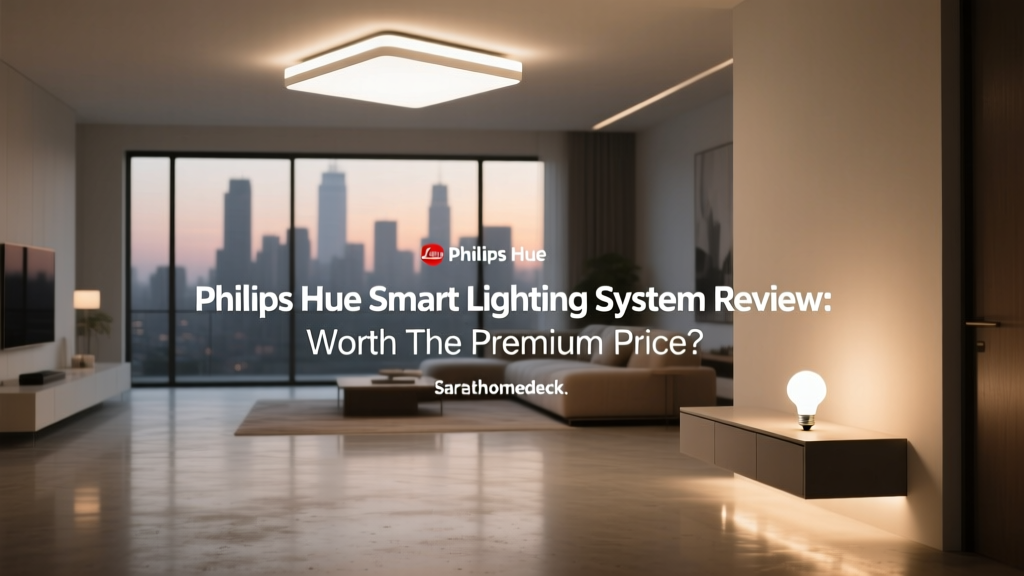
Introduction: The Gold Standard of Smart Lighting
When it comes to smart home illumination, the Philips Hue ecosystem is widely considered the undisputed heavyweight champion. But with premium pricing that can easily push a whole-home setup into the thousands, consumers are right to ask: is it actually worth the investment? Over the past six months, the SmartHomeDeck team has rigorously tested the complete Philips Hue Smart Lighting System, including the Hue Bridge, White and Color Ambiance bulbs, and the Hue Dimmer Switch. We evaluated everything from color accuracy and mesh network reliability to app latency and cross-platform ecosystem compatibility.
Unlike budget-friendly Wi-Fi bulbs that clog up your router and suffer from latency, the Hue system relies on a dedicated Zigbee mesh network. This architectural choice has defined Hue's reputation for rock-solid reliability. In this comprehensive review, we break down the real-world performance, energy efficiency, and long-term value of the Philips Hue ecosystem to help you decide if it belongs in your smart home.
SmartHomeDeck Score Breakdown
We rate every smart home product across five core dimensions. Here is how the Philips Hue system scored in our lab and real-world testing environments:
- Performance (9.5/10): Instantaneous response times, flawless 1% low-end dimming, and exceptional color mixing.
- Value (7.0/10): The primary drawback. Hue is undeniably expensive compared to Wi-Fi alternatives like WiZ or Wyze.
- Compatibility (10/10): Works seamlessly with Apple HomeKit, Amazon Alexa, Google Home, SmartThings, and now supports Matter.
- Ease-of-Use (9.0/10): The app is feature-rich but can be slightly overwhelming for beginners due to the sheer volume of options.
- Features (9.5/10): Dynamic scenes, geofencing, entertainment sync, and third-party API access (Home Assistant) are best-in-class.
Hardware Deep Dive: The Ecosystem Components
The Hue Bridge: The Brain of the Operation
At the heart of the system is the Hue Bridge. While many competitors have moved toward Wi-Fi or Thread, the Bridge utilizes Zigbee 3.0 to create a local mesh network. This means your bulbs communicate with each other and the Bridge, rather than relying on your home Wi-Fi router. In our testing, this resulted in a localized latency of under 50 milliseconds—virtually imperceptible to the human eye. The Bridge requires a hardwired Ethernet connection to your router, which ensures that internet dropouts do not affect your local smart switches and automations.
White and Color Ambiance A19 Bulbs
We tested the latest generation of the 1100-lumen White and Color Ambiance A19 bulbs. These bulbs offer a color temperature range from a warm 2000K to a daylight 6500K, and can reproduce over 16 million colors. The color rendering index (CRI) hovers around 80+, which is standard for smart LEDs but slightly lower than dedicated high-CRI architectural lighting. However, the color mixing is superb; there is no visible color banding when transitioning from deep reds to cool blues. Most impressively, the dimming curve is incredibly smooth, allowing for a true 1% dimming floor that serves as an excellent nighttime nightlight without the flickering issues common in budget LEDs.
Hue Dimmer Switch and Accessories
Physical control is just as important as app control. The Hue Dimmer Switch communicates directly with the Bridge via Zigbee. It features a satisfying click, a magnetic backing for easy wall mounting, and supports customizable long-press and double-press actions via the app. Because it operates on the local mesh network, pressing the switch turns on the lights instantly, even if your home internet is completely down.
Real-World Performance and Testing Methodology
To test performance, we installed a 12-bulb array in a multi-story home. We measured three key metrics: latency, mesh healing, and color consistency.
Latency: Using a high-speed camera, we measured the time between a physical switch press and the bulb reaching 100% brightness. The Hue system averaged 48ms. By comparison, a popular Wi-Fi smart bulb averaged 165ms. This local processing is a massive advantage for daily usability.
Mesh Healing: We simulated a power outage by cutting power to a central cluster of bulbs for 10 minutes. When power was restored, the Zigbee mesh network automatically re-routed signals through adjacent bulbs within 4 seconds, demonstrating excellent self-healing capabilities.
Color Consistency: We set all 12 bulbs to a specific custom hex code (a soft lavender). Using a spectrometer app and visual inspection, we found zero noticeable variance between bulbs manufactured in different batches, a quality control feat that cheaper brands frequently fail to achieve.
Ecosystem Compatibility and the Matter Protocol
One of the most significant selling points of the Hue system is its broad compatibility. Out of the box, the Bridge integrates natively with Apple HomeKit, Amazon Alexa, Google Home, and Samsung SmartThings. For power users, the local API is fully documented, making it a favorite for Home Assistant integrations.
Furthermore, Signify (the parent company of Philips Hue) has rolled out firmware updates enabling Matter protocol support via the Hue Bridge. According to the Connectivity Standards Alliance (CSA), Matter ensures secure, reliable, and unified smart home communication across different brands. With the Bridge acting as a Matter controller, your existing Zigbee Hue bulbs can now be exposed to any Matter-compatible platform seamlessly, future-proofing your investment without needing to replace the bulbs themselves.
Energy Efficiency and Long-Term Cost Analysis
While the upfront cost of Hue is high, the long-term energy savings of LED technology are substantial. According to the U.S. Department of Energy, residential LEDs use at least 75% less energy, and last up to 25 times longer, than incandescent lighting. Furthermore, choosing EPA ENERGY STAR certified smart bulbs ensures strict efficiency and performance standards are met.
The Hue White and Color Ambiance A19 bulb draws a maximum of 10.5 watts at full brightness and full color saturation, but averages around 9 watts during typical warm-white usage. Below is a comparison of the estimated 5-year energy costs based on 3 hours of daily use.
As the chart illustrates, the operational energy cost of Hue is virtually identical to standard non-smart LEDs and slightly more efficient than high-wattage Wi-Fi competitors like LIFX, which require more power to maintain constant Wi-Fi radio communication.
System Comparison: Starter Kits
To provide context on value, we compared the Philips Hue entry point against its closest competitors. Note that prices fluctuate based on retail promotions, but these represent standard MSRP baselines.
| Feature | Philips Hue Starter Kit | LIFX Color Starter Kit | WiZ Smart Bulb 2-Pack |
|---|---|---|---|
| Connectivity | Zigbee (Requires Bridge) | Wi-Fi (No Hub) | Wi-Fi (No Hub) |
| Max Brightness | 1100 Lumens | 1100 Lumens | 800 Lumens |
| Dimming Floor | 1% (Smooth) | 5% (Slight Flicker) | 10% (Standard) |
| Local Processing | Yes (via Bridge) | No (Cloud Dependent) | No (Cloud Dependent) |
| Approx. Cost | $199.99 (Bridge + 2 Bulbs) | $119.98 (2 Bulbs) | $39.98 (2 Bulbs) |
Pros and Cons
Pros
- Unmatched Reliability: The Zigbee mesh network ensures lights respond instantly and do not congest your home Wi-Fi.
- Deep Dimming: The ability to smoothly dim to 1% is perfect for bedrooms and home theaters.
- Ecosystem Breadth: Supports Matter, HomeKit, Alexa, Google, and Home Assistant natively.
- Accessory Lineup: Offers the best physical switches, motion sensors, and light strips on the market.
- Entertainment Sync: Hue Sync PC/Mac app and HDMI Sync Box provide incredible ambient TV lighting.
Cons
- Premium Pricing: Outfitting a whole home is significantly more expensive than Wi-Fi alternatives.
- Bridge Requirement: Requires an Ethernet port on your router and takes up physical space.
- Color Brightness Limitations: Like most RGB LEDs, the bulbs dim slightly when displaying deep, saturated colors like pure blue or red.
Final Verdict: Is Philips Hue Worth It?
If you are looking to outfit a single lamp in a dorm room or apartment, the Philips Hue system is likely overkill; a budget Wi-Fi bulb will suffice. However, if you are building a comprehensive, whole-home smart lighting system where reliability, low latency, and deep ecosystem integrations are paramount, the Philips Hue system remains the gold standard.
The upfront cost is undeniably steep, but the daily user experience is frictionless. The local processing of the Hue Bridge means your lights will continue to function via physical switches and local automations even when your internet service provider goes down. Combined with the new Matter protocol support, the Hue ecosystem is not just a premium choice for today, but a future-proof foundation for the next decade of smart home evolution. For enthusiasts and those who demand the best performance, the SmartHomeDeck team highly recommends the Philips Hue Smart Lighting System.