Introduction: The Case for Smart Power Strips
When most people begin their smart home journey, they start with a single smart plug. It is an easy, low-cost way to automate a stubborn lamp or a coffee maker. However, as your ecosystem grows, single plugs quickly become a cluttered mess of bulky adapters blocking adjacent outlets. This is where a dedicated smart power strip becomes an essential upgrade. The Kasa Smart Wi-Fi Power Strip (KP303) by TP-Link has long been a staple in the smart home community, offering a reliable, budget-friendly solution for multi-device control.
In this comprehensive review, we put the Kasa KP303 through our rigorous SmartHomeDeck testing methodology. We evaluate its physical design, app experience, real-world latency, ecosystem compatibility, and overall value. If you are looking to automate your entertainment center, home office desk, or holiday lighting setup, this review will tell you everything you need to know before you buy.
Design and Build Quality
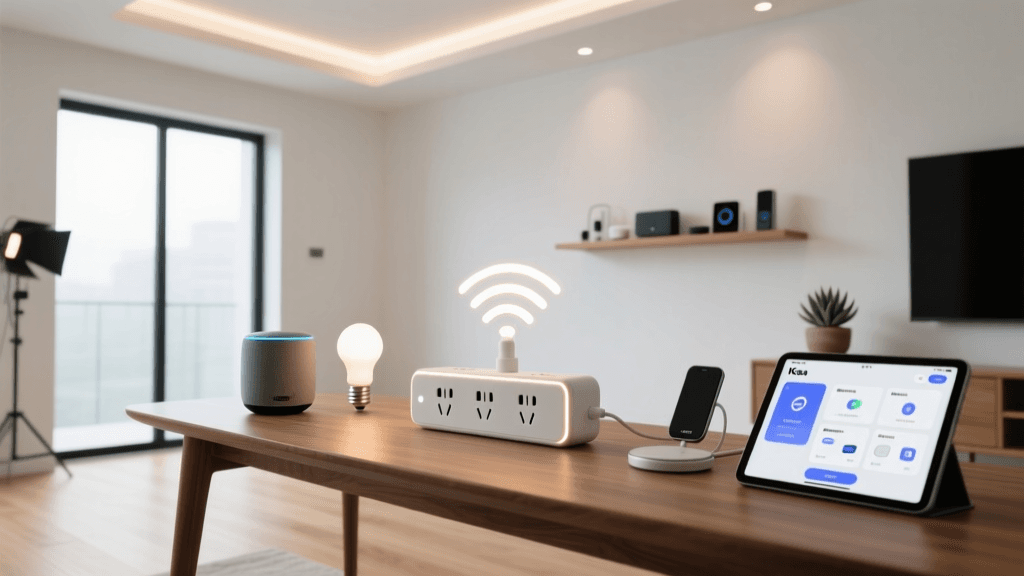
The physical design of a power strip is just as important as its smart features. A poorly designed strip can block wall outlets or fail to accommodate bulky power bricks. The Kasa KP303 features a compact, rectangular housing with three independently controllable AC outlets. Unlike traditional power strips that offer six or more outlets, the three-outlet configuration keeps the footprint small and manageable, perfect for sliding behind a TV stand or resting on a desk.
Cord Length and Plug Orientation
The KP303 comes with a 3.3-foot (1-meter) braided power cord. While some users might prefer a longer 5-foot option for larger living rooms, the 3.3-foot length is ideal for desk setups or nightstands where excess cable clutter is a nuisance. The wall plug features a smart, angled design. This is a crucial ergonomic choice, as it prevents the plug from blocking the second socket on a standard duplex wall outlet, leaving you free to plug in a non-smart device or a phone charger.
Outlet Spacing
One of our primary testing metrics for power strips is outlet spacing. The KP303 spaces its three outlets far enough apart to accommodate most standard plugs and many medium-sized power adapters. However, if you are using massive, oversized transformer bricks (like those found on some older laptops or audio equipment), you may find yourself blocking an adjacent outlet. For the vast majority of household devices—lamps, fans, routers, and phone chargers—the spacing is more than adequate.
Additionally, the strip includes a master physical power button on the side. This allows you to manually cut or restore power to all three outlets simultaneously, which is a vital failsafe if your Wi-Fi network goes down or you need to hard-reset a connected device like a router.
Setup and the Kasa App Experience
TP-Link’s Kasa Smart app is widely regarded as one of the most user-friendly and stable applications in the smart home market. Setting up the KP303 is a breeze, provided you are aware of one critical networking requirement: the KP303 only supports 2.4GHz Wi-Fi networks.
The 2.4GHz Limitation
If you are using a modern mesh Wi-Fi system (like Eero, Orbi, or Google Nest) that combines 2.4GHz and 5GHz bands under a single SSID, you might encounter hiccups during setup. The Kasa app attempts to pass your phone’s Wi-Fi credentials to the strip. If your phone is connected to the 5GHz band, the handoff will fail. We recommend temporarily disabling your 5GHz band or using an older 2.4GHz-only guest network to ensure a smooth onboarding process. Once connected, the strip reliably maintains its connection, even in areas with moderate signal strength.
App Interface and Controls
Once online, the Kasa app presents a clean, intuitive dashboard. Each of the three outlets is treated as an individual device, meaning you can rename them (e.g., ‘Desk Lamp’, ‘Monitor’, ‘Phone Charger’) and assign unique icons. You can control each outlet independently or group them together to act as a single master switch. The app also provides real-time status updates, so you never have to wonder if you left the space heater on when you left the house.
Smart Features and Automation
The true value of the KP303 lies in its software capabilities. It is not just a remote-controlled switch; it is a versatile automation tool.
- Scheduling: You can set precise daily or weekly schedules for each outlet. For example, set your coffee maker to turn on at 6:30 AM on weekdays, or your desk lamp to turn off at 11:00 PM every night.
- Timers: The auto-off timer is perfect for devices you want to run for a specific duration. We used this for a bathroom exhaust fan, setting it to automatically shut off 20 minutes after being turned on.
- Away Mode: This is a standout security feature. Away Mode randomly toggles the connected devices on and off within a specified time window to simulate human presence while you are on vacation. It is highly effective for deterring burglars when paired with a living room lamp.
- Smart Actions: Within the Kasa app, you can create basic multi-device routines without needing a third-party hub. For instance, you can trigger all three outlets to turn on when a separate Kasa motion sensor detects movement.
Ecosystem Compatibility
While the Kasa ecosystem is robust on its own, integration with broader smart home platforms is where the KP303 truly shines for voice control enthusiasts.
Amazon Alexa and Google Assistant
The KP303 offers native, first-party integration with both Amazon Alexa and Google Home. Linking your Kasa account to these platforms takes seconds. Once linked, voice commands are snappy and reliable. You can say, ‘Alexa, turn on the desk lamp,’ or ‘Hey Google, turn off the entertainment center.’ Because the outlets are individually addressable, you can also include them in complex Alexa Routines, such as triggering your desk setup to power on when your morning alarm is dismissed.
IFTTT and SmartThings
For advanced users, the KP303 is compatible with IFTTT (If This Then That). This opens up cross-ecosystem automations, such as turning on your office lights when your phone enters a specific geofence, or triggering a notification if a device is turned on manually. Samsung SmartThings integration is also available, though it sometimes requires a bit more manual configuration via the SmartThings hub compared to the plug-and-play nature of Alexa.
The Missing Links: HomeKit and Matter
It is important to note what the KP303 lacks. It does not support Apple HomeKit, nor does it support the new Matter protocol. If you are deeply invested in the Apple ecosystem or are building a future-proof, hub-based Matter network, the KP303 will require a workaround (like Homebridge) or should be bypassed entirely in favor of a Matter-compatible strip.
Real-World Performance and Limitations
During our two-week testing period, the KP303 performed flawlessly regarding network stability. We experienced zero drop-offs, and voice command latency averaged under 400 milliseconds, which feels instantaneous to the human ear. The physical relays inside the strip click satisfyingly and do not produce a loud, disruptive snap, making them suitable for bedroom use.
The Energy Monitoring Drawback
The most significant limitation of the KP303 is the lack of energy monitoring. Unlike some of TP-Link’s single plugs (like the KP125) or premium competitor strips, the KP303 cannot track voltage, amperage, or historical energy consumption. If your goal is to track phantom power loads from your entertainment center or monitor the energy usage of a space heater, this strip will not provide that data. For those specific use cases, you will need to look at higher-end alternatives or use a dedicated smart energy monitor at your breaker panel.
Competitor Comparison
How does the KP303 stack up against other smart strips on the market? Below is a structured comparison to help you weigh your options.
| Feature | Kasa KP303 | Kasa KP315 | Meross Smart Strip |
|---|---|---|---|
| Smart Outlets | 3 | 3 | 3 or 4 |
| USB Ports | None | 3 USB-A | Varies |
| Energy Monitoring | No | No | No |
| HomeKit / Matter | No | No | HomeKit version available |
| Approximate Price | $25 - $30 | $30 - $35 | $35 - $45 |
Note: If you need USB charging capabilities for your nightstand or desk, the KP315 is a slightly more expensive but highly recommended alternative in the same Kasa lineup.
Deck Score Breakdown
Our proprietary Deck Score evaluates smart home products across five critical dimensions. Below is the radar visualization for the Kasa KP303.
- Performance (90/100): Excellent Wi-Fi stability and low latency relay switching.
- Value (95/100): Unbeatable price-to-performance ratio for a multi-outlet smart strip.
- Compatibility (75/100): Great for Alexa and Google, but docked heavily for the lack of Matter and HomeKit support.
- Ease-of-Use (90/100): The Kasa app is intuitive, though 2.4GHz setup can trip up networking novices.
- Features (70/100): Solid scheduling and Away Mode, but the absence of energy monitoring limits its utility for power users.
Pros and Cons
Pros
- Individually controllable outlets with excellent app grouping options.
- Highly reliable Wi-Fi connection with minimal drop-offs.
- Compact, angled plug design saves wall space.
- Native, low-latency integration with Alexa and Google Home.
- Extremely affordable price point.
Cons
- No energy monitoring capabilities.
- Lacks Apple HomeKit and Matter protocol support.
- Only supports 2.4GHz Wi-Fi, which can complicate setup on modern mesh networks.
- No built-in USB charging ports (requires stepping up to the KP315).
Final Verdict and Buying Advice
The Kasa KP303 Smart Wi-Fi Power Strip remains one of the most practical and cost-effective smart home upgrades you can buy. It excels in its primary mission: taking a cluster of ‘dumb’ devices and bringing them into a unified, voice-controlled, and schedulable ecosystem. Whether you are automating your home office peripherals, managing a complex holiday lighting display, or securing your home with Away Mode, the KP303 delivers consistent, frustration-free performance.
Who should buy this? The KP303 is perfect for Amazon Alexa and Google Home users who want reliable multi-device control on a budget without needing advanced energy tracking.
Who should skip it? Apple HomeKit purists, Matter early-adopters, and users who specifically need to track the wattage and energy consumption of their connected appliances should look elsewhere.
If your needs align with its feature set, the Kasa KP303 is a resounding recommendation and a SmartHomeDeck staple for everyday automation. For those requiring USB ports or HomeKit compatibility, exploring the KP315 or Meross alternatives will better serve your specific ecosystem requirements.