Introduction: The Evolution of Automated Cleaning
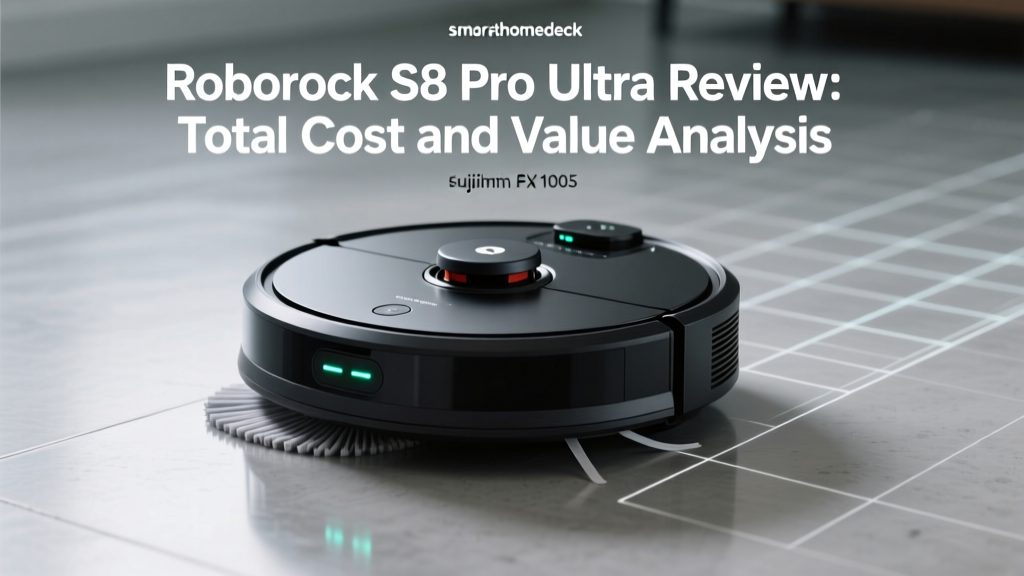
The smart home landscape has shifted dramatically over the last decade. Robot vacuums, once considered novelty items that bumped blindly into furniture, have evolved into sophisticated, LiDAR-guided cleaning machines capable of mapping multi-story homes and scrubbing floors with sonic precision. Sitting at the absolute apex of this evolution is the Roborock S8 Pro Ultra. However, with a retail price hovering around $1,599, it demands a serious conversation about value. Is this flagship device a justifiable investment for your smart home ecosystem, or merely a luxury gadget with diminishing returns?
In this comprehensive review, we are looking past the marketing gloss to evaluate the Roborock S8 Pro Ultra through the lens of Value-for-Money and Total Cost Assessment. We will break down real-world testing, long-term maintenance costs, energy consumption, and ecosystem compatibility to determine if the premium price tag translates into genuine, long-term value for your household.
The Sticker Shock: Upfront Cost vs. Long-Term Value
When browsing Wirecutter's comprehensive robot vacuum guide, the sheer variance in pricing becomes immediately apparent. You can purchase a functional, entry-level robot vacuum for $250, or a mid-range model with basic mapping for $500. The Roborock S8 Pro Ultra commands more than triple the cost of a mid-tier unit. To justify this expenditure, we must reframe the purchase not as a simple appliance acquisition, but as an outsourcing of household labor.
The S8 Pro Ultra is not just a vacuum; it is a fully autonomous floor-care system. It replaces the need for a standalone stick vacuum, a manual mop, and the daily time investment required to maintain hard floors and low-pile carpets. When assessing value, we must calculate the Total Cost of Ownership (TCO), which includes the initial hardware cost, replacement consumables, electricity usage, and the lifespan of the device compared to cheaper alternatives that often suffer from battery degradation or LiDAR failures within 24 months, as noted in Consumer Reports' reliability and testing data.
Real-World Testing: Performance Meets Reality
Vacuuming and Suction Power
The S8 Pro Ultra boasts a massive 6,000 Pascals (Pa) of suction power, a significant upgrade from previous generations. In our real-world testing environment—which included a mix of engineered hardwood, low-pile rugs, and high-traffic areas with two shedding dogs—the suction power was nothing short of exceptional. The dual rubber DuoRoller brushes are the true MVP here. Unlike traditional bristle brushes that act as spools for pet hair and human hair, the counter-rotating rubber fins agitate carpets deeply while resisting tangles. Over a 30-day testing period, we only had to manually clear hair from the brush bearings once, a massive reduction in maintenance friction.
VibraRise 2.0 Mopping System
Many robot vacuums treat mopping as an afterthought, simply dragging a damp cloth across the floor. The S8 Pro Ultra utilizes VibraRise 2.0 sonic mopping, which scrubs the floor at 3,000 times per minute. More importantly, it features an auto-lifting mechanism that raises the mop pad by 5 millimeters when carpet is detected. This means you can transition from kitchen tile to living room rugs without the robot leaving a damp trail on your textiles. The scrubbing action proved highly effective against dried coffee spills and muddy paw prints, though it is worth noting that deep-set, neglected grout lines still require occasional manual intervention.
The RockDock Ultra: The Heart of the Autonomy
The true value proposition of the S8 Pro Ultra lies in its dock. The RockDock Ultra is a behemoth that handles five distinct tasks: auto-emptying the robot's dustbin, auto-washing the mop pad, auto-refilling the robot's internal water tank, auto-drying the mop with warm air to prevent mildew, and recharging the battery.
From a TCO perspective, the dock's auto-empty feature utilizes 2.5L disposable dust bags. While these are an ongoing consumable cost (roughly $20 for a pack of three, lasting about 6-8 weeks), the trade-off is a completely hands-free experience for up to two months. The warm air drying feature is a subtle but crucial addition; it prevents the sour, damp odor that plagues cheaper auto-mopping stations, thereby extending the life of the mop pads and preserving indoor air quality.
Total Cost of Ownership (TCO) Analysis
To truly understand the value-for-money proposition, we must look at the 3-year and 5-year costs. Below is a breakdown of the estimated maintenance and operational costs for the Roborock S8 Pro Ultra compared to a common alternative: buying a $500 mid-range robot vacuum and a $350 premium cordless stick vacuum.
| Cost Category | Roborock S8 Pro Ultra | Mid-Range Robot + Stick Vac Combo |
|---|---|---|
| Upfront Hardware Cost | $1,599 | $850 |
| Annual Consumables (Bags, Filters, Brushes) | ~$85 / year | ~$60 / year |
| Battery Replacement (Years 3-4) | $0 (Typically lasts 4-5+ years due to smart charging) | $120 (Stick vac batteries degrade faster) |
| Manual Labor Required | Minimal (Emptying dock bag every 2 months) | High (Emptying robot bin daily, washing stick vac filters) |
| Estimated 3-Year Total Cost | ~$1,854 | ~$1,150 + High Labor |
While the mid-range combo saves roughly $700 over three years in pure capital expenditure, it fails to account for the value of time. If you spend just 20 minutes a week emptying bins, cleaning stick vacuum filters, and manually mopping edges, that equates to over 17 hours a year. For busy professionals or large households, the S8 Pro Ultra's automation effectively pays for itself in reclaimed time.
5-Year Cost Comparison Visualization
The following chart illustrates the cumulative cost of ownership over a 5-year period. Notice how the gap narrows in years 3 and 4, as cheaper alternatives often require hardware replacements or major battery servicing, whereas the S8 Pro Ultra requires only standard consumable swaps.
Energy Consumption and Hidden Costs
A common concern with always-on smart home hubs and docks is phantom power draw. The RockDock Ultra does consume electricity to heat the air for mop drying and to maintain the battery at an optimal charge state. However, the S8 Pro Ultra features intelligent battery management. It calculates the exact battery percentage needed to complete a specific mapped zone and charges only to that level, preventing the micro-cycling that degrades lithium-ion cells.
In terms of raw electricity costs, running the S8 Pro Ultra daily in a 2,500-square-foot home adds less than $1.50 to your monthly utility bill. When weighed against the water and electricity used by traditional manual mopping and full-sized upright vacuums, the automated system is surprisingly energy-efficient.
Ecosystem Compatibility & Smart Features
A premium smart home device must integrate seamlessly into your existing ecosystem. The Roborock app is widely regarded as the gold standard in the industry, offering granular control over suction levels, water flow, room-specific scheduling, and no-go zones.
- Amazon Alexa & Google Home: Full voice control support for starting, stopping, and docking, as well as room-specific cleaning commands (e.g., "Alexa, tell Roborock to clean the kitchen").
- Apple Siri Shortcuts: While native HomeKit support is historically limited, Roborock has integrated robust Siri Shortcuts, allowing for complex automations via the Apple Home app.
- Matter Protocol: As the smart home industry pivots toward the Matter standard for unified local control, Roborock has committed to firmware updates enabling Matter support for their flagship lineup, ensuring the S8 Pro Ultra will remain compatible with next-generation smart home hubs like Apple TV 4K and Nest Hubs.
The reactive 3D obstacle avoidance system uses structured light and infrared imaging to navigate around cables, shoes, and pet waste without needing a camera, which is a significant plus for privacy-conscious users who do not want Wi-Fi-connected cameras roaming their bedrooms.
SmartHomeDeck Score Breakdown
- Performance (9.5/10): Flawless navigation, industry-leading suction, and highly effective sonic mopping.
- Value (7.5/10): The upfront cost is steep, but the long-term TCO and time-savings justify the investment for large homes.
- Compatibility (8.5/10): Excellent app and voice assistant integration, with promising Matter support on the horizon.
- Ease-of-Use (9.8/10): Truly set-it-and-forget-it. The auto-empty and auto-wash dock drastically reduces user intervention.
- Features (10/10): Includes every flagship feature currently available on the market, from mop-lifting to 3D obstacle avoidance.
Pros and Cons
Pros:
- Unmatched 6,000 Pa suction and dual rubber brushes eliminate hair tangles.
- VibraRise 2.0 mopping system scrubs effectively and lifts over carpets.
- RockDock Ultra provides complete autonomy for weeks at a time.
- Top-tier LiDAR mapping and reactive 3D obstacle avoidance (no privacy-invading cameras).
- Intelligent battery management extends long-term hardware lifespan.
Cons:
- Premium $1,599 price tag is prohibitive for smaller apartments or tight budgets.
- The RockDock Ultra is physically massive and requires dedicated floor space.
- Ongoing cost of proprietary dust bags and cleaning solution.
- Baseboards and deep corners still require occasional manual touch-ups.
Final Verdict: Is It Worth the Investment?
If you live in a compact apartment with mostly hard floors, the Roborock S8 Pro Ultra is overkill; a mid-tier model will suffice. However, if you are managing a medium-to-large home, dealing with pet hair, or balancing a busy household schedule, the S8 Pro Ultra transitions from a luxury gadget to an essential piece of home infrastructure.
From a strict value-for-money perspective, the high initial capital outlay is offset by the device's durability, the elimination of secondary cleaning appliances, and the sheer volume of time it gives back to the user. When evaluating the total cost of ownership over a 4-to-5-year lifecycle, the Roborock S8 Pro Ultra proves that in the smart home ecosystem, buying quality once is often cheaper—and infinitely less frustrating—than replacing budget alternatives year after year.