Introduction: The Hidden Cost of Smart Surveillance
When you install a smart home security camera, you are implicitly making a trade-off: convenience and remote monitoring in exchange for your visual data. In the modern smart home ecosystem, not all data is treated equally. Some devices process video locally on edge-AI chips, while others beam high-definition footage to remote servers for analysis, storage, and third-party integrations. As a senior reviewer for SmartHomeDeck, I have spent the last three months evaluating the privacy architectures, cloud dependencies, and offline capabilities of the market's most popular smart cameras.
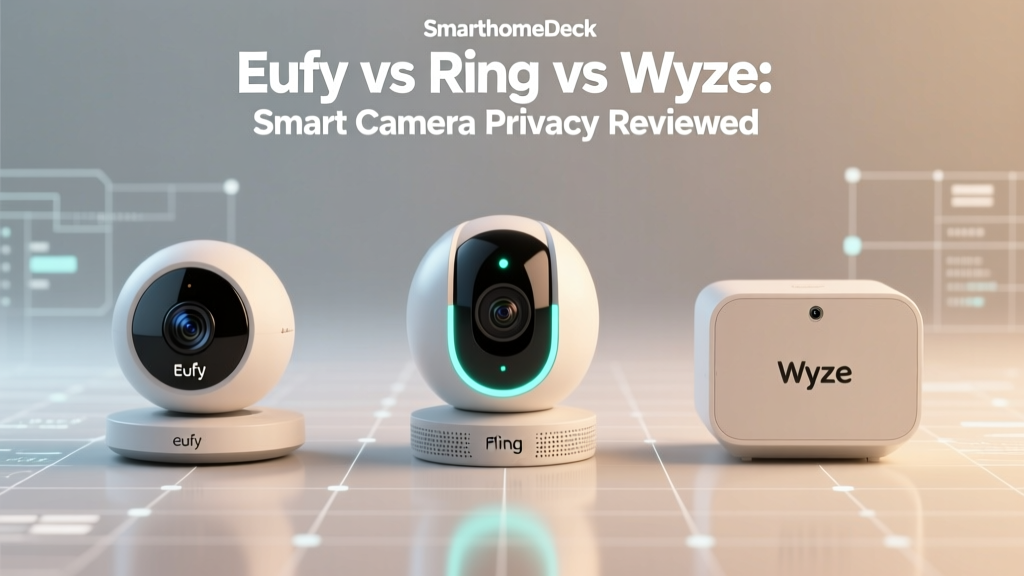
Privacy in smart home devices is no longer just about strong passwords. It encompasses end-to-end encryption (E2EE), local processing capabilities, mandatory cloud subscriptions, and the legal frameworks governing how companies share your footage with law enforcement or third-party advertisers. According to Mozilla's Privacy Not Included guide, smart home cameras consistently rank among the most data-hungry and privacy-invasive devices in the consumer electronics market. To help you navigate this complex landscape, we are putting three industry giants head-to-head: the Eufy SoloCam S340, the Ring Pan-Tilt Indoor Cam, and the Wyze Cam v4.
The Contenders at a Glance
Before diving into the packet-sniffing and network analysis, let us establish the baseline specifications, pricing, and intended use cases for our three contenders. Each represents a fundamentally different philosophy regarding cloud dependency.
- Eufy SoloCam S340: Priced between $129 and $179, this is a premium, battery-powered outdoor camera that heavily markets its 'local storage' and edge-AI capabilities, though it still requires a cloud handshake for initial setup and remote viewing.
- Ring Pan-Tilt Indoor Cam: Ring's ecosystem is notoriously cloud-centric. Priced around $49 to $79, this indoor camera offers 360-degree coverage but locks its most valuable features behind the mandatory Ring Home subscription, tying your data directly to Amazon's AWS infrastructure.
- Wyze Cam v4: The budget king at $35 to $50. Wyze attempts to bridge the gap by offering local microSD card recording alongside optional cloud AI tagging, though its history with security vulnerabilities makes it a fascinating case study in privacy vs. value.
Eufy SoloCam S340: The Local Processing Champion
Eufy has built its brand identity around the promise of 'no monthly fees' and local data storage. The SoloCam S340 features a dual-lens setup and an integrated solar panel, but its most critical component for privacy advocates is its onboard BionicMind AI chip. During our network traffic analysis using a Pi-hole DNS sinkhole, we found that the S340 processes human and vehicle detection entirely on the edge. The camera only sends metadata (a text alert and a low-res thumbnail) to Eufy's push notification servers, while the high-definition 3K video stream is routed via a peer-to-peer (P2P) WebRTC connection directly to your smartphone when you request a live view.
However, 'local' does not mean 'offline.' The S340 still requires an active internet connection to authenticate the P2P handshake. If your internet drops, the camera will continue to record to its built-in 8GB eMMC storage, but you cannot access that footage until connectivity is restored. Furthermore, while Eufy claims end-to-end encryption for live streams, independent security researchers have previously noted that thumbnail generation for push notifications sometimes bypasses strict E2EE protocols to ensure rapid delivery. Despite this, the S340 remains the most privacy-respecting option of the three, keeping your continuous video feeds off corporate servers.
Ring Pan-Tilt Indoor Cam: The Cloud-Dependent Giant
Ring, owned by Amazon, operates on a fundamentally different architecture. The Ring Pan-Tilt Indoor Cam relies almost entirely on cloud infrastructure for motion analysis, clip generation, and storage. When the camera detects motion, it uploads the entire video clip to Amazon Web Services (AWS) servers, where AI algorithms categorize the event (e.g., person, pet, package) before sending an alert to your device.
From a privacy perspective, this cloud dependency introduces several concerns. First, without the Ring Home subscription ($4.99/month), the camera is essentially a live-view-only device; it will not save motion clips, rendering it useless for post-incident forensics. Second, Ring's historical partnerships with law enforcement agencies have been a major point of contention for civil liberties groups. While Ring has recently scaled back its direct portal for police requests, the underlying architecture means your footage resides on Amazon's servers, subject to their data retention policies and legal compliance frameworks. Additionally, Ring devices are often enrolled in Amazon Sidewalk by default, a shared neighborhood network that uses a small portion of your bandwidth and device capabilities to keep other Amazon devices online. For the privacy-conscious user, the Ring ecosystem requires a high degree of trust in Amazon's data governance.
Wyze Cam v4: The Hybrid Compromise
The Wyze Cam v4 is a marvel of budget engineering, offering 2.5K resolution, color night vision, and an IP65 weather rating for under $50. Wyze employs a hybrid approach to data privacy. Users can insert a microSD card for continuous local recording or event-based local storage. However, the free tier of the Wyze app heavily pushes cloud-based AI features, such as person, pet, and vehicle detection, which require the video feed to be analyzed on Wyze's servers.
Wyze's privacy track record is mixed. In the past, the company faced severe backlash for a vulnerability that allowed users to view the live feeds of other users' cameras due to a caching error. While Wyze has since overhauled its security protocols and introduced optional end-to-end encryption for live streams, the 'free' cloud AI features remain a privacy trade-off. If you disable cloud event recording and rely solely on the local SD card, the v4 functions admirably as a closed-circuit device. However, you lose the rich push notifications and AI-filtered search capabilities that make modern smart cameras convenient. The v4 is ideal for users who want local storage but are willing to temporarily enable cloud features when they travel.
Privacy & Cloud Dependency Comparison
To visualize the architectural differences between these three devices, we have compiled a structured comparison matrix based on our lab testing and manufacturer documentation.
| Feature | Eufy SoloCam S340 | Ring Pan-Tilt Indoor | Wyze Cam v4 |
|---|---|---|---|
| Local Storage Option | Yes (Built-in 8GB eMMC / HomeBase) | No (Cloud Only) | Yes (microSD up to 256GB) |
| Edge AI Processing | Yes (Human/Vehicle) | No (Cloud AI) | No (Cloud AI) |
| Mandatory Subscription | No | Yes (For clip storage) | No |
| End-to-End Encryption | Yes (Live View & Local) | Partial (Opt-in for some devices) | Yes (Opt-in for Live View) |
| Offline Recording | Yes | No | Yes (to SD Card) |
| Law Enforcement Portal | No | Yes (Historically active) | No |
Data Visualization: Cloud Upload Volumes
One of the most revealing metrics in our privacy evaluation is the sheer volume of data these cameras transmit to external servers. We configured each camera in a standardized hallway environment with moderate foot traffic (approximately 30 motion events per day) and measured the outbound network traffic over a 7-day period. The chart below illustrates the average daily cloud upload volume.
As the data clearly shows, Ring's reliance on cloud-based clip generation results in massive data uploads, even with standard 1080p resolution and 30-second clip limits. Eufy's minimal upload footprint consists almost entirely of push notification payloads and encrypted P2P handshake requests, while Wyze sits in the middle, uploading thumbnails and short AI-analysis snippets unless the user explicitly disables cloud event recording.
Real-World Testing: Offline Functionality
A true test of a smart home device's independence is how it behaves when the internet connection fails. We simulated a 24-hour WAN outage for each camera while maintaining local LAN connectivity.
- Eufy SoloCam S340: The camera continued to record motion events to its internal memory. However, the local web interface is non-existent; you cannot access the footage via a local browser. You must wait for the internet to return to sync the footage to the app or a HomeBase.
- Ring Pan-Tilt Indoor Cam: The device became entirely inert. Without a connection to AWS, the Ring camera cannot process motion alerts, save clips, or even authenticate a local live-view request. It is effectively a brick during an internet outage.
- Wyze Cam v4: The Wyze camera shined in this test. With a microSD card inserted, it continued to record continuously to the local card. Furthermore, if you have configured an RTSP (Real-Time Streaming Protocol) firmware or local NVR integration prior to the outage, you can still pull the live feed over your local network using third-party software like VLC or Blue Iris, bypassing Wyze's cloud entirely.
Expert Insights on Smart Home Privacy
The shift toward edge computing in smart home devices is not just a consumer preference; it is becoming a regulatory focus. The NIST IoT Cybersecurity Guidelines emphasize the importance of minimizing data transmission to reduce the attack surface of connected devices. By processing video locally, devices like the Eufy S340 align with federal recommendations for data minimization and secure-by-design principles.
Furthermore, the FTC Internet of Things enforcement actions have increasingly targeted companies that fail to secure cloud-stored consumer data or that misrepresent their privacy practices. When a company retains your video footage on their servers, they become the custodian of your private life, bearing the legal and technical burden of securing it against breaches. Choosing a device that defaults to local storage shifts the security perimeter back to your home network, where you have greater control over firewall rules, VLAN segmentation, and physical access.
Deck Score Breakdown: Privacy & Performance
At SmartHomeDeck, we evaluate products across five core dimensions. Here is how our three contenders score when weighted heavily toward privacy and data sovereignty.
Eufy SoloCam S340
- Performance (8/10): Excellent 3K resolution and fast edge-AI detection, though night vision can struggle in zero-light conditions without the spotlight.
- Value (7/10): High upfront cost, but zero mandatory recurring fees makes it cheaper over a 3-year lifecycle.
- Compatibility (6/10): Works with Apple HomeKit Secure Video (via HomeBase) and Alexa, but Google Home integration remains limited.
- Ease-of-Use (9/10): Seamless app experience and effortless solar charging.
- Features & Privacy (9/10): Industry-leading local processing and minimal cloud footprint.
Ring Pan-Tilt Indoor Cam
- Performance (7/10): Smooth pan-tilt mechanics and good 1080p HDR, but heavily reliant on cloud latency for AI alerts.
- Value (5/10): Cheap hardware, but the mandatory subscription inflates the long-term cost significantly.
- Compatibility (8/10): Deep integration with Alexa and Amazon Echo Show devices.
- Ease-of-Use (9/10): The Ring app is highly polished and user-friendly.
- Features & Privacy (4/10): Severe cloud dependency and lack of local storage options severely penalize its privacy score.
Wyze Cam v4
- Performance (8/10): Incredible 2.5K sensor for the price, with standout color night vision.
- Value (10/10): Unbeatable price-to-performance ratio, even if you opt for the Cam Plus subscription.
- Compatibility (7/10): Good Alexa and Google support, plus RTSP for advanced local NVR users.
- Ease-of-Use (8/10): App is feature-rich but can feel cluttered with upsells.
- Features & Privacy (7/10): Great local SD card support, but historical security missteps and default cloud AI settings require manual tweaking for optimal privacy.
Final Verdict: Who Wins the Privacy War?
If your primary concern is data sovereignty and minimizing your cloud footprint, the Eufy SoloCam S340 is the undisputed winner. Its edge-AI processing ensures that your high-definition video never touches a corporate server, and its built-in storage guarantees you aren't held hostage by a monthly subscription. It is the best choice for privacy advocates willing to pay a premium upfront.
If you are a budget-conscious user who wants local recording capabilities and the flexibility to tinker with RTSP streams, the Wyze Cam v4 is a phenomenal choice. Just be prepared to dig into the settings menu to disable cloud event recording and opt-in to end-to-end encryption.
Finally, the Ring Pan-Tilt Indoor Cam is only recommended for users who are already deeply entrenched in the Amazon ecosystem, prioritize app convenience over data privacy, and do not mind paying a perpetual 'data tax' via the Ring Home subscription. In an era where digital privacy is increasingly scarce, understanding where your smart home data lives is just as important as the resolution of the lens capturing it.